



Moraine Park winter RV camping: will the last open RMNP campground fit your rig?
Decide whether Moraine Park's first-come winter sites, 40-foot rig limit, electric loops and shared water and dump service work for your RV.

Moraine Park winter RV camping: will the last open RMNP campground fit your rig?
By Romana | October 22, 2026
Rocky Mountain National Park's campground choice has collapsed to one. The 2026-2027 winter season began at 1 p.m. on October 19, and Moraine Park is now the only campground open inside the park. Winter sites are first come, first served rather than reservable.[1]
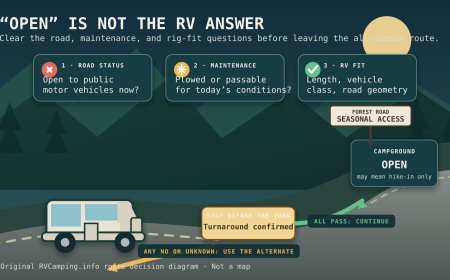
For an RV traveler, "open" is only the start of the decision. Moraine Park still offers electric sites, a fresh-water fill and a dump station, but it does not offer water or sewer at the campsite. Snow removal also runs on a different priority than many travelers expect.[1]
The useful question is whether that reduced setup works for the rig and the loads it must support.
Three conditions that rule out the stay
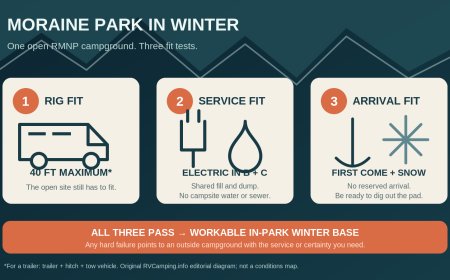
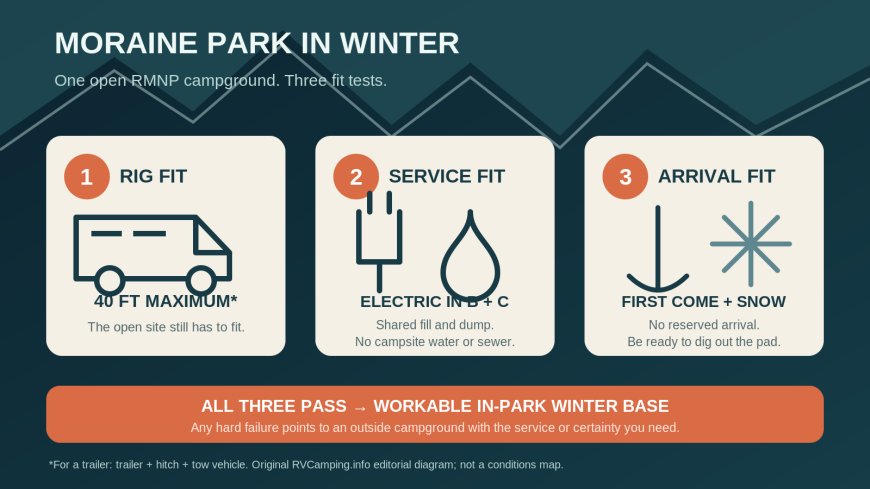
Moraine Park is a poor winter fit if any of these are non-negotiable:
- The traveling combination exceeds 40 feet. Recreation.gov defines the trailer measurement as trailer plus hitch plus tow vehicle, with 40 feet as the campground maximum. It also warns that many sites are intended for tents or vans, so the campground ceiling is not a promise that every open space fits a 40-foot setup.[2]
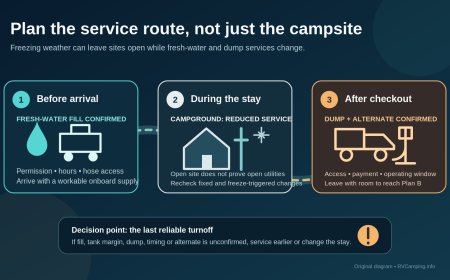
- You need water or sewer connected at the site. The park says no Moraine Park campsite has a water hookup. Winter fresh water and dumping remain available at the shared station near the ranger station.[1]
- You need a guaranteed campsite before arrival. Winter operation is first come, first served. There is no winter reservation to remove vacancy risk.[1]
A traveler who fails the second or third test needs an outside-the-park campground with the required service or booking model. Arriving early does not turn a shared fill point into a water hookup, and a Recreation.gov campground page does not turn the winter inventory into reservations.
What remains open after the transition
The winter footprint is substantial but smaller than the summer campground. NPS lists sites 1 through 62 in Loop A, all of Loops B and C, and all of Loop E. Groups of eight or more are directed to a group site in Loop E.[1]
| Need | Officially posted winter provision | What it means for an RV plan |
|---|---|---|
| Shore power | The winter electric inventory is confined to Loops B and C.[1] | Target B or C, but arrive prepared for the possibility that a compatible electric site is occupied. |
| Fresh water | Loops A, B and C retain running water; RVs can also fill at the dump station.[1] | Fill the tank at the shared station. Do not plan on a hose remaining connected at the campsite. |
| Waste disposal | The dump station near the ranger station remains available.[1] | Arrive with enough tank capacity to use a shared service point rather than a sewer connection. |
| Restrooms | NPS lists restrooms in A, B and C. Loops B and E also have vault toilets.[1] | Loop E has a more limited restroom arrangement than the serviced loops. |
| Firewood and ice | Neither is sold in the campground during winter; NPS points travelers to Estes Park for supplies.[1] | Buy them before entering the campground, subject to current fire rules. |
The park posts winter rates of $30 per night for a standard non-electric site and $55 for a standard electric site. Senior and Access pass holders receive a 50% standard-site discount.[1] Campers can pay with Recreation.gov's Scan & Pay function or in person at the Beaver Meadows or Fall River entrance.[1]
Those facts support two workable operating plans. A rig with a cold-weather electrical demand can look for a compatible B or C electric site. A self-contained rig can use a non-electric site if its battery, propane and generator plan covers the stay. Neither plan includes campsite water or sewer.
Electric service solves only the power problem
Recreation.gov says Moraine Park has 49 electric campsites supporting 20-, 30- or 50-amp service, and most campground sites are non-electric.[2] The NPS winter notice narrows electric service to open Loops B and C but does not promise that an arriving camper will find a vacant site with the desired amperage.[1]
Treat the RV's plug type and amperage as an exact-site check, not a campground-wide feature. An electric site may remove the need to run a generator for routine loads. It does not provide a water connection, sewer connection, plowed pad or guaranteed arrival slot.
Generator backup has limits. Recreation.gov allows generator use in Loops A, B, C and E from 7:30 to 10 a.m. and 4 to 8:30 p.m.[2] Build the battery plan around those windows before relying on a non-electric site. If an onboard system, medical device or cold-weather load cannot tolerate a missed electric site or restricted generator schedule, first-come winter camping is the wrong level of uncertainty.
A 40-foot maximum still requires a site-level fit
The campground accepts RVs and connected trailer combinations up to 40 feet, but Recreation.gov tells campers to read the details for the individual site because many spaces fit only tents or vans.[2] In winter, the usual pre-booking site screen becomes an on-arrival inspection.
Measure the complete traveling footprint before leaving home:
- motorhome body plus any rear carrier or other fixed projection;
- trailer, hitch and tow vehicle as one connected combination;
- a towed vehicle that must use the same parking area;
- height and clearance needs;
- room needed to enter the pad without crossing vegetation or blocking the campground road.
NPS limits parking to two vehicles per site, counts an RV, trailer or towed unit as a vehicle, and notes that some pads accommodate only one.[1] A site can be open and still fail the length or parking test. Pass it and continue looking rather than forcing the setup onto an undersized pad.
Snow changes the arrival test
NPS says individual campsites are not plowed or shoveled. Campers are advised to carry a shovel and be ready to dig out their site. Main park roads receive priority after snow; campground roads are plowed, but delays should be expected.[1]
That is an observed operating condition, not a prediction of snow on a particular travel date. The planning advice is to keep daylight and weather margin in the arrival schedule, carry traction and recovery equipment appropriate to the vehicle, and reject a pad that cannot be entered or leveled safely. Electricity at the pedestal does not make the parking surface usable.
Moraine Park is on the east side of the park. Recreation.gov warns that a west-side approach uses seasonal Trail Ridge Road, which can close temporarily because of weather; if it is closed to through travel, drivers must route around the park to reach the campground.[2] Check the NPS road status before departure rather than letting a navigation app assume a cross-park route.
Decide with the service chain, not the campground name
Moraine Park's winter setup works best for a rig at or below the exact site's physical limit when the crew accepts first-come arrival and shared tank service. It becomes much more useful if the RV can take an electric opening in B or C without depending on one being vacant.
Before committing to the drive, write down five answers:
- Is the full traveling combination 40 feet or less, and can it use more than one site shape?
- Can the RV operate without campsite water and sewer connections?
- Is there a fallback if no compatible electric site is open?
- Can the crew dig out and assess a snowy or icy pad without forcing an unsafe setup?
- Is the approach route open, and is there enough daylight to inspect a first-come site?
Five yes answers make Moraine Park a plausible in-park winter base. A no on length, essential utility service or arrival certainty is a reason to choose a different campground, not a detail to solve at the kiosk.
Editorial note: This research-based guide uses official NPS and Recreation.gov information retrieved October 22, 2026. Official facts are cited; operating recommendations are RVCamping.info advice. No firsthand stay, road drive, campsite inspection, weather forecast or vacancy check is claimed. Conditions and open services can change, so check the park page and road status before travel.
Sources
- Campgrounds — Rocky Mountain National Park — NPS 2026-2027 winter dates, open loops, first-come operation, fees, utilities, payment, snow-removal priorities, length and parking rules. Accessed October 22, 2026.
- Rocky Mountain National Park Moraine Park Campground — Recreation.gov rig measurement, exact-site fit warning, electric service, generator hours and access-route information. Accessed October 22, 2026.
What's Your Reaction?