
















Cedar Pass vs. Sage Creek: which Badlands campground fits your RV?
Compare Badlands National Park's Cedar Pass and Sage Creek options by RV length, paved versus gravel access, electricity, water, generator rules, weather exposure, and booking certainty.

Cedar Pass vs. Sage Creek: which Badlands campground fits your RV?
By Romana | Updated September 14, 2026
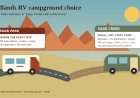
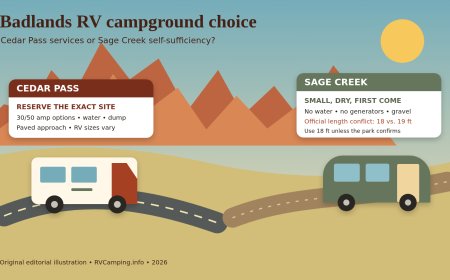
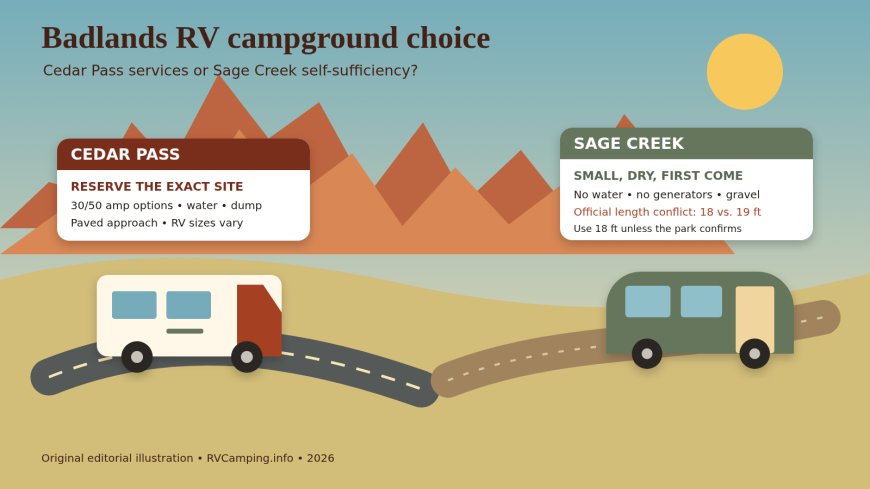
Cedar Pass is the practical Badlands base for almost every conventional RV.[3] It has reservable, site-specific inventory, paved approaches, some 30/50-amp sites, seasonal flush toilets and coin showers, drinking water, and a dump station.[3][4][5] Sage Creek is the deliberate primitive choice: free, first come, no water, no generators, an unpaved access road, and a very small RV-length envelope.[1][2]
The awkward detail is the length rule.[1][2] The current NPS campground page excludes RVs longer than 18 feet, while the park's 2026-posted compendium permits rigs up to 19 feet.[1][2] Until Badlands staff resolves that one-foot conflict, plan around the stricter 18-foot figure or get written confirmation for a 19-foot vehicle. A travel trailer plus tow vehicle is not a sensible Sage Creek gamble.
Fast decision: Reserve Cedar Pass if you need predictable arrival, shore power, bathroom services, a dump station, or room for a normal motorhome/trailer combination.[3][4][5] Try Sage Creek only with a compact rig that clears the conservative 18-foot test, carries its own water and power, and can retreat if rain closes or softens the gravel road.[1][2]
The comparison at a glance
| Decision factor | Cedar Pass Campground | Sage Creek Campground |
|---|---|---|
| Booking | Site-specific reservation | Free, first come |
| RV size | Varies by individual site; official examples span 30 to 60 feet | Conflicting official limit: 18 feet on the campground page, 19 feet in the posted compendium |
| Road approach | SD 240/Badlands Loop Road and SD 377; paved park approach | Sage Creek Rim Road; unpaved and subject to temporary weather closures |
| Electricity | Some sites have 30/50-amp electric | None; generators prohibited |
| Water/sewer at site | No water or sewer at the two cited electric examples | None |
| Shared services | Seasonal flush toilets, coin showers, drinking water, dump station | Pit/vault toilets and covered tables; no water |
| Generator use | 8 a.m. to 8 p.m. under the compendium | Prohibited |
| Campfires | Ground fires prohibited; follow current stove/grill rules | Same parkwide fire limits |
| Weather posture | Exposed, but with developed services and easier exit choices | Exposed, dry camping, and access can deteriorate after precipitation |
| Best for | Most RVs, reservations, air-conditioning on an electric site | Self-contained vans and very small motorhomes seeking a primitive stay |
Badlands has two established campgrounds.[1] NPS counts 96 level sites at Cedar Pass and 22 sites at Sage Creek.[1] Those numbers do not make them interchangeable. Cedar Pass is front-country infrastructure; the compendium says the park manages Sage Creek for a quieter, more primitive setting without larger RVs or generator noise.[2]
Rig fit: Cedar Pass has range, not a blanket promise
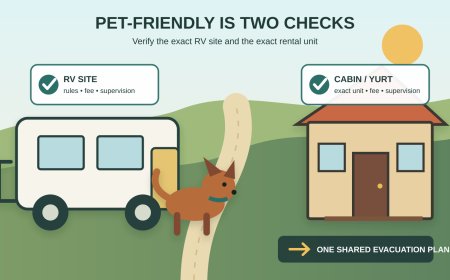
Do not use a campground-wide maximum when booking Cedar Pass.[4][5] Recreation.gov sells named sites with their own equipment and driveway fields.[3] Site 13, for example, is a 30-foot electric space with one vehicle allowed; its listing says it is unsuitable for fifth wheels, toy haulers, and large Class A motorhomes.[4] Site 73 is also electric, but its record lists a 60-foot site and allows two vehicles.[5]
That 30-to-60-foot spread is useful evidence, not a guarantee that every length exists on every date.[4][5] Filter for your equipment, then open the exact site record. Confirm:
- the permitted equipment type, not just the driveway length;
- maximum RV or vehicle length;
- number of vehicles allowed;
- whether your tow vehicle or towed car must share the published space;
- electrical service and the absence or presence of water/sewer;
- site width, slide clearance, and road-parking notes.
Measure the complete travel setup before searching. For a trailer, record trailer body length, overall hitch-to-bumper length, tow-vehicle length, and connected length. For a motorhome, include racks, rear boxes, bicycles, and the towed car. Recreation.gov's site-level number should be treated as a ceiling, not an invitation to arrive with zero margin.
Cedar Pass has two wheelchair-accessible individual campsites and one accessible group site according to NPS; accessible restrooms and an automated fee machine are also listed.[1] Travelers who depend on a particular accessible layout should confirm the site record and seasonal service status rather than relying only on the general campground description.
Rig fit: Sage Creek is for genuinely small RVs
Sage Creek's size conflict deserves more than a footnote. The NPS campground page says motorhomes, pull-behind trailers, and other RVs over 18 feet are prohibited.[1] The compendium posted on a page with a 2026 approval header says recreational camping vehicles may be no longer than 19 feet.[2]
Both sources are official, and the difference changes the answer for some camper vans and compact Class B motorhomes. The conservative booking rule is simple: 18 feet or less. If your registration or manufacturer specification says 19 feet, call Badlands National Park before driving the unpaved approach and ask which limit staff is enforcing. Record the date and answer.
A small trailer introduces another problem even when its box measures under 18 feet. The campground rule refers to RVs used for camping, while the access road and campsite still must accommodate the tow vehicle and turning movement. The compendium also limits each campsite to two vehicles, two tents, and six people.[2] Nothing in those rules promises that a trailer combination will maneuver comfortably. Cedar Pass is the safer default for towables.
Sage Creek has rougher terrain around an otherwise accessible vault-toilet facility, and NPS describes no onsite water.[1] That combination may be a poor fit for travelers who need a firm, predictable route between rig and restroom.
Road and arrival: pavement versus a weather-dependent back road
Cedar Pass has several official approach choices.[3] From I-90 exit 131, Recreation.gov directs travelers onto SD 240 for eight miles before the turn toward SD 377 and the campground; an approach from Interior uses SD 377 for about two miles.[3] For a large or low-clearance rig, those published routes are better inputs than an app-generated shortcut.
Sage Creek sits on the unpaved Sage Creek Rim Road.[1] NPS warns that the road can close temporarily after winter storms and spring rain.[1] A closure is the obvious failure. A road that remains open but is wet, rutted, dusty, or washboarded can still be a bad match for low clearance, long rear overhang, lightly secured interiors, or a trailer prone to sway.
Build an escape hatch into a Sage Creek plan:
- Check the park's current conditions and alerts on arrival day.
- Ask a ranger about the road surface, not merely whether the road is open.
- Enter with enough daylight to inspect conditions and turn around safely.
- Keep Cedar Pass or an outside-park campground as a fallback; do not count on an unreserved Cedar Pass site materializing.
- Save the official park map offline because rural cellular coverage and app routing can be unreliable.
Cedar Pass removes much of that access uncertainty, but not all driving risk. Both campgrounds sit in exposed prairie terrain, and sudden wind or storms can affect awnings, slide toppers, roof gear, and towing.[3][6]
Services: decide what your tanks and batteries can cover
The Cedar Pass site examples show 30/50-amp electricity with no water or sewer connection at the pedestal.[4][5] Recreation.gov lists shared drinking water, a dump station, seasonal flush toilets, and coin showers; the campground overview calls the Group Loop dump station complimentary.[3][4] Treat water and sanitation as shared systems, and verify shoulder-season availability before depending on them.
Electric service changes the hot-weather calculation.[4][5] If air-conditioning is medically necessary or simply essential to sleep, reserve a site whose record explicitly says electric. A generic Cedar Pass reservation does not imply power because Recreation.gov lists both electric and nonelectric RV inventory.[3]
At Sage Creek, arrive with the potable water needed for drinking, cooking, dishes, and the toilet.[1] NPS says there is no water at the campground and points campers to the Ben Reifel Visitor Center for potable water.[1] There is no dump station or shower service listed at Sage Creek. Plan the fill and dump stops before turning onto the rim road rather than trying to solve full tanks after arrival.
Generators are banned at Sage Creek.[2] At Cedar Pass, the compendium permits them only from 8 a.m. through 8 p.m.; quiet hours run 10 p.m. to 6 a.m.[2] An overnight battery, fan, CPAP, refrigerator, or medical-device plan at Sage Creek must work without an engine-driven backup. Solar output also depends on weather, panel angle, dust, and shade from the rig.
Weather exposure changes the campground choice
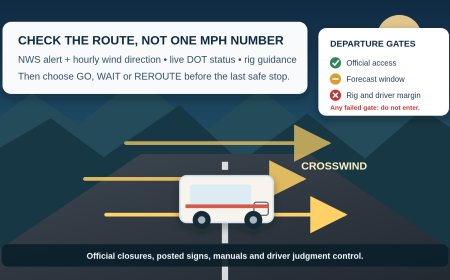
Badlands weather is not a decorative concern.[6] NPS describes hot, dry summers punctuated by violent thunderstorms, with hail and occasional tornadoes possible.[6] The agency also warns that conditions can change suddenly and recommends checking the local forecast before driving or hiking.[6]
Both campgrounds are open to wind. Recreation.gov tells Cedar Pass campers to secure their belongings because heavy winds and storms can arrive abruptly.[3] Retract the awning whenever you leave the site or go to sleep. Lock down chairs, mats, grills, dish tubs, solar panels, and anything clipped lightly to the ladder.
Cedar Pass is the more forgiving choice during a marginal forecast because an electric site can run cooling without generator hours, shared water is available seasonally, and the paved approach is less vulnerable to rain than Sage Creek Rim Road.[3][4][5] That does not make Cedar Pass storm shelter. Know where you would move during a severe-weather warning, keep shoes and keys ready, and do not treat an RV as equivalent to a permanent building.
Sage Creek adds three layers of exposure: no water, no generators, and an unpaved exit.[1][2] A high heat forecast strains batteries and freshwater. Rain can alter the road. Strong wind can make a compact, high-roof van uncomfortable even when no formal warning is active. Choose Sage Creek only when the weather window, rig, and supplies all agree.
A booking decision framework that works
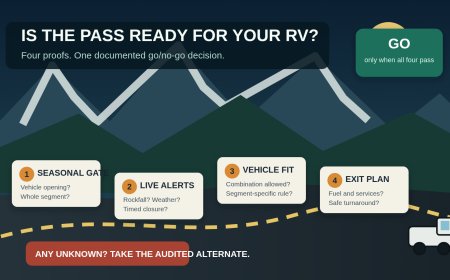
Run these gates in order. The first "no" is your answer.
- Is the complete RV 18 feet or shorter? If no, eliminate Sage Creek unless park staff confirms the 19-foot compendium allowance for your exact rig.[1][2]
- Can you accept first-come uncertainty? If no, reserve Cedar Pass. Sage Creek has no permit or reservation process.[1][2]
- Can the stay work with no onsite water and no generator? If no, eliminate Sage Creek.[1][2]
- Is the Sage Creek road suitable on arrival day? If the road is closed, wet enough to worry you, or rougher than your clearance and tires can handle, use the fallback.
- Do you need air-conditioning or dependable shore power? If yes, select a Cedar Pass site whose own record states 30/50-amp service.[4][5]
- Does the exact Cedar Pass record fit the whole combination? Match equipment type, length, vehicle count, and utilities before checkout. Site 13 and site 73 show why the individual record matters.[4][5]
- Can shared water and dump facilities cover the stay? Cedar Pass electric is not full hookup in the representative records.[4][5]
- Does the forecast favor the plan? Recheck heat, wind, thunderstorms, and rain shortly before departure.[6]
A compact van with full water, quiet battery power, flexible timing, and a dry forecast is the strongest Sage Creek candidate. A 32-foot Class C, any larger Class A, and nearly every trailer combination belong at Cedar Pass or another developed campground. A small Class B that needs overnight air-conditioning also belongs on a verified Cedar Pass electric site.
Before you commit
For Cedar Pass, save screenshots or a PDF of the site's equipment, driveway, hookup, and vehicle fields. Recreation.gov lists the campground as seasonal from late March into mid-October, while the NPS campground page describes limited winter availability.[1][3] The live calendar and park/concessioner confirmation should control a shoulder-season trip; the two general descriptions do not line up cleanly.
For Sage Creek, call if the rig falls between the two official limits. Check current conditions, fill water, empty waste tanks, charge batteries, secure the cabin, and arrive before dark. Keep enough fuel to leave by the same route or continue without depending on a campground service that is not there.
Park rules apply at both locations. Each party needs a park entrance pass, stays are capped at 14 days in a 30-day period, food must be secured from wildlife, and ground fires are prohibited.[2] Current restrictions can be tighter, so read alerts again at the entrance.
Bottom line
Cedar Pass is the default RV answer because it turns the trip into a site-selection problem: choose the right length, vehicle count, and electric category, then plan around shared water and dump facilities. Sage Creek is a conditions-dependent privilege for compact, self-sufficient rigs. Its price is zero, but the cost is uncertainty about arrival, power, water, and even the published length cutoff.
Use 18 feet as the Sage Creek limit unless the park confirms otherwise. For Cedar Pass, ignore campground shorthand and trust the exact site's fields. Those two habits prevent most of the expensive mistakes in this comparison.
Source credit: RVCamping.info compared current National Park Service and Recreation.gov records retrieved September 14, 2026. The rig-fit gates, weather contingency plan, and booking sequence are original editorial analysis.
Sources
- Campgrounds: Cedar Pass and Sage Creek — National Park Service; campground inventory, Sage Creek access, services, and the 18-foot wording. Accessed September 14, 2026.
- Superintendent's Compendium — National Park Service; campground rules, generators, stays, entrance pass, fires, and the 19-foot wording. Accessed September 14, 2026.
- Cedar Pass Campground — Recreation.gov; reservation inventory, access directions, shared dump station, generator notice, and weather warning. Accessed September 14, 2026.
- Cedar Pass site 13 — Recreation.gov; representative 30-foot electric-site record and amenity fields. Accessed September 14, 2026.
- Cedar Pass site 73 — Recreation.gov; representative 60-foot electric-site record and amenity fields. Accessed September 14, 2026.
- Weather — National Park Service; climate extremes and storm preparation. Accessed September 14, 2026.
What's Your Reaction?