






The small-RV fridge test for a pot of soup or chili
A container-first plan for cooling, storing, and reheating soup or chili when a compact RV refrigerator cannot hold the whole pot.

The small-RV fridge test for a pot of soup or chili
By Romana | September 27, 2026 | Cooking
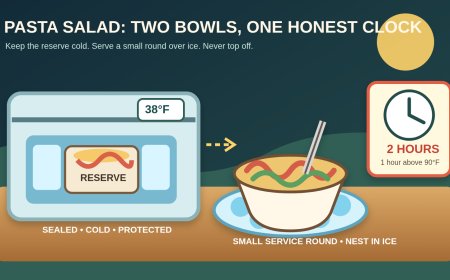
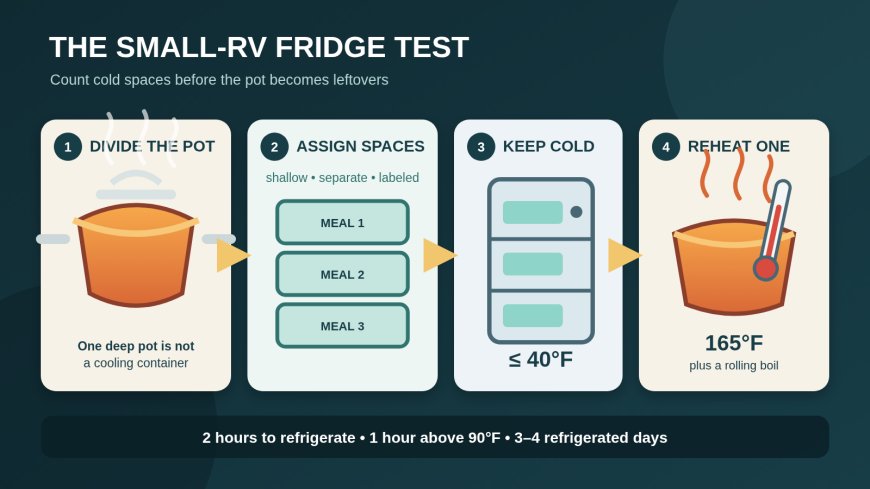
Quick answer: Before dinner, fit empty meal-size containers into the RV refrigerator and decide exactly how many can cool there without being stacked. After service, divide the soup or chili among clean, shallow containers and refrigerate within two hours, or within one hour if the food is exposed to temperatures above 90°F. Keep cold food at 40°F or colder. Eat refrigerated portions within three to four days, and reheat only the portion needed to 165°F. USDA adds a visible endpoint for reheated liquid foods: soup, sauce, and gravy must reach a rolling boil.[1][3][4]

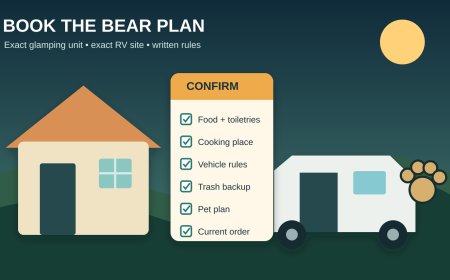
The safe batch size is the amount your cold space can accept as shallow portions. Original illustration by RVCamping.info.
Treat refrigerator space as an ingredient
A compact refrigerator can be running normally and still have too little open shelf area for a stockpot's leftovers. That is a capacity problem, not a temperature-setting problem. Solve it while the pot is still empty.
Choose the containers that will hold tomorrow's meals and place them on the intended shelf. They need to sit level, with the door fully closed and without warm containers being stacked. Read an appliance thermometer rather than the control dial. The storage target is 40°F or colder.[3]
Count those usable containers. That count is the cooling budget for this meal. If three meal-size boxes fit, plan to save no more than three boxes. Cooking six extra servings and hoping to rearrange the refrigerator after dinner creates a problem at the point when the clock is already running.
This page is deliberately narrower than a general leftovers guide or a one-pot recipe. It deals with one awkward mismatch: a large, heat-holding liquid batch and a refrigerator that cannot take the whole pot.
Give every portion a destination before serving
Mark three lanes on painter's tape:
- Eat now: the amount intended for the current meal.
- Chill now: only the meal-size portions that have assigned refrigerator space.
- Do not save: any excess that lacks verified cold space or has passed the time limit.
A separate food cooler may serve as overflow storage only if a thermometer confirms 40°F or colder. It needs enough ice or frozen packs to maintain that temperature, sealed containers kept out of meltwater, and a lid that will stay closed. A merely cool box is not a measured cold-storage lane.
Do not use the RV freezer as an excuse to skip rapid cooling. A deep container of hot chili remains a deep container even when the compartment around it is colder. Divide the batch first. If a portion is meant for later freezing, give it the same prompt-cooling start as the refrigerated portions.[1]
The useful decision is made before the ladle reaches the leftovers: each portion either has a real cold destination or it does not.
Start the clock when temperature control ends
Write down when cooking or verified hot holding ended. CDC says to refrigerate leftovers at 40°F or colder within two hours of cooking or removal from equipment that kept the food at a safe temperature. The limit becomes one hour when the food is in temperatures hotter than 90°F, such as at a picnic.[3]
That clock follows the food. Time on the serving table, time on the RV counter, and time spent searching for lids all count toward the same limit. Moving the pot into shade or carrying it inside does not start a new clock.
Do not wait for a large pot to cool on the counter. CDC says to package warm or hot food in several clean, shallow containers and refrigerate it; small hot portions may go into the refrigerator because they chill faster.[4] FoodSafety.gov gives the same direction for big pots of chili or stew and confirms that those hot portions can be put into refrigeration.[2]
If the applicable one- or two-hour limit has already passed, reheating is not a repair step. Discard the food rather than assigning it a fresh storage label.
Turn one hot mass into separate meals
Set the empty containers on a stable counter or table. Use a clean ladle and portion the food that still falls inside the time limit. Keep the layer shallow instead of filling a tall box to the rim.
The federal pages for home cooks do not prescribe a single container depth that works for every recipe, refrigerator, and material. Do not turn an unsupported inch measurement into a campsite rule. The practical job is to replace one deep, insulated mass with smaller portions that expose more food to the cold container and surrounding air.[1][2][4]
Load the assigned refrigerator spaces without stacking warm boxes. Keep the air path open and avoid pinning a container against a door seal. Check that the door closes cleanly, then note the refrigerator temperature again after loading.
When the small refrigerator needs help removing heat, USDA allows hot food to be rapidly chilled in an ice or cold-water bath before refrigeration.[1] For soup or chili:
- set the pot or heat-safe containers into a sanitized tub prepared as an ice bath;
- keep the bath's waterline beneath every container opening and away from the food;
- stir with a clean utensil so the hot center moves toward the cooler sides;
- replenish ice as it melts;
- transfer the food into the assigned shallow containers and refrigerate promptly.
The bath is active cooling, not countertop storage. Keep the original refrigeration deadline visible while using it.
Do not crowd out the food that is already cold
A full shelf-fit test can still fail if it ignores what the refrigerator already contains. Milk, deli food, eggs, and other perishables also depend on the appliance staying cold. Do not wedge several hot boxes into every gap and assume only the soup is affected.
A practical loading order is:
- remove empty packaging and expired items before cooking;
- move drinks to a separate cooler if one is available;
- reserve one shelf for the shallow containers;
- keep raw meat or seafood sealed below ready-to-eat leftovers so leaks cannot reach them;
- leave labels facing the door so nobody has to unload the shelf to identify dinner.
After loading, verify the appliance remains at 40°F or colder. If it cannot hold the target, move portions promptly to a verified-cold overflow cooler or discard them. The answer is not to combine several boxes back into the pot.
Label one uninterrupted history
Write the food name, cooking date, and the refrigeration deadline on each lid. Add the actual refrigerator or cooler reading if several people will handle the food. A label records the history; it does not create one.
USDA says refrigerated leftovers may be kept for three to four days.[1] Count from the original cooking day. Moving a box between an RV refrigerator and a cold cooler does not restart the calendar, and warming the whole batch for one bowl creates another cooling task.
Use the oldest safe portion first. Freeze a portion sooner if the meal plan will not use it within the refrigerated window. If the refrigerator lost power, the cooler warmed, or nobody can establish how long a box was above 40°F, treat that missing history as a reason to discard it.
Reheat one container, not the batch
Remove only the amount that will be eaten. Keeping the other containers cold preserves their simple history and prevents the refrigerator from having to cool the same food again.
Use a food thermometer to confirm that each reheated leftover portion reaches 165°F. For soup, sauce, and gravy, USDA also calls for a rolling boil.[1] CDC likewise sets 165°F or hotter for reheated leftovers.[3]
On an RV burner, use a saucepan large enough to stir without splashing. Scrape the bottom and fold the center toward the sides. Bring the portion to a rolling boil and check thick solids and several areas for 165°F. Chili can bubble around the edge while a dense pocket in the middle remains cooler.
In a microwave, use a microwave-safe dish and vented cover. Pause to stir and rotate, then measure several spots. CDC says microwaved reheated food should reach 165°F.[4] A timer preset, steam on the lid, or one hot spoonful does not measure the coldest part.
Serve the reheated portion. Do not pour it back into a cold container or mix it with an older batch.
Use the six-line pot card
Put this on the refrigerator door before cooking:
- Cold spaces available: ____ shallow containers
- Cooking or hot holding ended: ____
- Refrigerate by: ____ (two hours; one hour above 90°F)[3][4]
- Cold storage: ____°F, must be 40°F or colder[3]
- Use by: cooking date + three to four refrigerated days[1]
- Reheat one portion: rolling boil and 165°F[1][3]
The card turns a vague plan to "save the rest" into a fixed number of containers, a deadline, and two measured temperatures. When the pot is larger than the available cold space, the safe choice is to save less, not to make the refrigerator absorb more than it can handle.
Evidence note: USDA FSIS, FoodSafety.gov, and CDC provide the temperatures, time limits, shallow-container guidance, storage period, ice-bath option, and reheating instructions. RVCamping.info created the cold-space budget, three-lane allocation, and six-line pot card as planning tools. This is U.S. household food-safety guidance, not a food-service cooling plan.
Sources
- Leftovers and Food Safety | USDA Food Safety and Inspection Service — Federal consumer guidance for rapid cooling, refrigerated storage, ice-bath cooling, and reheating.
- Bacteria and Viruses | FoodSafety.gov — Federal food-safety table excerpt addressing large pots of chili or stew.
- Preventing C. perfringens Food Poisoning | CDC — Federal guidance for cold holding, refrigeration deadlines, and reheating.
- Preventing Food Poisoning | CDC — Federal guidance for shallow containers, prompt refrigeration, and microwave reheating.
What's Your Reaction?