













Raw eggs in campsite recipes: use a pasteurized option or cook the mixture
A campsite decision guide routes no-cook dressings, eggnog, frozen-dessert bases and batters to a pasteurized option or a verified cook.

Raw eggs in campsite recipes: use a pasteurized option or cook the mixture
By Romana | October 19, 2026 | Cooking
A clean shell is not a safety certificate. FDA says even clean, uncracked eggs may contain Salmonella. That matters when a campsite preparation goes from mixing bowl to plate, cup or ice-cream freezer without a full cooking step.[1]
Quick answer: Decide by the final state of the egg. If a dressing, beverage, frozen dessert base or other mixture will be served raw or undercooked, use shell eggs specifically labeled pasteurized or a pasteurized egg product that suits the preparation. If the mixture will be cooked, egg dishes and cooked egg bases should reach 160°F, measured in the mixture rather than against the pan. Keep eggs and finished mixtures at 40°F or below, contain shell contact, and discard perishable food after two hours outside temperature control—or one hour when the outdoor temperature is above 90°F.[1][2][3]

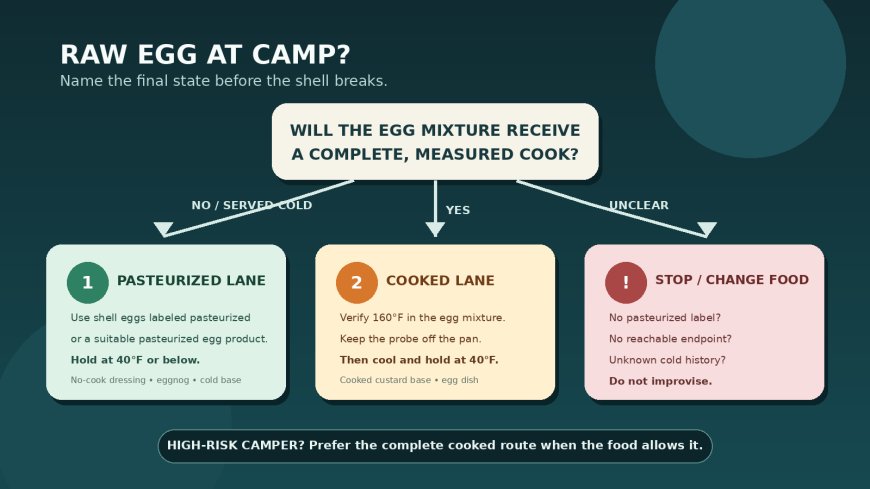
Name the final state before cracking an egg: pasteurized for a no-cook route, or a verified 160°F mixture for the cooked route. Original RVCamping.info decision diagram.
This is not a recipe collection. It is a go/no-go check for preparations whose eggs can disappear into other ingredients: no-cook dressings and sauces, eggnog-style drinks, custard bases for frozen desserts, and batters. The label, tested preparation directions and available cold space still control the exact food.
Ask what happens after mixing
“Homemade” and “fresh” do not describe risk. Neither does the food’s name. Two mixtures called dressing may follow different paths: one is served directly from the bowl; the other is heated. An ice-cream base may be cooked before chilling, or it may go from raw mixing to freezing. Freezing is not the cooking step.
Use one question before opening the carton:
Will every part of this egg mixture receive a measured cook before anyone tastes or serves it?
- No, it stays raw or undercooked: choose a labeled pasteurized shell egg or pasteurized egg product from the start.[1][2]
- Yes, it becomes a cooked egg mixture: use a food thermometer and verify 160°F where applicable.[1][2]
- The method is unclear, the product is unlabeled or the thermometer cannot read the mixture: change the method or choose another food.
Do not plan to “fix it later.” Once ordinary raw egg has been blended into a cold dressing or drink, refrigeration can slow bacterial growth, but it does not turn that egg into a pasteurized ingredient.
No-cook dressing belongs in the pasteurized lane
FDA specifically points to Caesar dressing as a preparation that may contain egg served raw or undercooked. Its consumer guidance says to use shell eggs treated to destroy Salmonella or pasteurized egg products for that kind of recipe.[1]
At the store, read the actual egg or egg-product label. A clean carton, a brown shell, a local-farm claim or an organic label does not mean pasteurized. FDA notes that treated shell eggs are generally labeled to say they were treated.[1] If the needed pasteurized option is unavailable, use a dressing that does not rely on raw egg or choose a commercially prepared product whose label and storage directions fit the meal.
Keep the distinction narrow: pasteurization addresses the egg hazard. It does not excuse a dirty whisk, an unwashed hand, warm dairy, contaminated produce or hours on a picnic table. Make only what the group can keep cold and serve promptly.
Eggnog and frozen-dessert bases have two safe routes
For eggnog-style drinks and egg-containing homemade ice cream, choose the route before packing.
Route A: start with a pasteurized egg option
FDA identifies pasteurized shell eggs, pasteurized egg products and suitable substitutes as alternatives to ordinary raw shell eggs in homemade ice cream. It also explains that manufacturers generally control the egg hazard in products such as ice cream, mayonnaise, Caesar dressing and eggnog by using treated egg ingredients or pasteurizing the finished food.[2]
“Typically” is not a campsite verification. Read the package. Follow its refrigeration, use-after-opening and preparation directions. Do not pour a refrigerated liquid egg product into an anonymous travel bottle and discard the label; the label is how another camper can confirm what it is and how to handle it.
Route B: cook the egg base, then chill it
FDA gives 160°F as the endpoint for casseroles and other egg dishes, and its homemade-ice-cream guidance describes a cooked egg base heated to 160°F before cooling.[1][2]
For a cooked liquid mixture, stir as the tested method directs and measure the food itself. Keep the sensing area away from the pot bottom and sides, which can read hotter than the liquid. Check more than one area if the camp stove heats unevenly. A steaming edge, thickened appearance or “almost simmering” guess is not the endpoint.
The cook is only half the plan. Before starting, reserve enough ice, cooler volume or refrigerator capacity to cool and hold the finished base at 40°F or below. If the campsite cannot support both the 160°F cook and controlled chilling, use a sealed commercial alternative or change dessert.
FDA and USDA advise starting with a cooked base for optimal safety even when using pasteurized products, especially when serving people at high risk.[2]
Batter needs an ingredient check, not one borrowed number
“Batter” can mean an egg-only coating, a flour-based breakfast mix, a cake mix or a frozen-dessert base. Do not assign all of them the 160°F egg-dish endpoint and call the job done.
If a batter contains flour, pasteurized egg does not make the flour ready to eat. Do not taste it raw. Follow the complete package or tested-recipe cooking directions for that flour-containing food. This article does not replace the separate raw-flour workflow or invent a universal pancake, cake or dough temperature.
For an egg mixture that FDA classifies as an egg dish, use the 160°F endpoint. For an individual egg, FDA’s consumer guidance is different: cook until both white and yolk are firm.[1] The preparation determines the check.
That boundary also keeps the thermometer useful. It verifies a defined cooked mixture; it does not transform every spoonful called batter into the same food.
Keep shell contact on one side of the table
Pasteurized shell eggs still arrive in shells. Ordinary shell eggs can also be used when the mixture will be thoroughly cooked. Either way, use a contained cracking routine:
- Buy refrigerated eggs with clean, uncracked shells and keep the carton cold.[1]
- At camp, set the carton, cracking cup and shell container on the raw side of the table. Keep ready-to-eat garnishes, cups and clean serving tools elsewhere.
- Crack one egg into a small cup before adding it to the main mixture. This limits the spread of a damaged egg or shell fragment; it is an RVCamping.info workflow step, not a federal requirement.
- Discard any egg found cracked or leaking. Do not try to wash a suspect shell back into service.
- Move shells directly to a closed waste container. Do not stack them on a cutting board or in a serving bowl.
- After raw-egg contact, clean hands and wash the contacted tools, equipment and work areas in hot, soapy water, as FDA directs.[1]
A pasteurized label changes the ingredient decision, not the cleanup decision. Shells, hands and equipment can still move contamination around a cramped galley.
Give the food cooler, not the drink cooler, the egg job
FDA says to store eggs promptly at 40°F or below and use a refrigerator thermometer. Its outdoor guidance calls for a 40°F-or-colder insulated cooler supplied with sufficient ice or frozen cold packs. It also recommends separating beverages from perishable food so repeated drink runs do not keep warming the food cooler.[1][3]
For a mixture served cold:
- pre-chill ingredients and the food cooler;
- keep the original product label with any shell eggs or egg product;
- return reserve ingredients to cold storage as soon as the active batch is measured;
- hold the finished preparation at 40°F or below until serving;
- put out a small amount and replenish from the cold supply rather than displaying the whole batch;
- track all time outside control, including prep, serving and cleanup.
FDA’s outdoor limit is two hours outside safe hot or cold holding, reduced to one hour when the outdoor temperature is above 90°F. Once that limit is exceeded, discard the perishable mixture. Putting it back on ice does not erase its warm history.[3]
An ice-cream machine, frozen bowl or bag of ice should not be assumed to hold every ingredient at 40°F or below during assembly. Measure the cooler or refrigerator that protects the food before and after processing.
Use the stricter branch for high-risk campers
FDA lists children, older adults, pregnant people and people with weakened immune systems among those at greater risk of severe illness from Salmonella. Its homemade-ice-cream guidance says a cooked base provides optimal safety for high-risk people even when pasteurized products are used.[1][2]
For a group that includes anyone in those categories:
- avoid ordinary raw or undercooked shell eggs entirely;
- prefer a preparation with a complete cooking step when the food can support one;
- use a labeled pasteurized option when a no-cook form is necessary;
- do not serve from a batch whose temperature history, label or shell handling is uncertain;
- keep other hazards in view: dairy should be pasteurized, flour-containing batter still requires complete cooking, and clean tools must stay separate from shell-contact tools.[2]
This is not a judgment about appetite or tradition. It is a lower-risk branch for people more likely to have severe consequences from the same exposure.
The camp egg-mixture decision card
Before cracking:
- FINAL STATE: Served raw/undercooked, or fully cooked?
- INGREDIENT: Does the package explicitly identify a pasteurized shell egg or egg product?
- ENDPOINT: If it is a cooked egg mixture, can the mixture itself be verified at 160°F?
- OTHER RAW INGREDIENTS: Does flour or another ingredient require its own complete cook?
- COLD CAPACITY: Can ingredients and finished food stay at 40°F or below?
- CAMPERS: Is anyone in a higher-risk group who should receive the stricter cooked route?
- STOP: If the label, endpoint or temperature history is missing, choose another preparation.
The useful decision happens before the shell breaks. A no-cook plan needs a pasteurized option. A cooked plan needs a reachable endpoint and a real chilling route. If the campsite cannot provide either, the safer move is not improvising—it is changing the food.
Evidence note: FDA supplies the egg hazard, pasteurized-option guidance, 160°F egg-mixture endpoint, high-risk groups, sanitation, cooler temperature and outdoor time limits. The final-state question, three-lane decision diagram, cracking layout and stop rules are original RVCamping.info planning tools. No recipe was copied or adapted.
Sources
- FDA: What You Need to Know About Egg Safety — clean shells can still contain Salmonella; pasteurized options for raw preparations; shell selection, 40°F storage, sanitation, 160°F egg-dish endpoint and higher-risk groups (content current March 5, 2024; retrieved October 19, 2026).
- FDA: Enjoying Homemade Ice Cream Without the Risk of Salmonella Infection — pasteurized and cooked-base options for frozen desserts, 160°F cooked base, pasteurized dairy and the stricter high-risk route (content current June 19, 2018; retrieved October 19, 2026).
- FDA: Handling Food Safely While Eating Outdoors — 40°F cooler control, separate beverage cooler, outdoor handwashing and the two-hour/one-hour discard limit (content current March 5, 2024; retrieved October 19, 2026).
What's Your Reaction?