

Campground generator hours: how to verify the rules before you book
How to confirm campground generator hours, quiet hours and loop restrictions before booking, then plan RV battery capacity for off-hours.

Campground generator hours: how to verify the rules before you book
The short answer: Check the rules for the exact campground, loop and travel dates before paying. Quiet hours and generator hours are separate restrictions, and a site can be inside a generator-free loop even when the campground allows generators elsewhere. Save the policy you relied on, ask the campground when the wording is unclear, then size your battery plan around the longest period when you cannot run the generator.
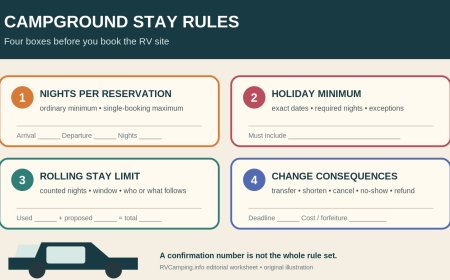
A broad search for a park's quiet hours is not enough. The useful question is: "At this campground, in this loop, on these dates, when may I run my generator?"

Why the campground name is not specific enough
Official listings show how much the answer can change from one destination to another:
- Yosemite permits generator use only during three windows: 7–9 a.m., noon–2 p.m. and 5–7 p.m. Its quiet hours are 10 p.m.–6 a.m.[1]
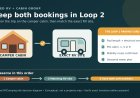
- Mather Campground at Grand Canyon lists two generator windows, 7–9 a.m. and 6–8 p.m., with quiet hours from 10 p.m.–6 a.m. The same notice says Pine Loop is generator-free from March 1 through November 30.[2]
- Colter Bay Campground lists a much longer 6 a.m.–10 p.m. operating period, but only in loops H, J, K, M and O and in group sites. Quiet hours are 10 p.m.–6 a.m.[3]
- California State Parks' camping rules page lists generator operation from 10 a.m.–8 p.m. and quiet hours from 10 p.m.–6 a.m.[4]
Those examples are not a national rule. They are a warning against assuming one. Yosemite divides generator time into short blocks. Mather uses two blocks and adds a seasonal generator-free loop. Colter Bay ties permission to named loops. The California page has a continuous daytime window. A reservation that says "dry camping" or "generator allowed" still does not answer all three booking questions: where, when and on which dates?
Translate the rule into an overnight power gap
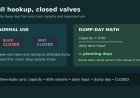
For RV planning, the most useful number is often the interval from the last legal generator shutoff to the next legal start. Based on the posted times, that gap is 12 hours at Yosemite (7 p.m.–7 a.m.) and 11 hours at Mather (8 p.m.–7 a.m.).[1][2]
It is 8 hours in an eligible Colter Bay loop (10 p.m.–6 a.m.) and 14 hours under the California State Parks schedule (8 p.m.–10 a.m.).[3][4]
This is an editorial calculation, not a promise that every site in those systems follows the same schedule. Loop restrictions, seasonal rules, local notices and temporary conditions can change the decision. Use the actual listing for your site.
A simple battery worksheet
Build the budget from the things that must run while the generator is off:
- List each overnight load in watts.
- Multiply watts by expected run time in hours.
- Add the results to get watt-hours (Wh).
- Add a reserve for colder weather, longer furnace cycling or an unexpectedly early shutdown.
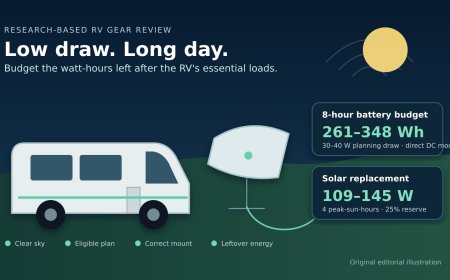
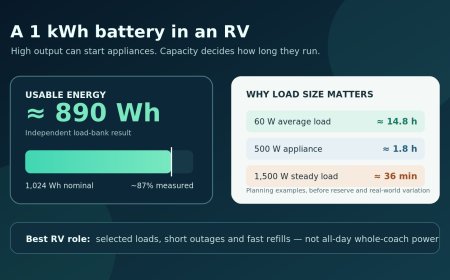
- Compare the total with the usable watt-hours your battery manufacturer specifies for your installed battery bank, not merely the large nominal number on a product page.
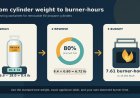
For example, suppose your selected overnight loads average 120 watts across a 12-hour no-generator period. That is 1,440 Wh. Adding a self-chosen 20% planning reserve brings the target to 1,728 Wh. Both the load and reserve are assumptions; replace them with measurements from your RV.
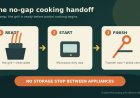
Do not let the generator schedule choose loads for you after dark. Choose the loads first, calculate the gap, and decide whether the site works. If the numbers do not fit, book hookups, choose a location with a compatible generator window, reduce discretionary loads, or increase usable battery capacity before the trip.
The five-minute pre-booking check
Use this sequence while the reservation page is still open:
- Fix the identity. Write down the park, campground, loop, site number and dates. Similar campground names and nearby concession-operated facilities can have different rules.
- Search the exact listing. Use the page's find function for
generator,quiet,noise,hours,loopandseasonal. Read the notices and rules, not only the amenity icons. - Read the governing park page. Compare the campground listing with the park's camping regulations or current superintendent/manager notices. If the pages conflict, treat the narrower rule as the working limit until staff confirms otherwise.
- Ask one precise question. Call or email: "For site [number] in loop [name] on [dates], what generator hours apply, and is the loop generator-free?" Ask whether the rule includes built-in RV generators. California's page, for example, explicitly says its off-hours rule applies even to generators on RVs.[4]
- Keep evidence. Save the URL and a dated screenshot or PDF with the confirmation. Recheck shortly before departure and read the board or handout at check-in.
A vague answer such as "generators are fine during the day" is not enough to plan an overnight battery gap. Ask for start time, stop time, any midday closure, the affected loops and seasonal exceptions.
Booking decision: yes, conditional or no
Classify the site before checkout:
- Book it: the exact loop permits your generator, the legal windows match your charging needs, and the battery bank covers the longest off-hours gap with your chosen reserve.
- Book only with a change: the site works if you reserve hookups, select another loop, lower planned loads or add usable battery capacity.
- Skip it: the rule is unclear, staff cannot confirm it, or your required power use depends on running during prohibited hours.
This test prevents a common planning error: treating quiet hours as the only hours that matter. Mather's generator operation ends at 8 p.m., two hours before its posted quiet period begins, while Yosemite has long daytime stretches when generator use is also prohibited.[1][2] Silence rules describe noise expectations. Generator rules describe when that particular machine may operate. You need both.
Screenshot-ready checklist
- Exact park and campground confirmed
- Loop and site confirmed
- Travel dates checked for seasonal exceptions
- Generator start/stop windows copied
- Midday closures checked
- Generator-free loop status checked
- Built-in versus portable generator wording checked
- Quiet hours copied separately
- Longest no-generator gap calculated
- Overnight Wh estimate and reserve fit usable battery capacity
- Conflicts confirmed with campground staff
- Policy saved and scheduled for a pre-trip recheck
The rule that matters is the one attached to your site and dates. Verify that rule before booking, then make the energy plan fit the quiet period rather than hoping the campground will make an exception.
Sources
- Campground Regulations, Yosemite National Park Accessed September 11, 2026; official campground or park rule page.
- Mather Campground, Grand Canyon National Park Accessed September 11, 2026; official campground or park rule page.
- Colter Bay Campground, Grand Teton National Park Accessed September 11, 2026; official campground or park rule page.
- Camping Rules and Safety, California State Parks Accessed September 11, 2026; official campground or park rule page.
What's Your Reaction?