























Camco 40055 review: cheap RV pressure protection, limited flow
The Camco 40055 is a cheap fixed RV water-pressure safeguard, but no gauge and limited flow make it a poor fit for demanding hookups.

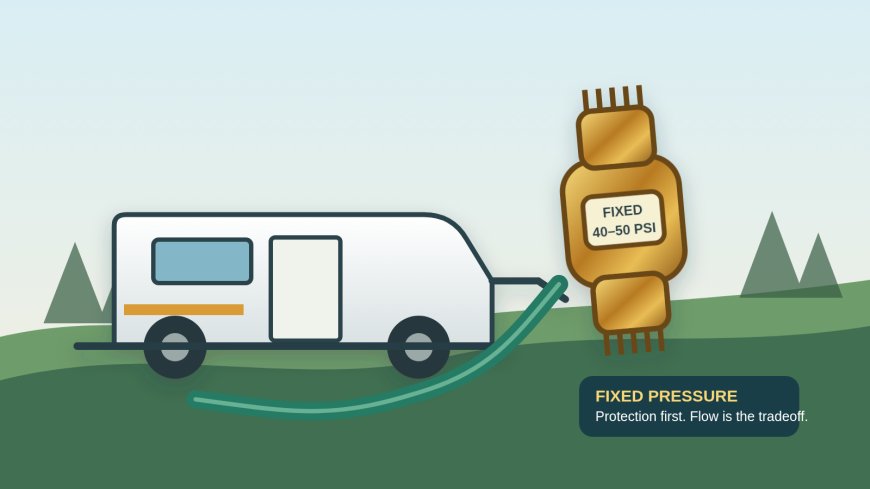
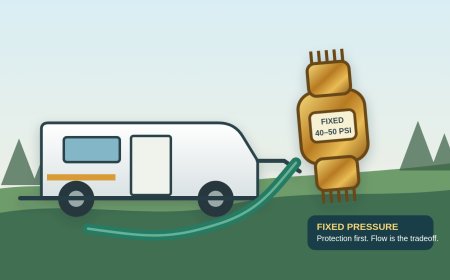
The Camco 40055 is a sensible basic regulator for occasional campers who want a compact, fixed-pressure safeguard between a campground spigot and an RV. It is factory set for 40 to 50 psi, uses standard 3/4-inch garden-hose threads, and has no gauge or adjustment.[1][4]
Skip it if you want to see the actual pressure, tune the outlet to your RV maker's limit, or keep stronger flow for simultaneous fixtures. The central tradeoff is low cost and simplicity versus limited information and potentially restrictive flow.
This is a research-based review. RVCamping.info did not buy, install, or physically test this product.
As an Amazon Associate, RVCamping.info earns from qualifying purchases. If you buy through an Amazon link in this article, we may earn a commission at no additional cost to you.
Check the Camco 40055 on Amazon. The checked listing identifies model 40055, UPC 014717400558, and ASIN B003BZD08U; Camco's current product page carries the same model and UPC.[1][2]
The short verdict
Buy the Camco 40055 if your RV manual allows a 40-to-50-psi city-water connection and you are comfortable with a regulator that has one fixed job. It reduces high inlet pressure, but it does not measure pressure for you, increase a weak campground supply, filter the water, or prove that the water is potable.[1][3][4]
The fixed design is the appeal.[1][4] There is no dial to bump and no gauge to protect in the storage bin.[1][4] Screw it onto a standard hose connection, use a sound washer, and check for leaks.[1][4]
That simplicity also hides what is happening.[1][4] If the shower becomes weak, you cannot look at the 40055 and tell whether the park supply is low, the regulator is restricting flow, a filter is clogged, or an RV inlet screen needs cleaning.[1][3] Heartland's water-system guide warns that inexpensive fixed regulators often have small internal passages and can become a major flow restriction.[3]
For weekend use with one fixture at a time, that may be acceptable.[3] For full-time hookups, a washing machine, a tankless water heater with a minimum flow requirement, or anyone who wants a stronger shower, a gauge-equipped high-flow regulator is easier to diagnose and control.[3]
Exact model, connection, and pressure boundary
This review covers the single Camco brass regulator sold as model 40055. Camco lists UPC 014717400558, while the verified Amazon page lists the same model, UPC, and ASIN B003BZD08U.[1][2]
The current Amazon and Ace pages describe these specifications:[1][4]
- fixed 40-to-50-psi output range;[1][4]
- female 3/4-inch garden-hose inlet and male 3/4-inch garden-hose outlet;[1][4]
- brass construction intended for drinking-water plumbing;[1][4]
- outdoor use;[1]
- no built-in pressure gauge and no user adjustment.[1][4]
Amazon describes the brass as CSA low-lead-content certified to NSF/ANSI 372.[1] That certification concerns lead content in wetted components.[1] It does not certify the campground water as microbiologically safe, remove sediment, or replace an RV water filter.[1][3]
Check the delivered package before installing it.[1][2] Camco sells other regulators with similar names, including gauge-equipped and adjustable products.[2] The link in this review is specifically for model 40055 and ASIN B003BZD08U.[1][2]
Compatibility starts with the RV manual
Do not assume that every RV should run at 50 psi.[3] Find the city-water limit in the manual for the exact coach, trailer, inlet assembly, and installed appliances.[3] Use the lower applicable limit if an older hose, filter housing, ice maker, washer, or other component carries its own rating.[3]
The Heartland guide says its plumbing is designed around 40 to 50 psi and warns against exposing it to more than 60 psi.[3] That supports the 40055's general target, but it is not permission to apply Heartland's limit to another brand or an older modified RV.
The regulator cannot repair a weak source.[3] If a campground supplies 30 psi, a fixed regulator will not raise it to 40 or 50 psi.[3] It can only reduce pressure when the incoming supply is higher than its outlet setting.[3]
Pressure and flow are different.[3] A line can show acceptable static pressure while delivering disappointing flow once the shower opens.[3] Heartland identifies the hose, filter, inlet screens, and low-cost regulator as common external restrictions.[3] The 40055's public specifications state its pressure range but do not publish a flow curve, so there is no sound basis for promising a particular gallons-per-minute result.[1][2][4]
Where the 40055 belongs in the hookup
The conservative default is to put the regulator at the campground spigot.[3] That reduces pressure before it reaches the drinking-water hose and the RV.[3] It also takes the strain off downstream filter housings and fittings.[3]
A filter complicates the order.[3] Heartland notes the same tradeoff: placing the regulator first protects the filter from high pressure, while placing a sediment filter first can keep grit out of the regulator.[3] For a small disposable inline filter, protecting the housing from unknown pedestal pressure usually matters more.[3] For a canister system with its own regulator instructions, follow that system's rated layout.[3]
Use this setup sequence:
- Read the RV, hose, filter, and appliance pressure limits. Do not use a higher setting than the lowest rated component.[3]
- Inspect the campground faucet. Keep the potable-water parts away from the ground and well clear of the sewer connection.[3]
- Confirm that the 40055 has a clean screen, an undamaged washer, intact threads, and no cracks or heavy corrosion.[1][3]
- With the faucet off, connect the regulator to the spigot. Add the drinking-water hose and then any filter arrangement allowed by its manufacturer.[1][3][4]
- Open the faucet slowly. Check every joint before walking away.[3]
- Run one cold-water fixture to purge air, then inspect the hose, regulator, filter, city-water inlet, and nearby interior plumbing for leaks.[3]
- Test the shower and any flow-sensitive appliance. If performance is poor, diagnose the system rather than removing pressure protection and leaving the RV connected to an unknown supply.[3]
Hand-tight is the safer starting point for hose threads.[1][4] A wrench can distort a washer or damage soft threads. If a joint drips, shut off the source, relieve pressure, reseat the gasket, and inspect the mating surfaces.[3]
What owner ratings do and do not tell us
Ace displayed a 4.5-star average across 39 reviews when checked, and Camco's own page showed three recent five-star reviews.[2][4] That is useful evidence that many buyers find the simple device satisfactory, but it is weak evidence about long-term pressure accuracy, flow, or performance in hard water.[2][4]
Camco's small review sample includes one owner reporting a 40-psi result.[2] Treat that as an individual report, not a laboratory test.[2] The product has no gauge, so owners need a separate test gauge to confirm outlet pressure in their own hookup.[1][2][4]
The more useful independent evidence is Heartland's category-level warning about small-bore fixed regulators.[3] It does not name the Camco 40055, so it cannot prove this exact unit will restrict every installation.[3] It does explain why a compact fixed regulator may feel fine at a sink yet disappoint when a shower and another fixture run together.[3]
How to diagnose weak water flow
Do not jump straight to "bad campground pressure." Work from the source toward the RV:
- Verify that the spigot is fully open and the hose is not kinked.[3]
- Check flow at the hose before the RV inlet. Heartland notes that flow inside the coach cannot exceed what reaches the inlet.[3]
- Temporarily remove the filter for diagnosis only, while keeping the regulator in place.[3]
Replace a clogged cartridge rather than operating without filtration where it is needed.[3]
- Inspect the regulator and city-water inlet screens for sediment.[3]
- Compare city-water performance with the onboard pump. Good pump flow but poor city-water flow points toward the external hose, filter, regulator, or inlet path.[3]
- Use a separate gauge if you need to know static and flowing pressure.[1][3][4]
Never solve a slow shower by leaving the RV connected without a regulator when the pedestal pressure is unknown.[3] Filling the fresh tank and using the onboard pump is a better fallback at a site with low or erratic city-water flow, provided the water source is suitable and the RV manual permits that procedure.[3]
Inspection, storage, and replacement
Inspect the 40055 at every hookup.[1][3] Replace it if the body is cracked, threads are badly damaged, the swivel leaks from the body rather than the washer, or pressure becomes erratic.[3] A sudden flow decline can also point to sediment or mineral buildup.[3]
Drain the regulator before storage and protect both threaded ends from dirt. Do not leave trapped water in it during freezing weather. Ice expansion can damage a brass body or internal components even if the outside looks normal afterward.
A separate pressure gauge is the only practical way to verify a gauge-less regulator.[1][4] Test it periodically and whenever the plumbing behaves differently.[3] Do not rely on age alone: clean-water seasonal use and continuous hard-water service are very different workloads.[3]
Who should buy it
The Camco 40055 makes sense for:
- occasional RV campers whose manuals permit a 40-to-50-psi supply;
- owners who want a compact fixed regulator with standard garden-hose connections;
- people who normally use one water fixture at a time;
- campers willing to carry a separate gauge for occasional verification;
- a basic spare, after confirming it matches the RV's pressure limit.
Its strongest case is simple protection without another adjustment to manage.
Who should skip it
Choose a different regulator if:
- the RV requires a pressure below the 40055's fixed range;
- you want to see pressure at a glance;
- you need to tune pressure for a specific coach or appliance;
- simultaneous fixtures make flow a priority;
- you use a tankless water heater, washer, or other appliance with a documented minimum flow requirement;
- you want published flow performance rather than an unspecified internal passage;
- you need an indoor installed regulator rather than a portable outdoor hose fitting.
An adjustable, gauge-equipped, high-flow model is the better category for those jobs. Set it according to the RV manual, not according to how forceful the shower feels.
Is the Camco 40055 worth buying?
Yes, if the brief is "small, cheap, fixed protection" and the RV is compatible. Model 40055 has a clearly identified 40-to-50-psi range, standard hose threads, and a current Amazon identity that matches Camco's model and UPC.[1][2][4]
No, if you expect it to diagnose a hookup or preserve residential-style flow. It has no gauge, no adjustment, and no published flow curve on the checked product pages.[1][2][4] Those omissions matter more for full-time campers and flow-sensitive appliances than for a weekend trailer using one fixture at a time.
Before ordering, verify model 40055, UPC 014717400558, and ASIN B003BZD08U.[1][2] Before connecting, verify the RV maker's pressure limit. After connecting, check for leaks and confirm that the real system, including its hose and filters, delivers usable flow without exceeding that limit.[3]
Sources
What's Your Reaction?