





How to choose a one-night RV site without unhitching
A six-part test for finding a one-night campsite where a towable can remain connected, covering full rig length, pad geometry, grade, hookups, exit clearance and campground approval.

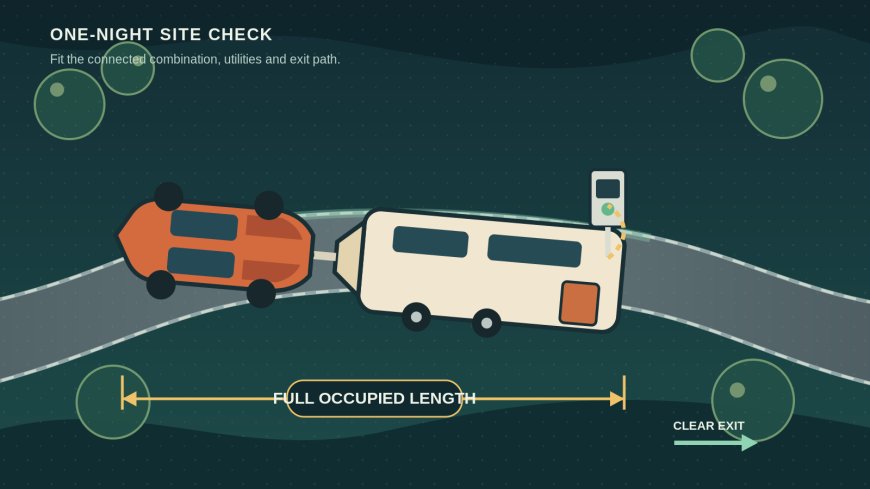
A one-night stop can work with a travel trailer or fifth wheel still connected to the tow vehicle, but a pull-through label is not enough. The whole combination has to fit where the campground permits it, rest at an acceptable attitude for your exact RV, reach any utilities you plan to use, and preserve a clear way out. Get the campground's approval before treating any site as a stay-hitched site.
The best candidate is a nearly level pull-through with usable space ahead of and behind the rig. A long back-in can work too, but correcting side-to-side level may require pulling out and starting over. If any test below fails, plan to unhitch. Saving several minutes is not worth improvising with a short pad or an unsuitable grade.
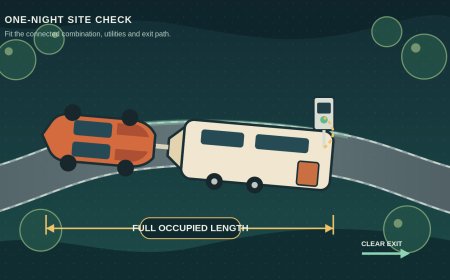
Start with occupied length, not trailer length
Measure the combination in its overnight position. That means the front of the tow vehicle to the farthest rear item on the trailer, including a spare tire, bike rack or cargo carrier. Record the overall length and the trailer length separately. A reservation field may describe either one.
Two federal site records show why the wording matters. Recreation.gov lists Lynx Campground Site 19 as a pull-through with a 190-foot driveway, a 55-foot site length and a 35-foot maximum vehicle length.[2] North Rim Site 72 is also a pull-through, but its notes explicitly say the 27-foot rating is a combined length that includes the tow vehicle.[3] "Pull-through" describes entry geometry; it does not answer what measurement the booking limit controls.
Use this booking test:
required occupied length = measured coupled length + front margin + rear margin
The margins are not universal numbers. Choose them from the actual site shape and your rig: room to open the truck door, walk around the coupler, keep the trailer out of the road, avoid a post or tree, and pull forward without the trailer cutting into an obstruction. Ask staff whether the quoted limit is the trailer, one vehicle, the developed parking area or the entire connected combination.
A promising site can still fail because the pad bends. A curved pull-through may be long on paper while forcing the truck and trailer into an angle. That can put a slide, entry door or utility connection against the inside of the curve. Request a current site photo or a staff description when the map does not show the shape.
Put the tow vehicle in the campsite plan
Sketch the overnight arrangement before booking. Draw the trailer axles, hitch, tow vehicle, road edge, utility pedestal, sewer inlet, picnic table, trees and posts. Then place the entry door and every slide you expect to open. This catches the common mistake of fitting the trailer while leaving the truck nose in the lane.
Campground rules decide where the combination may sit. Yosemite, for example, requires all vehicles to be on a parking pad and counts a trailer outside the motor-vehicle limit only while it fits on that pad.[1] That is one facility's rule, not a nationwide standard. A private campground, state park or another federal facility may count equipment differently or require the tow vehicle in a separate space.
Ask one concrete question rather than "Is the site big?"
Our tow vehicle is ___ feet and our trailer is ___ feet; connected, the occupied length is ___ feet. May both remain coupled overnight on Site ___, entirely within the assigned parking area?
Then confirm whether the tow vehicle may remain in front of the trailer, whether any part may extend onto an approach apron, and whether the campground requires a particular orientation. Save the answer with the employee's name and date. A reservation agent's general reassurance is less useful than approval for the numbered site and measured combination.
Treat level and grade as separate checks
A site can be long enough and still be a poor stay-hitched choice. Side-to-side level is controlled at the trailer wheels, usually by choosing the wheel path or using equipment allowed by the RV and leveling-system manufacturers. Front-to-back attitude is harder while coupled because the hitch fixes the trailer tongue or pin to the tow vehicle.
Do not make up a tolerance. Check the manuals for the RV, refrigerator, slide system and leveling equipment, then use the most restrictive applicable instruction. Airstream's setup guidance for its travel trailers, for example, tells owners to disconnect and use the tongue jack for front-to-back leveling. The same guidance says stabilizer jacks are not for leveling.[4] That procedure cannot be assumed to cover every towable, but it shows why "we are only staying one night" does not override a model-specific setup method.
Evaluate the pad in this order:
- Stop with the trailer wheels on the intended path and the truck straight enough to leave.
- Check side-to-side and front-to-back attitude with the method specified for your RV.
- Decide whether approved leveling equipment can correct side-to-side without moving any wheel off the developed surface.
- If front-to-back attitude is outside the equipment maker's instructions while coupled, unhitch or choose another site.
- Use stabilizers only as their manufacturer directs. They do not turn an unacceptable slope into a level site.
Never rely on the listing's grade word alone. Lynx Site 19, for instance, is labeled "moderate," but that field does not tell a particular owner what the trailer floor angle will be at the chosen stopping point.[2] A photo can reveal a crest or dip, yet it still cannot replace an on-site check.
Make the hookups meet the rig, not the other way around
For one night, decide which services you will actually connect before judging the site. Shore power may be worthwhile; sewer may not be. Every skipped connection reduces setup work and the number of items that must be cleared before departure.
For each planned service, record:
- the connection point on the RV and the pedestal or hydrant position shown in site photos;
- the usable length of your cord or hose without counting on a tight diagonal;
- whether the run crosses the entry step, a neighboring site, a tire path or the route needed to pull out;
- campground rules for adapters, hose placement, wastewater and generator use;
- the disconnect and storage steps required before the rig can move.
Do not shift the trailer backward until the truck blocks the road merely to reach a pedestal. Do not stretch a power cord through a puddle-prone low spot or route a hose where a tire will cross it. If the only workable utility layout damages the departure path, camp without that connection or use a different site.
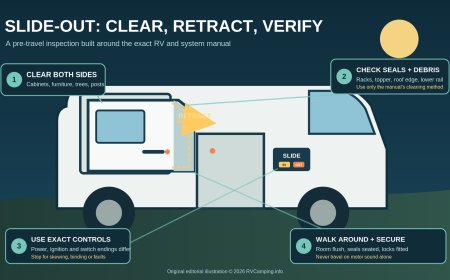
Slides and steps belong in this check. A coupled rig that fits with everything closed may not be usable overnight. If a required slide would meet a tree, post or pedestal, the site fails unless the RV's own instructions allow sleeping with that slide closed and the needed interior spaces remain accessible.
Decide what "ready to leave" means
Remaining hitched removes the coupling task. It does not make a set-up trailer road-ready. Wheel chocks, leveling aids, stabilizers, shore power, water, sewer, steps, slides, vents, an awning and loose cabin items can still prevent departure.
Build a one-night setup around a short, complete teardown rather than an imaginary instant exit. Keep optional gear stowed. Park facing the permitted departure direction. Keep the truck keys, shoes, light and departure checklist in known places. Do not place chairs, grills or a tow-vehicle door in the route to the trailer exit.
Use two readiness levels:
| Level | Meaning | Suitable setup |
|---|---|---|
| Normal early departure | Leave after a deliberate walk-around and the RV maker's full departure procedure | Essential utilities only; no optional outdoor camp |
| Possible urgent relocation | Reduce setup while still following every towing and campground requirement | No slides or stabilizers unless required; minimal connections; clear cab and exit path |
An urgent situation does not authorize towing with equipment deployed or skipping a safety check. If wildfire, flooding, severe weather or another hazard is plausible, ask the campground how it issues warnings, where it directs campers and whether staying coupled changes the approved evacuation position. Follow staff and emergency-service instructions rather than inventing a faster route through the campground.
Use a six-part go/no-go check
A site is a reasonable candidate only when every answer is yes:
- Permission: The campground confirms that this numbered site may hold the connected tow vehicle and trailer overnight.
- Geometry: The complete occupied length fits on the assigned surface without entering the road, neighboring site or protected ground.
- Position: Doors, required slides and the walking route work with the truck where it must remain.
- Attitude: The trailer can stay within every applicable manufacturer instruction without using stabilizers as leveling jacks.
- Services: Any connection you plan to use reaches safely and can be removed before departure.
- Exit: The combination has a clear, permitted path out after a full departure check.
One "probably" makes the answer no until it is resolved. The easiest fallback is often to unhitch normally. If the pad itself is too short, too curved or too steep, choose another site rather than treating the tow vehicle as overflow parking without permission.
For a one-night stop, convenience comes from choosing the right geometry and setting up less. It does not come from squeezing a coupled rig into a site whose rules or slope were never checked.
Sources
- Campground Regulations - Yosemite National Park (retrieved September 18, 2026)
- Site 19, Lynx Campground - Recreation.gov (retrieved September 18, 2026)
- Site 072, North Rim Campground - Recreation.gov (retrieved September 18, 2026)
- Leveling and Stabilizing a Travel Trailer - Airstream Support (retrieved September 18, 2026)
What's Your Reaction?