








Safe-T-Alert 35-742-BR review: right fit matters, and so does authenticity
Research-based Safe-T-Alert 35-742-BR review covering RV fit, 12-volt wiring, five-year life, testing and counterfeit risk.

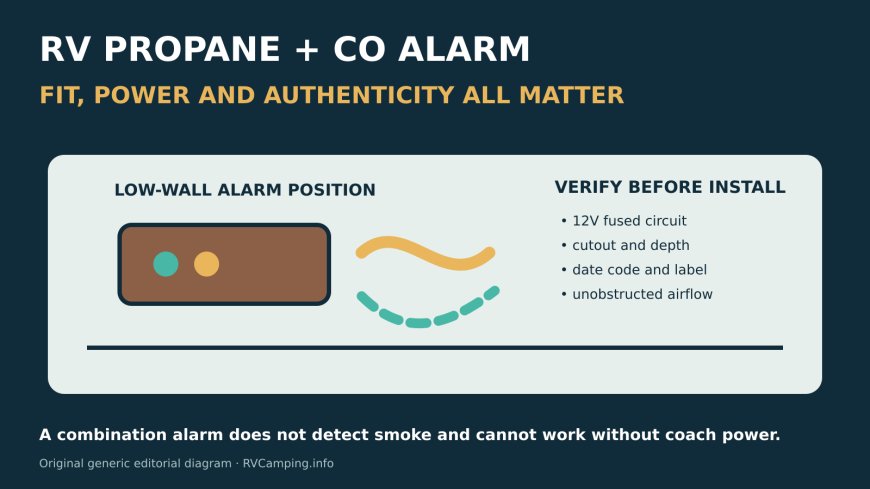
The Safe-T-Alert 35-742-BR is a practical replacement for an expired flush-mounted RV propane alarm when the existing opening, 12-volt wiring and required low-wall location fit. It adds carbon-monoxide detection in the same housing. Skip it if you need a surface-mount alarm, battery backup, smoke detection, a digital CO display, or a replacement that covers a different cutout without trim work.
The exact product reviewed is the brown Safe-T-Alert 35 Series flush-mount dual carbon-monoxide and propane alarm, model 35-742-BR, Amazon ASIN B005GSFTSE. The current manufacturer page identifies the base flush-mount model as 35-742; the BR suffix identifies the brown version.[1][2][3]
This is a research-based review. RVCamping.info did not buy, install or expose this alarm to test gas. The assessment uses current manufacturer documentation, government and fire-safety guidance, retailer identity data and attributed RV-owner reports.
As an Amazon Associate, RVCamping.info earns from qualifying purchases. If you buy through an Amazon link in this article, we may earn a commission at no additional cost to you.
Check the Amazon listing for Safe-T-Alert 35-742-BR, ASIN B005GSFTSE. Before ordering, confirm the seller, model suffix, production date when the package arrives, 12-volt hardwire design and brown flush-mount housing. Safe-T-Alert has reported counterfeit 35-742-BR units in online marketplaces, so matching the ASIN alone is not enough.[6]
Verdict in one minute
Buy the 35-742-BR when you are replacing a compatible recessed RV alarm and want one hardwired device for propane and CO. Its useful features are continuous coach-power operation, separate propane and CO sensing, distinct alarm patterns, a mute/reset button and an end-of-life warning.[1][2]
The catch is fit and provenance. This is not a universal drop-in merely because a listing calls it one. The manual requires a low installation position, a recessed opening, clearance behind the panel and a properly fused 12-volt circuit. Current manufacturer dimensions also differ slightly from the 2023 manual, so measure the old unit and opening instead of trusting one dimension block.[1][2]
There is a second catch that is unusual for an RV accessory: authenticity is part of the safety check. Safe-T-Alert says counterfeit black, brown and white 35-742 alarms have appeared online and that tested counterfeits did not meet UL standards or applicable safety requirements.[6] Buy from a seller you can identify, keep the receipt and inspect the label rather than choosing solely by price.
Who should buy it, and who should skip it
The 35-742-BR makes sense for:
- an RV with an expired or faulty flush-mounted 12-volt propane alarm;
- an owner whose existing opening and wall depth match the 35-742 installation envelope;
- a coach where the approved low-wall location can remain unobstructed;
- someone who wants CO detection added while replacing an older propane-only Safe-T-Alert 30-442 or a compatible CCI Controls unit.[1][2]
Choose another alarm or ask an RV technician for help when:
- the old alarm is surface-mounted rather than recessed;
- the wall opening, screw locations or rear clearance do not fit;
- the circuit is switched off while the RV is occupied;
- you need smoke or fire detection, since this unit does neither;
- a sleeping area needs an additional CO alarm because the combo unit is remote or behind a closed door;
- you cannot verify the product's seller, labeling or date code;
- you are not comfortable identifying RV polarity, the correct fused circuit or legacy two-lead wiring.
A combination alarm saves wall space, but it does not replace every life-safety device in the RV. The manufacturer states that the 35 Series detects propane and CO, not smoke or fire, and that gas elsewhere in the coach may not reach the sensor promptly.[2]
Check the opening before buying
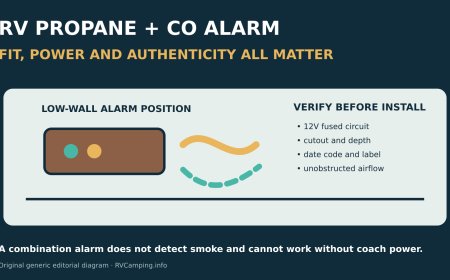
The manual gives the installation details that matter most: model 35-742 needs a 5 3/8-inch-wide by 2-inch-high cutout and one inch of clearance to recess the case. It must sit at least 4 inches and no more than 20 inches above the floor.[2]
Do not measure only the visible bezel. Remove power, pull the old alarm far enough to inspect the actual opening, and record:
- cutout width and height;
- usable depth behind the panel;
- overall bezel space;
- screw-hole locations and the condition of the thin wall panel;
- wire count, polarity and available slack;
- height above the finished floor;
- distance from opening windows, exterior doors and heating or return vents.
The manufacturer says not to install the alarm behind furniture or drapes, in a closet, on an outside wall, or within 12 inches of an opening window, exterior door or HVAC vent.[2] A physically convenient hole is not acceptable if air cannot reach the sensors correctly.
The published dimensions do not quite agree
The current product page lists a 6.375 by 2.875 by 1.25-inch case.[1] The May 2023 manual lists model 35-742 at 6.5 by 2.75 by 1.5 inches, while retaining the 5 3/8 by 2-inch cutout and one-inch recess-clearance instruction.[2] Home Depot's current indexed listing repeats the manual's 6.5 by 2.75 by 1.5-inch dimensions.[8]
Those differences are small, but small is enough to expose an old screw hole or stop a bezel from lying flat. Treat the manual's cutout as the required opening and the larger published outer dimensions as the safer allowance until you can measure the specific unit received. If the existing opening is larger, use a manufacturer-approved trim solution or choose a model made for that footprint rather than improvising a loose mount.
Power is the central compatibility boundary
This alarm requires 12-volt DC coach power. The current product page specifies 108 mA at 12 volts and an operating range of 12 volts plus or minus 15 percent.[1] It has no replaceable household battery standing behind the RV circuit.
That design avoids a forgotten disposable battery, but it ties protection to the health of the coach electrical system. The manual warns that the alarm will not work without power. A blown fuse, broken wire, poor connection, discharged house battery, reversed polarity or disconnected lead can leave the unit dark.[2]
The installation instructions call for 14- to 18-gauge wire and a properly fused circuit with a maximum 15-amp overcurrent device. Red connects to positive and black to ground. The circuit should not be controlled by an ordinary wall switch. The manual permits connection through the RV's main disconnect, but says the RV must not be occupied when that disconnect is off.[2]
Legacy wiring deserves special attention. Some Atwood or CCI Controls propane detectors use two power leads. Safe-T-Alert instructs installers to connect its single red lead to coach power and cap or remove the second legacy lead, not connect both to the new alarm.[2] If the old wiring does not match the diagram you have, stop and identify it before making a connection.
Installation and first-use checklist
- Read the manual for the exact alarm in the package. Compare the face, rear label, model, certification marks and date code with the seller's description.
- Disconnect the 12-volt supply to the circuit and verify that the old alarm is de-energized.
- Confirm that the existing position is 4 to 20 inches above the floor and outside the manufacturer's draft and obstruction exclusions.[2]
- Measure the opening and rear clearance. Do not enlarge a panel until you have checked for wiring, plumbing and structural material behind it.
- Inspect the supply conductors and identify positive and ground. Use recognized permanent connectors appropriate to the wire size and RV environment.
- Connect red to the fused positive supply and black to ground. Handle any second legacy power lead exactly as the manual directs.
- Secure the alarm without crushing the panel or overtightening screws into thin RV wall material.
- Restore power. The propane channel needs about one minute to warm up; the CO channel needs about ten minutes. The CO channel cannot alarm for CO during its warm-up period.[2]
- After warm-up, confirm the steady green operating indication and run the button test. The manufacturer says the button checks the alarm's electrical functions, not the sensors themselves.[2]
- Write the installation and replacement dates where future owners can find them. Keep the manual and receipt with the RV records.
Professional installation is the better choice if the wire identity is uncertain, the opening needs modification, the alarm shares a questionable circuit, or a previous unit shows heat or water damage.
Five-year life means five years, not until it stops beeping
The 2023 manual recommends replacement after five years of service and tells an owner who does not know the installation date to replace no later than five years after the production date on the back.[2] Safe-T-Alert's current counterfeit-check page takes the more conservative position that its alarms must be replaced within five years of the production date.[6]
Follow the date printed on the received unit and the instructions packed with it. A heavily discounted alarm that has already spent years in inventory may offer less useful service life. RV owners have reported receiving online replacements with older production dates, which is a reason to inspect the label immediately rather than after the return window closes.[7]
The end-of-life pattern is a red-red-green-green flash sequence with a beep every 25 to 30 seconds. Pressing reset silences that signal for 72 hours at a time, for no more than 30 days total. It is a short replacement window, not a service-life extension.[2]
Testing and maintenance
Safe-T-Alert calls for a button test after storage, before each trip and at least weekly while the RV is in use.[2] The manual also calls for monthly vacuuming with a soft brush, cleaning the cover with a damp cloth and keeping silicone products, sprays, waxes and cleaning agents away from the face.[2]
The button test has a firm limit: it checks circuitry and the sounder, not whether the gas and CO sensors respond accurately. Do not create carbon monoxide as a test. If sensor testing is needed, use only the method and test product specified by the manufacturer or have a qualified technician do it.[2]
NFPA's RV safety guidance says to keep a working CO alarm, keep an updated gas-leak detector aboard and have the propane system inspected.[5] CPSC likewise says RVs should use CO alarms and that an alarm adds protection but does not replace correct appliance installation, ventilation and maintenance.[4]
What to do when it alarms
Treat an alarm as real first. A propane alarm is a flashing red gas light with continuous beeping. The CO pattern is four beeps followed by five seconds of silence, with a red CO indication.[2]
For a propane alarm, the manual directs occupants to extinguish flames and smoking materials, shut down gas appliances, evacuate, leave doors and windows open, close the propane tank valve, and have the leak found and repaired before re-entry.[2] Do not operate an electrical switch while standing in a suspected gas atmosphere.
For a CO alarm, move everyone to fresh air and call emergency services. CPSC says not to re-enter until responders give permission, and not to reuse a malfunctioning fuel-burning appliance until trained personnel have serviced it.[4]
Do not explain away a signal as a nuisance because the propane cylinder is closed or because no odor is obvious. The manual notes that alcohol, aerosols, gasoline, butane and other vapors can affect the gas sensor, and low voltage or a fault can produce separate warning patterns.[2] Identify the LED and beep sequence, get people safe, then diagnose the cause.
Counterfeit risk changes the Amazon buying decision
ASIN B005GSFTSE currently resolves to a listing titled for model 35-742-BR, with UPC 715456357454.[3] That verifies the listing identity, not the authenticity of every unit offered by every marketplace seller.
Safe-T-Alert specifically names counterfeit 35-742-BR, 35-742-BL and 35-742-WT alarms. The company says confirmed counterfeit sellers included AOLIK NICEman and RVDay, warns that other resellers may also have stock, and offers to review clear photos of the front, rear label and receipt.[6]
The safest Amazon workflow is to inspect the current seller before checkout, keep screenshots and the receipt, and check the unit immediately after delivery. Look for a crisp label, a legible ETL or UL certification reference, correct model and date markings, consistent packaging and a manual that matches the product. If anything is doubtful, do not install it as your only protection. Ask Safe-T-Alert to verify it or return it and buy through the manufacturer or an authorized RV retailer.[6]
Final assessment
The Safe-T-Alert 35-742-BR is a good replacement when three conditions line up: the RV needs a flush-mounted 12-volt combination alarm, the existing location meets the low-wall and airflow rules, and the received unit is genuine and fresh enough to provide a full service interval.
Its biggest advantage is straightforward coverage of two RV hazards in one hardwired housing. Its biggest weaknesses are equally practical: no protection when coach power is absent, no smoke detection, a fixed five-year life, exact cutout requirements and a documented counterfeit problem in online channels.
Measure before ordering. Verify the seller and label after delivery. Install it on the correct always-available fused circuit, wait through the warm-up, test it on schedule and replace it by the applicable date. An alarm this important should never be chosen by face color and lowest price alone.
Sources
- Safe-T-Alert: 35 Series flush-mount dual CO/LP alarm
- Safe-T-Alert: RV 35 Series user manual, May 2023
- Amazon listing: Safe-T-Alert 35-742-BR, ASIN B005GSFTSE
- U.S. Consumer Product Safety Commission: Carbon Monoxide Fact Sheet
- National Fire Protection Association: RV safety tips
- Safe-T-Alert: warning about counterfeit alarm models and sellers
- iRV2 owner discussion: counterfeit notices and manufacturer authentication reports, January 2025
- Home Depot listing: Safe-T-Alert 35-742-BR product identity and dimensions
What's Your Reaction?