



Big Cypress RV Campgrounds Compared: 5 Front-Country Choices
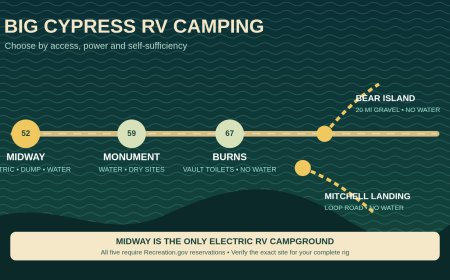
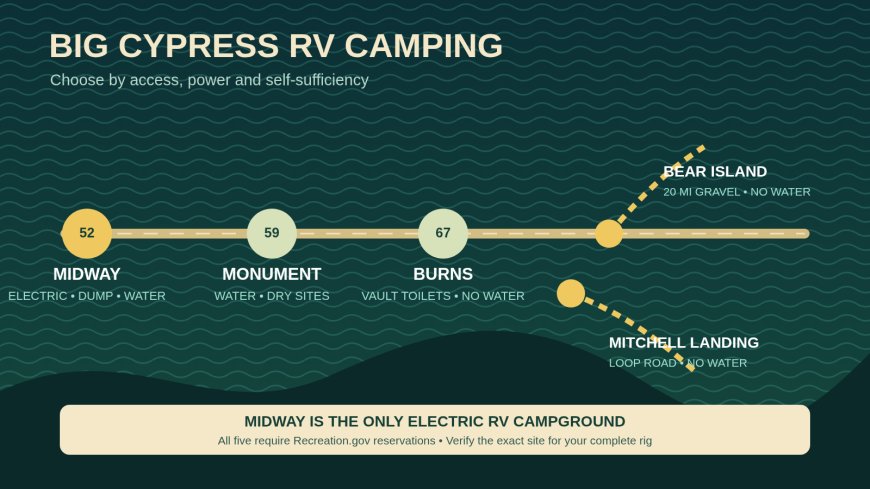
Midway is the only electric RV campground; Monument Lake is the serviced dry-camping alternative, while Burns Lake, Bear Island and Mitchell Landing are primitive choices.

Big Cypress RV campgrounds compared: five front-country choices
Quick answer: Midway is the easy default for an RV that needs electricity, potable water, flush toilets and an onsite dump station. Monument Lake keeps the US 41 access and drinking water but drops campsite electricity. Burns Lake is smaller and primitive, while Bear Island and Mitchell Landing trade pavement and services for quieter, more remote access. The National Park Service identifies these five as Big Cypress National Preserve's car-accessible front-country campgrounds; Gator Head and Pink Jeep are backcountry sites, and Pinecrest is group camping rather than a normal individual-site alternative.[1][2]
| Campground | Access and practical rig fit | Services | Published season | How to reserve |
|---|---|---|---|---|
| Midway | Direct from US 41 near mile 52; simplest approach for conventional RVs | 26 electric RV sites; potable water, flush toilets, dump station | Year-round | Recreation.gov, up to six months ahead |
| Monument Lake | Direct from US 41 near mile 59; RV loop has 26 nonelectric sites | Drinking water and flush toilets; no campsite hookups or onsite dump | Aug. 15-Apr. 15 | Recreation.gov |
| Burns Lake | Near US 41 around mile 67; 10 nonelectric RV sites | Vault toilets; no potable water, hookups or dump | Aug. 15-Apr. 15 for camping | Recreation.gov |
| Bear Island | About 20 miles on a secondary gravel road; gravel or grass pads | Vault toilets, shared food storage; no water, hookups or dump | Sites 1-12 all year; 13-40 Aug. 15-Apr. 15 | Recreation.gov; book before losing cell service |
| Mitchell Landing | About seven miles on Loop Road from the east entrance; secondary gravel access | Vault toilets and shared food storage; no water, hookups or dump | Aug. 15-Apr. 15 | Recreation.gov; reserve before arrival |
Start with access, not the campground name
Midway, Monument Lake and Burns Lake are the low-friction choices. All three branch from the US 41 corridor, so they avoid the long gravel approaches used by the two remote campgrounds. Midway is around mile marker 52, Monument Lake around 59 and Burns Lake around 67.[9][10][11] That arrangement also makes the first three easier for a late arrival, a low-clearance motorhome or a trailer owner who does not want a long washboard-road commitment.
Bear Island is different. Recreation.gov places it at the end of roughly 20 miles of secondary gravel road and describes the pads as gravel or grass.[12] A reservation proves that a campsite is assigned; it does not prove that the road will suit a low-slung coach after rain. Check current preserve conditions before leaving US 41, secure cabinets, and allow much more travel time than the mileage suggests.
Mitchell Landing is reached from Loop Road. Recreation.gov specifically directs larger vehicles to use the east entrance, then travel about seven miles to the campground.[13] That is valuable routing guidance, not a blanket big-rig endorsement. The approach remains secondary gravel, and the listing does not publish one campground-wide maximum length.
Rig fit is site-specific
The official 2026 campground table counts 26 RV spaces at Midway, 26 at Monument Lake, 10 at Burns Lake, 40 mixed tent/RV spaces at Bear Island, and 11 mixed spaces at Mitchell Landing.[2] Recreation.gov currently describes Mitchell Landing as a 12-site campground, so the two federal sources disagree by one.[13] Use the live reservation map as the inventory authority for the date you plan to book, and do not build a group plan around the larger count without confirming it.
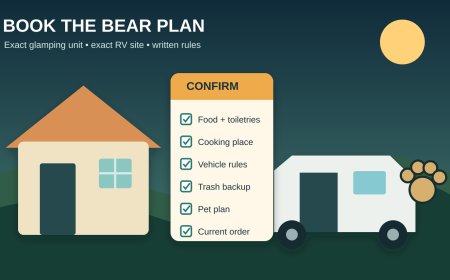
None of the official sources provides a single safe maximum RV length for each campground. This matters most at Bear Island and Mitchell Landing, where road surface, turning room, pad material and the complete vehicle combination can matter as much as the coach body. Enter the actual equipment in Recreation.gov, open the exact site record, and check parking orientation and permitted equipment. For a trailer, measure the trailer and tow vehicle rather than quoting only the box length. For a motorhome, include a towed car if both vehicles must fit the designated area.
Midway has the strongest conventional-RV inventory because all 26 RV listings are electric. Recreation.gov labels them “RV Electric,” while the remaining 10 spaces are tent-only.[9] Monument Lake's 26 RV spaces are explicitly nonelectric.[10] Burns Lake's current inventory separates 10 RV-nonelectric spaces from five tent sites.[11] “RV” at the primitive campgrounds means the site accepts that equipment category; it does not imply a level paved pad or utility pedestal.
Services: Midway is in a category of its own
Midway supplies electrical hookups at its RV sites, campground water, flush toilets and a dump station.[9] The 2026 NPS handout also identifies Midway and Dona Drive, 2.5 miles east of State Road 29 on US 41, as the preserve's dump points. Campers who paid for an NPS campground may use them without another charge; other users pay the posted $10 fee.[2] Midway is therefore the cleanest choice for air-conditioning, battery charging and tank management, though campers should still confirm amperage and the exact site's attributes before booking.
Monument Lake is dry camping at the pad. Recreation.gov lists drinking water and flush toilets but no electrical hookup and no campground dump station.[10] The NPS overview also says showers are available there.[1] Because the booking page does not include showers in its facility list, confirm shower operation close to the trip rather than treating it as guaranteed. Monument works for a self-contained rig that wants pavement-adjacent access and campground water but can live without shore power.
Burns Lake, Bear Island and Mitchell Landing all require a full fresh tank. Each has vault toilets and no fresh water.[11][12][13] None offers hookups. Plan the waste side before turning off the main corridor, too: the shared preserve dump choices are Midway and Dona Drive, not these campsites.[2] In hot weather, “no water” is a hard capacity limit, not a minor amenity gap.
Season and reservation method
NPS requires reservations at every designated Big Cypress campground. Book through Recreation.gov or call 877-444-6777; the park says online inventory opens no more than six months ahead.[1][2] Do not plan to arrive and pay cash. The Recreation.gov notices for several campgrounds warn that coverage is limited and payment is online, which is especially important for Bear Island and Mitchell Landing.[10][12][13]
Midway operates year-round. Monument Lake, Burns Lake and Mitchell Landing publish an Aug. 15-Apr. 15 camping season. Bear Island keeps sites 1-12 open throughout the year, then adds sites 13-40 from Aug. 15 through Apr. 15.[2][12][13] Burns Lake remains available for day use and backcountry-access parking outside its camping season, but that does not make overnight camping available there.[2]
The calendar points toward winter for more than administrative reasons. NPS defines November through April as the dry season, with cooler temperatures, fewer mosquitoes and greater concentrations of wildlife around remaining water. It also warns that winter brings larger crowds.[8] Reserve early for those months and keep a fallback; “open” does not mean “available.”
Which campground should an RVer choose?
Choose Midway when electricity, an onsite dump, easy highway access or year-round operation matters. It is the least complicated answer for a normal motorhome or travel trailer.
Choose Monument Lake for an easy US 41 approach and campground water when the rig can dry camp. Confirm the shower status if that service is part of the plan.
Choose Burns Lake for a small, primitive campground close to the main corridor, especially when ORV or backcountry access is the point of the stay. Bring all water and expect vault toilets.
Choose Bear Island only after accepting the 20-mile gravel approach. It offers the broadest primitive inventory and a 12-site year-round core, but it is a poor default for low clearance, uncertain road conditions or anyone who needs campground water.
Choose Mitchell Landing for Loop Road access and the airboat-launch area. Use the east entrance with a larger vehicle, reserve before cell service fades, and treat the 11-versus-12-site discrepancy as a reason to trust live inventory rather than a summary table.
Before departure, reopen the exact Recreation.gov site, check NPS conditions, and compare the site's equipment fields with the full traveling combination. Big Cypress has an RV option for many setups, but only Midway functions like a developed electric campground. The other four require some degree of dry-camping independence.
Sources
- Eating & Sleeping — Big Cypress National Preserve; official overview of the five front-country campgrounds and six-month reservation horizon.
- Campgrounds in Big Cypress National Preserve (2026); official campground table, seasons, services, fees and dump-station policy.
- Alerts & Conditions — Big Cypress National Preserve; seasonal planning context checked Oct. 3, 2026.
- Midway Campground — Recreation.gov; current facilities, access and site types.
- Monument Lake Campground — Recreation.gov; current facilities, access and nonelectric RV inventory.
- Burns Lake Campground — Recreation.gov; current primitive services and RV/tent inventory.
- Bear Island Campground — Recreation.gov; gravel access, site count, services and seasonal split.
- Mitchell Landing Campground — Recreation.gov; access guidance, services, season and current 12-site description.
What's Your Reaction?