























Towing across state lines? Rebuild the RV speed-and-lane plan at each border
A route-card method for checking trailer speed caps, left-lane restrictions, weight thresholds, posted exceptions, and safe pull-off points before a multistate tow.

Towing across state lines? Rebuild the RV speed-and-lane plan at each border
By Romana | October 14, 2026 | RV Camping
Quick answer: Do not carry one towing-speed assumption through a multistate trip. Make a route card for every state that lists the trailer speed rule, any combination-weight threshold, lanes you may use, roadway conditions that trigger the rule, and the official source checked. Recheck posted signs and current traffic restrictions on travel day. A legal maximum is still too fast when weather, traffic, tires, the tow vehicle, or the trailer calls for less.

The speed-limit sign ahead may look simple. The rule attached to your rig may not be. A state can set a lower ceiling for any vehicle towing a trailer, define a separate limit for a vehicle combination, or restrict the left lane only when the freeway has a certain number of lanes. Another state may use a weight rating rather than the fact of towing.
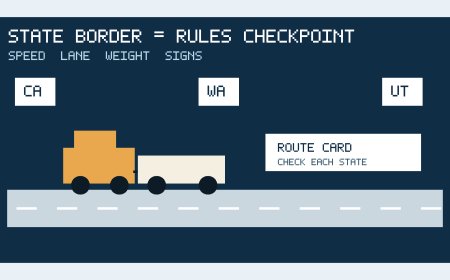
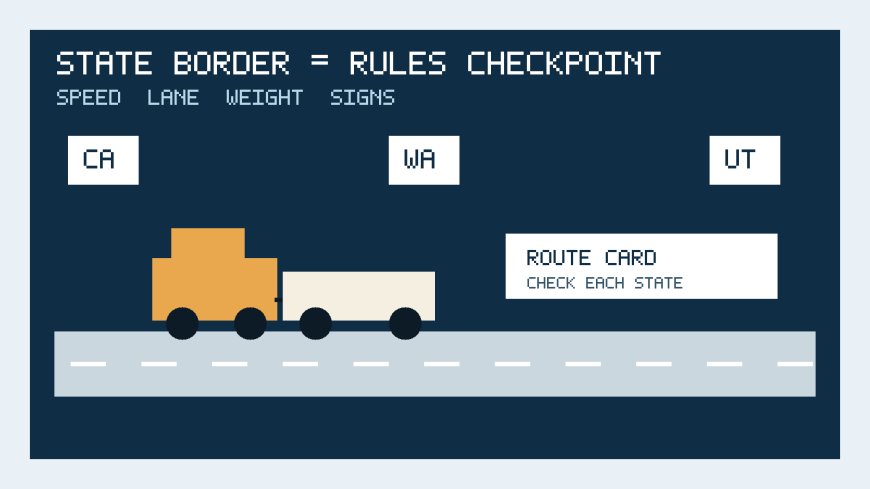
That makes state borders planning checkpoints. The job is not to memorize a national chart. It is to identify the exact combination, read each state's current primary source, and translate the rule into a short card a driver can use without searching the web at highway speed.
Describe the combination before researching the road
Start the card with the hardware, because legal categories often depend on it:
- tow vehicle year, make, model, and gross vehicle weight rating;
- trailer type and gross vehicle weight rating;
- actual loaded weights from a recent scale ticket, if available;
- combined rating and measured overall length;
- number of axles;
- whether a second trailer or vehicle is attached;
- tire speed ratings and the lower speed restriction in any equipment manual.
Do not substitute actual weight for a rule written around a rating, or a rating for a rule written around actual gross weight. The words matter. Utah's published highway-restriction page, for example, describes a leftmost-lane restriction on certain freeways using a gross vehicle weight rating threshold for the vehicle or combination.[5] Washington's cited speed section speaks about vehicles over a gross-weight threshold and vehicles in combination.[3]
If you cannot tell which category applies, stop treating a summary chart as an answer. Ask the responsible state agency or highway patrol and save the response with the route card.
Build one row per state
A useful route card is a table with these columns:
- state and route segment;
- towing or combination speed ceiling;
- lower posted limit that may control;
- lane rule and the number of same-direction lanes that activates it;
- weight or vehicle-category trigger;
- named exceptions or exempt road segments;
- official source URL and date checked;
- planned fuel, rest, and driver-change stops compatible with the slower schedule.
Keep the wording close to the source in your notes, but write the driver's action separately. "No leftmost lane on a three-lane limited-access road" is easier to apply than a pasted paragraph of statute. The article should never be your only legal source; the linked agency material and roadside signs control.
California: towing changes both speed and lane choice
California's driver handbook says vehicles towing trailers have a 55 mph maximum. The same handbook's towing section directs a driver towing a vehicle or trailer to use the far-right lane or a marked slow-vehicle lane. Where four or more lanes run in the same direction and no lanes are specifically marked, it limits use to the two lanes nearest the right edge.[1][2]
The route-card entry therefore needs more than "CA: 55." Write:
- towing ceiling: 55 mph unless a lower posted or safe speed controls;
- normal lane: far right or designated slower-vehicle lane;
- wide multilane condition: verify which two right-side lanes are permitted;
- exceptions and local controls: obey signs, work zones, and any route-specific direction.
This also changes the arrival estimate. A navigation app that predicts time from ordinary passenger-car flow may understate a towing day. Recalculate the route with the legal ceiling, fuel stops, grades, and an honest rest allowance. Do not make the lost time back by skipping inspections or arriving at a campground after its gate deadline.
Washington: "combination" appears in the speed rule
Washington law says the maximum for vehicles in combination, with an exception for auto stages, may not exceed 60 mph and can be set lower by the transportation secretary. The same section explains how the department uses "trucks" on maximum-speed signs to cover vehicles over the stated weight threshold and vehicles in combination.[3]
A separate Washington section bars a trailer-towing vehicle, or a vehicle or combination over 10,000 pounds, from the leftmost lane of a limited-access road with at least three lanes moving in the same direction, subject to the text's exceptions and exemptions.[4]
For an RV traveler, the important distinction is roadway geometry. The rule quoted above is not a blanket sentence saying "never use a left lane anywhere in Washington." Your card should identify:
- whether the road is limited access;
- how many general traffic lanes run in the direction of travel;
- whether the route segment is exempt;
- whether a left exit or other stated circumstance changes the immediate action;
- what the current signs show.
Plan merges early. Waiting until the last half-mile to move right invites abrupt lane changes with a long combination.
Utah: a weight-rating trigger can change the answer
Utah's transportation department describes a leftmost general-purpose-lane restriction on freeways with three or more general-purpose lanes in one direction. Its stated trigger is a vehicle or combination rated at 18,001 pounds or more.[5]
That is a different trigger from California's towing category and Washington's trailer-or-weight language. A route card copied from the previous state can therefore be wrong even if the trailer did not change.
Record the ratings from the certification labels and manuals before departure. If the card says only "about 17,000 pounds loaded," it may not answer a rule based on gross vehicle weight rating. Also distinguish a general-purpose lane from an auxiliary, managed, or high-occupancy lane; agency wording can treat them differently.
The Utah page is aimed broadly at highway restrictions and includes commercial and permitted-vehicle material. Use the specific threshold only after confirming that it applies to the exact personal RV combination and route. When the fit is uncertain, get an agency answer rather than borrowing a commercial-trucking conclusion.
Posted signs and safe speed still outrank the trip schedule
A statutory ceiling is not a target. California's handbook pairs maximum-limit information with the need to reduce speed for conditions.[2] For trip planning in every state, use the legal maximum as an upper boundary, then lower the planned speed when the equipment or conditions demand it.
Set a lower travel speed when required by:
- the tow vehicle or trailer manual;
- tire ratings or tire condition;
- crosswinds, rain, snow, ice, smoke, or poor visibility;
- downhill braking demands;
- congestion, construction, narrow lanes, or rough pavement;
- sway, steering instability, heat, or any mechanical warning.
If stable control requires a major speed reduction, choose a lawful place to leave the travel lane and reassess. Do not stop on a narrow shoulder merely to edit the route card.
Put lane planning into the navigation brief
Lane restrictions are easiest to follow when the driver knows where exits and merges occur. Before departure, mark:
- left exits that may require a legal, timely move;
- lane drops and mandatory exit lanes;
- urban segments with three or more same-direction lanes;
- work zones with temporary patterns;
- steep grades and truck lanes;
- safe pull-offs before complex interchanges.
The navigator can read the next transition from the route card while the driver watches traffic. If traveling alone, review the next segment while parked. A phone mounted in view does not make legal research safe while moving.
Do not assume the truck lane is always the correct lane for a personal RV. Read the sign. Nor should you assume an HOV or managed lane is available just because the party meets an occupancy number; trailer, weight, toll-account, or local restrictions may still apply.
Recheck at three times
A reliable route plan has three verification moments.
When the route is selected: identify every state, special facility, and urban freeway segment. Save the official laws or agency pages.
The day before departure: check for changed rules, construction, closures, weather, and temporary restrictions. Update the card and arrival estimate.
At the border or before the controlled segment: stop at a planned rest area or other lawful location. Confirm the next state's speed and lane row, then brief the driver. Roadside signs can impose a lower limit or route-specific instruction, so the card remains a preparation tool rather than permission to ignore them.
Date every source check. Traffic laws and agency explanations can change, and an undated screenshot is hard to trust on a later trip.
A route-card example without invented legal advice
Use this format, filling the blanks from current official sources:
- State / segment: ______
- Combination description: ______
- Towing or combination maximum: ______
- Lower equipment limit: ______
- Lane restriction trigger: ______
- Road type and lane count: ______
- Weight term used by source: actual / registered / GVWR / GCWR / other
- Exceptions or exempt segments: ______
- Current signs to expect: ______
- Official source and checked date: ______
- Planned pull-off before next border: ______
Do not fill a blank with "same as last state." If a state has no separate towing maximum, record the posted-rule source and the equipment-limited safe speed rather than leaving the cell empty.
The pre-departure test
Before hitching day becomes travel day, answer these questions:
- Do the route card and navigation route cover every state actually entered, including short corner crossings?
- Are weight terms copied accurately from labels and official sources?
- Is each lane rule tied to the right road type and number of lanes?
- Did the travel-time estimate account for the lowest legal or equipment limit on each segment?
- Are left exits, construction zones, grades, and border pull-offs marked?
- Can the navigator explain the next state's rule in one sentence?
- Will the driver obey a lower posted or condition-safe speed even if the schedule slips?
The safe schedule is the one that can survive a slower state, a headwind, and an early stop. A campground late-arrival call is cheaper than forcing a trailer through the last hour at the wrong speed or in the wrong lane.
Sources
- California Driver’s Handbook: Laws and Rules of the Road (Continued) (accessed October 14, 2026)
- California Driver’s Handbook: Safe Driving (Continued) (accessed October 14, 2026)
- Washington RCW 46.61.410 — Maximum speed for trucks and combinations (accessed October 14, 2026)
- Washington RCW 46.61.100 — Keep right and trailer left-lane rule (accessed October 14, 2026)
- Highway Restrictions — Utah Department of Transportation (accessed October 14, 2026)
What's Your Reaction?