





Canyonlands RV campgrounds compared: Needles or Island in the Sky?
The Needles is the better small-RV choice when a reservation matters; Willow Flat suits flexible dry campers with their own water and a backup plan.

Canyonlands RV campgrounds compared: Needles or Island in the Sky?

By Romana | Updated September 27, 2026
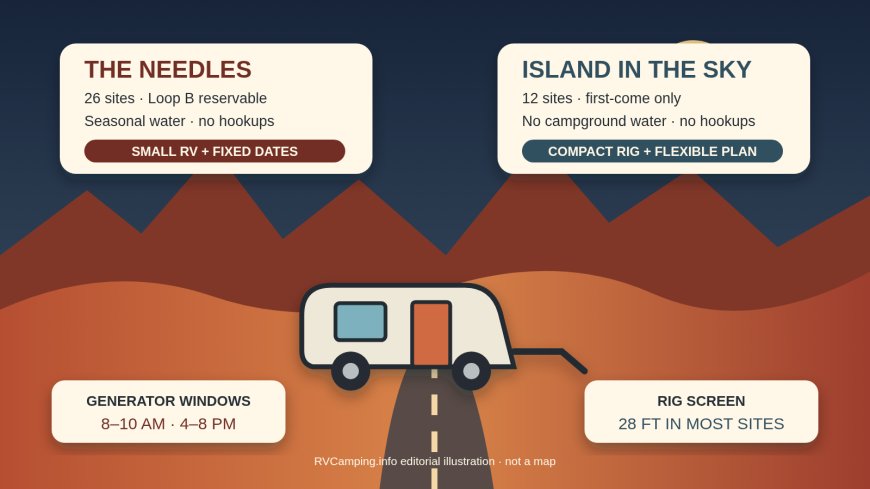
Canyonlands has two developed campgrounds, and neither is a conventional RV park. Both are open year-round, both lack hookups, both restrict generator use to two short daily windows, and both generally suit rigs around 28 feet or shorter. The useful difference is this: The Needles gives you a reservation path and seasonal campground water; Island in the Sky's Willow Flat is always first-come, first-served and has no campground water.[1][2][3]
For most small-RV travelers, The Needles is the better choice when a confirmed date matters. Willow Flat works better for an unreserved, compact dry-camping stay focused on Island in the Sky and the Moab side of the park. A large motorhome or long truck-and-trailer combination should not treat either campground as a safe default.
Planning date: Rules and operating information were checked September 27, 2026. Campgrounds may be open while roads, water systems, fire use, or individual sites are affected. Check the park's Alerts & Conditions page and the exact Recreation.gov listing before departure.[2]
Quick comparison for RV travelers
| Decision factor | Needles | Willow Flat at Island in the Sky |
|---|---|---|
| Operating season | Open year-round | Open year-round |
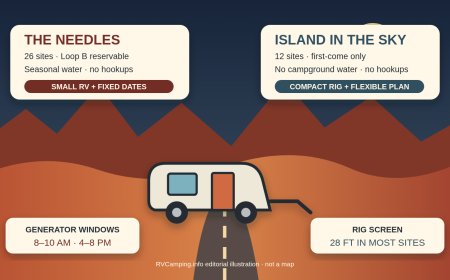
| Reservations | Loop B accepts bookings as far as six months ahead for dates from roughly March 15 to November 15; Loop A does not accept standard advance bookings | All 12 sites are first-come, first-served |
| Hookups | None | None |
| Dump station | None in the park | None in the park |
| Water | Drinking water is available at the campground seasonally | No water at the campground |
| Published RV fit | 28-foot combined length in most sites; a few sites can take longer equipment | NPS says the park's campgrounds average accommodation for RVs up to 28 feet; verify the actual space on arrival |
| Generator hours | 8–10 a.m. and 4–8 p.m. | 8–10 a.m. and 4–8 p.m. |
| Best fit | Small, self-contained RVs whose owners want a reservable cool-season trip | Compact, self-contained rigs with flexible arrival timing and a full water tank |
NPS lists 26 sites at The Needles and 12 at Island in the Sky. It also says there are no RV hookups and no dump station anywhere in the park's developed campgrounds.[1] The park's current conditions page lists both campgrounds as open year-round and warns that they usually fill early during spring and fall.[2]
Choose The Needles when a reservation matters
The Needles is the only one of the two with reservable individual campsites. Recreation.gov says Loop B sites may be booked up to six months in advance for stays from mid-March through mid-November. Loop A remains first-come, first-served, including during the busy spring and fall periods.[5] That split makes The Needles useful for two different plans: reserve Loop B for certainty, or keep Loop A as a same-day option without assuming a site will remain open.
Do not mistake a reservation for a utility upgrade. Recreation.gov describes every listed individual site as nonelectric and says the campground has no hookups, showers, or dump station. Drinking water and flush toilets are available, but its notice also identifies the water as seasonal.[5] An RV should arrive with enough fresh water to cover any outage or shoulder-season shutdown and enough waste capacity to leave the district without dumping.
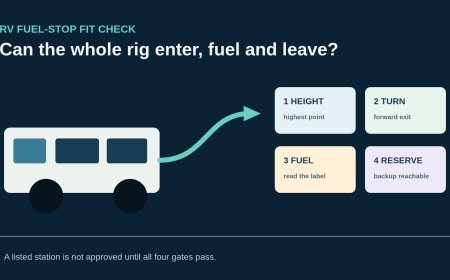
The location also demands a deliberate fuel and arrival plan. Recreation.gov places The Needles about 1.5 hours from Moab and says Highway 211 is the only paved road into and out of the district. The listing says the roadways and campsites are unlit, then recommends arriving before dark.[5] Fill the fuel tank, download directions, and settle the grocery and propane questions before turning west onto Highway 211.
Choose Willow Flat for a flexible Island in the Sky base
Willow Flat has only 12 sites, and every one is first-come, first-served.[1] The campground is open all year, but an open gate is not the same as likely availability. NPS says spring and fall arrivals often face a full campground early in the day.[1][2] A flexible traveler needs a real fallback outside the park, not a plan to circle the loop until someone leaves.
The utility gap is sharper here. NPS lists toilets, fire rings, and picnic tables, but no running water at the campground.[1] The safety page says water is available at the Island in the Sky visitor center, while specifically noting that none is available at the campground.[4] Treat visitor-center water as a planning aid rather than a campsite hookup: arrive with a full tank and confirm current visitor-center hours and water status before depending on it.
Willow Flat is the practical choice when the trip centers on Island in the Sky, the RV can fit a small dry site, and the schedule can absorb a full-loop outcome. It is a poor choice for a fixed late arrival, a nearly empty fresh tank, or a rig that needs electrical service overnight.
Site fit: use 28 feet as a screening number, not a promise
NPS says its Canyonlands campgrounds accommodate RVs up to 28 feet on average and notes that a few Needles sites can hold longer vehicles.[1] Recreation.gov is more specific: most Needles sites cap the tow vehicle and trailer together at 28 feet.[5]
The word combined matters. A 24-foot trailer behind a 19-foot pickup is not a 24-foot setup when both vehicles must fit on the pavement. Add the tow vehicle, trailer tongue, hitch, rear overhang, bike rack, and any cargo carrier before filtering a site. For a motorhome with a towed car, confirm whether both can remain within the site's marked parking area and vehicle limit.
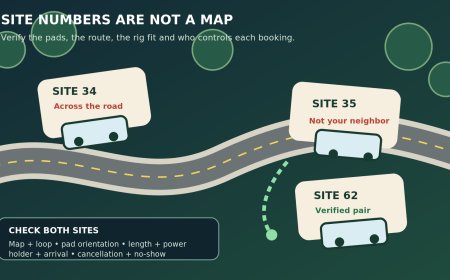
At The Needles, inspect the exact Recreation.gov site record rather than relying on the campground average. At Willow Flat, the first-come model makes the decision less predictable: a campground-level 28-foot average does not guarantee that the empty site you find has the right driveway length, entry angle, grade, or slide clearance. If the trip only works when one unusually large space is open, use a campground outside the park where the exact site can be confirmed.
Generator windows change the battery plan
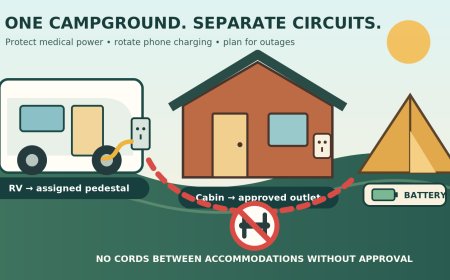
Canyonlands allows generators in both developed campgrounds only from 8–10 a.m. and 4–8 p.m.[3] This is more restrictive than a simple nighttime quiet-hours rule. There is no noon charging session, and running a generator after 8 p.m. is not an option.
Build the electrical budget around the overnight gap. Furnace fans, refrigerator controls, water pumps, lights, CPAP equipment, device charging, and inverter standby can consume more battery than expected. Recharge before the 8 p.m. cutoff, then preserve a reserve for the morning. Solar may help, but shade, clouds, season, panel angle, and short days make it a variable input rather than guaranteed replacement power.
Generator permission also does not make summer air conditioning practical. Neither campground has shore power, and the generator must be shut down for most of the day and all night.[1][3] If safe sleep depends on continuous air conditioning, book a hookup site outside the park or visit in cooler weather.
Heat can veto either campground
NPS says desert temperatures can exceed 85°F from April through September and often exceed 100°F in July and August. It recommends scheduling activity outside the 10 a.m.–4 p.m. heat window, carrying 2–3 liters of water per person for frontcountry hikes, and keeping extra water in the vehicle in case of a breakdown.[4]
For RV campers, heat planning starts before the site choice:
- Check the hourly forecast for the campground elevation, including the overnight low. A cooler hiking plan does not solve an RV that remains dangerously hot after sunset.
- Carry drinking water independently of the campground system. This is mandatory in practice at Willow Flat and prudent at The Needles, where campground water is seasonal.[4][5]
- Keep a departure option. Know where the nearest fuel, potable water, dump station, and climate-controlled refuge are before service disappears.
- Never leave a person or pet in an RV that depends on an unattended generator or air conditioner for survival.
- If continuous cooling is necessary, neither in-park campground is the right lodging product.
Summer storms add a second problem. NPS warns that monsoon weather can bring flooding, lightning, wind, and hail, and that rain can quickly make unpaved roads impassable.[2][4] Keep the campground stay separate from any backcountry-road plan, and never use an open developed campground as evidence that an unpaved side route is safe for an RV.
A booking sequence that avoids the common mistakes
- Measure the complete setup. Use 28 feet as the first screen, then verify the exact site or available parking space.[1][5]
- Choose certainty or flexibility. Reserve Needles Loop B for mid-March through mid-November if fixed dates matter. Use Needles Loop A or Willow Flat only with an outside-the-park fallback.[1][5]
- Plan for zero hookups and zero in-park dumping. Arrive with usable battery capacity, fresh water, and empty waste tanks.[1]
- Schedule generator charging. The only operating windows are 8–10 a.m. and 4–8 p.m.[3]
- Check heat and overnight lows. Move outside the park if the RV needs continuous cooling or the occupants cannot tolerate the forecast.[4]
- Read current alerts. Confirm campground status, water, fire restrictions, and approach-road conditions before the final fuel stop.[2]
The decision is simple once the nonnegotiables are honest. Pick The Needles for a small self-contained RV when a reservable site and seasonal water improve the plan. Pick Willow Flat for a compact dry-camping setup, an Island in the Sky itinerary, and enough flexibility to leave if all 12 sites are occupied. Choose neither when the rig is too long, hookups are essential, or the heat plan depends on continuous air conditioning.
Source credit: RVCamping.info compared current National Park Service campground, conditions, regulation, and safety guidance with the official Recreation.gov listing for The Needles, retrieved September 27, 2026. The rig-screening sequence, power budget, and heat decision framework are original editorial analysis.
Sources
- Canyonlands National Park frequently asked questions: campgrounds — NPS campground counts, amenities, reservation model, hookups, dump service, and general RV length guidance. Accessed September 27, 2026.
- Canyonlands Alerts & Conditions — Current operating season, reservation summary, fill warning, and road-condition context. Accessed September 27, 2026.
- Canyonlands Superintendent's Compendium — Current generator operating windows for the developed campgrounds. Accessed September 27, 2026.
- Canyonlands safety guidance — Heat, hydration, water availability, storms, road, and vehicle-breakdown advice. Accessed September 27, 2026.
- Canyonlands National Park Needles District Campground — Booking window, loop model, facilities, RV fit, water, access road, and arrival guidance. Accessed September 27, 2026.
What's Your Reaction?