



How to sanitize an RV fresh-water system without confusing it with water treatment
A model-aware RV fresh-water sanitizing checklist that separates routine tank and plumbing maintenance from emergency treatment of suspect source water.
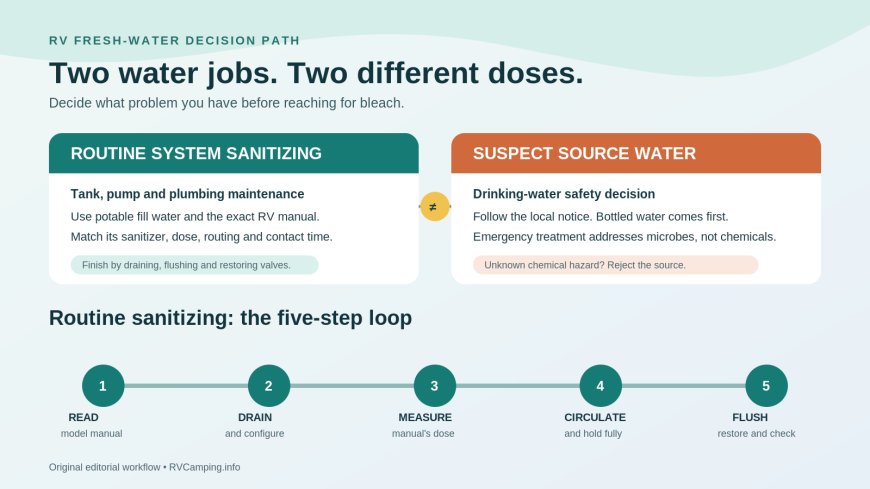
Sanitizing an RV fresh-water system is maintenance for the tank, pump and plumbing. It does not turn an unknown lake, questionable well or chemically contaminated tap into safe drinking water. Keystone's owner guidance says to put only potable water in the fresh-water system.[4] Follow the manual for the exact RV and installed components, circulate the specified sanitizer through every intended outlet, hold it for the stated contact time, then drain and flush.
That distinction matters because the two jobs use very different chlorine doses. A current Winnebago Solis manual, for example, specifies a 50-parts-per-million system treatment held for at least four hours, or a 100-ppm treatment held for at least one hour.[1] EPA emergency guidance for treating a gallon of drinking water uses drops, not cupfuls, and says chemical contaminants are outside the method's reach.[2]
Pick the right job first
| Situation | What you are trying to do | Best next step |
|---|---|---|
| The RV is new, has sat unused, has just come out of storage or may have a contaminated plumbing system | Sanitize the RV system | Use the exact RV and component manuals |
| A campground tap is under a boil-water notice | Make source water microbiologically safer | Follow the notice and local authority; use bottled water or treat water by the prescribed emergency method |
| Water came from a lake, flood, questionable well or unknown spigot | Evaluate and treat suspect source water | Do not assume the RV tank's sanitizing cycle makes it potable |
| Fuel, pesticide, heavy metals, salt or another chemical may be present | Avoid chemical exposure | Do not use the water; boiling and chlorine disinfection will not remove most chemicals[2] |
Winnebago's 2026 Solis manual recommends its system procedure for a new system, one left unused, one that could have become contaminated, and before long storage.[1] That is a model-specific maintenance schedule, not a universal interval for every RV.
Why one bleach recipe cannot cover both jobs
A sanitizing solution must contact the tank walls and plumbing at a concentration and for a duration chosen for the system. Emergency drinking-water treatment is a much lighter dose measured against the water itself.
EPA says that, when boiling is unavailable, the dose for one gallon of clear water is 8 drops when the bleach is 6% and 6 drops when it is 8.25%, followed by a 30-minute wait. Cloudiness, color or very low water temperature calls for twice the dose.[2] CDC's emergency handout gives a broader field instruction: 8 drops, or slightly less than 1/8 teaspoon, of 5%–9% unscented household bleach per gallon, with 16 drops for cloudy tap water, then wait at least 30 minutes.[3]
Those federal examples differ because EPA separates 6% and 8.25% products, while the CDC handout covers a 5%–9% range. Use the guidance named by the local advisory rather than averaging the tables. Both agencies put bottled water first when available, and CDC calls boiling the best emergency method.[2][3]
Neither method fixes every hazard. EPA says boiling or disinfection does not destroy heavy metals, salts and most other chemicals.[2] CDC's warning is equally blunt: these three emergency methods do not make chemical- or toxin-contaminated water safe.[3] Bad odor, an oily sheen, nearby flooding or a posted “non-potable” sign is a reason to reject the source, not add more bleach.
Read the model manual before opening a drain
Fresh-water layouts vary enough that a generic valve-by-valve script can cause trouble. Before starting, find the year-specific RV manual and the manuals for the water heater, hydronic system, filter, ice maker, washer and water-management panel. Record:
- fresh-water tank capacity;
- the sanitize, winterize and normal-use valve positions;
- whether a filter cartridge must be removed or replaced;
- whether the water heater is included, cooled, drained or bypassed;
- every hot and cold outlet the manual expects you to run;
- sanitizer type, product strength, dose, contact time and flushing steps;
- any disposal restrictions in the campground or municipality.
The current Solis illustrates why this homework matters. Its procedure tells the owner to cool the heating system, use a particular Water Center configuration and bypass the water heater while introducing the treatment. It still instructs the owner to run every faucet, including hot-water faucets, until chlorine is detected.[1] A different RV may route water differently. Copy the chemistry only if your own manual matches; copy the valve positions only if it is the same plumbing layout.
A practical sanitizing workflow
1. Prepare the work area
Park level where the drained solution may be discharged legally. Turn off water heating and let the equipment cool if the manual says to. Keep children and pets away. Use ventilation and the protective equipment listed on the bleach label. CDC says never mix bleach with ammonia or another cleaner and recommends fresh air when bleach fumes may be present.[5]
Use only the sanitizer permitted by the manuals. For an emergency drinking-water dose, EPA specifies regular, unscented chlorine bleach labeled for disinfection or sanitizing, not scented, color-safe or cleaner-added products.[2] Do not assume that language overrides a component maker that prohibits bleach.
2. Drain and configure the system
Turn off the pump and outside water. Open the fresh-tank and low-point drains in the sequence given by the manual. Drain or isolate the water heater only as directed. Remove, bypass or replace filter cartridges according to their instructions. Close the drains before filling.
Take a photo of the utility-panel valve diagram before moving anything. It is faster than reconstructing the normal-use position after the job.
3. Measure the manual's dose
Do not pour concentrated bleach straight onto fittings or tank surfaces unless the manufacturer explicitly instructs it. Prepare the diluted stock solution the way the manual describes, using a dedicated measuring cup and clean container.
Worked example, not a universal recipe: the 2026 Solis manual says to mix 1/4 cup of household chlorine bleach into one gallon of water. Each prepared gallon treats 15 gallons of tank capacity, producing the manual's stated 50 ppm result. For its one-hour alternative, the manual doubles the bleach to 1/2 cup per gallon of prepared solution; the same prepared-solution-to-tank ratio applies.[1]
| Tank capacity | Solis 50-ppm method, at least 4 hours | Solis 100-ppm method, at least 1 hour |
|---|---|---|
| 15 gallons | 1/4 cup bleach in 1 gallon water | 1/2 cup bleach in 1 gallon water |
| 30 gallons | 1/2 cup bleach in 2 gallons water | 1 cup bleach in 2 gallons water |
| 45 gallons | 3/4 cup bleach in 3 gallons water | 1 1/2 cups bleach in 3 gallons water |
| 60 gallons | 1 cup bleach in 4 gallons water | 2 cups bleach in 4 gallons water |
These amounts are simple multiples of Winnebago's published ratio. The manual does not state a sodium-hypochlorite percentage beside this recipe, so the table must not be “corrected” for a different bottle strength without manufacturer guidance.[1]
4. Fill, circulate and start the clock
Add the prepared solution through the method specified for the RV, then finish filling with known potable water. Do not leave a pressure-fill connection unattended. Run the pump and open outlets one at a time as the manual directs. Include both sides of mixer faucets, the shower, toilet, outside shower and any plumbed appliance that the manuals say should be sanitized.
Once the sanitizer has reached all required branches, close the outlets and begin the full contact time. “A while” is not a measurement. Write the finish time on painter's tape at the pump switch so nobody uses the system early.
5. Drain, flush and restore
Drain to an approved location. Refill with potable water, then flush each included hot and cold branch until the manual's endpoint is met. The Solis instruction uses the absence of chlorine odor as its endpoint.[1] One refill may not clear every low spot.
Return bypass valves and the water-management panel to normal service. Reinstall or replace filters, refill the water heater if required, purge air and check every disturbed fitting for leaks. Do not energize a tank-style water heater until it is full.
The do-not-miss checklist
- ☐ Confirm the exact model year, floorplan and installed plumbing components.
- ☐ Read the RV, water-heater, filter and utility-panel instructions.
- ☐ Verify tank capacity from the manual or build data, not the monitor-panel guess.
- ☐ Decide whether this is system maintenance or suspect-water treatment.
- ☐ Start with potable fill water for routine sanitizing.
- ☐ Check bleach type and strength against the instruction being followed.
- ☐ Never mix bleach with anything else; flush RV antifreeze out first.
- ☐ Cool or shut down water-heating equipment as directed.
- ☐ Remove or bypass filter cartridges only as directed.
- ☐ Dilute and measure; do not improvise a “stronger is better” dose.
- ☐ Reach every required hot and cold outlet.
- ☐ Hold for the complete manual-specified contact time.
- ☐ Drain legally and flush with potable water.
- ☐ Restore every valve, filter and heater to normal operation.
- ☐ Check for leaks and record the date and method used.
If the water source becomes suspect on the road
Stop using it for drinking, cooking, ice, tooth brushing and dishwashing. Disconnect from the source and follow the campground notice or local health authority. Bottled water is the simplest fallback. If an authority permits emergency treatment and the problem is microbial, treat measured batches by its current instructions rather than dumping a guessed dose into the RV tank.[2][3]
After the advisory ends, flush the supply hose and RV system as directed by the utility and the RV manufacturer. If suspect water entered the tank, the model manual may call for a full sanitizing cycle. If the possible contaminant was chemical, do not rely on odor, taste or a chlorine rinse to clear the system; ask the water authority and RV manufacturer what inspection, testing or component replacement is needed.
Source credit: Winnebago Industries, Keystone RV, the U.S. Environmental Protection Agency, and the U.S. Centers for Disease Control and Prevention. This guide provides general maintenance and emergency-planning information. The current manuals and labels for the exact RV and installed components control.
Sources
[1] 2026 Solis Operator Manual
[2] Emergency Disinfection of Drinking Water
[3] Make Water Safe During an Emergency
What's Your Reaction?