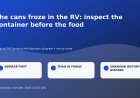













The cans froze in the RV: inspect the container before the food
Triage accidentally frozen commercial cans in an RV by damage, temperature history, refrigerator thawing, and a conservative swollen-can discard rule.

The cans froze in the RV: inspect the container before the food
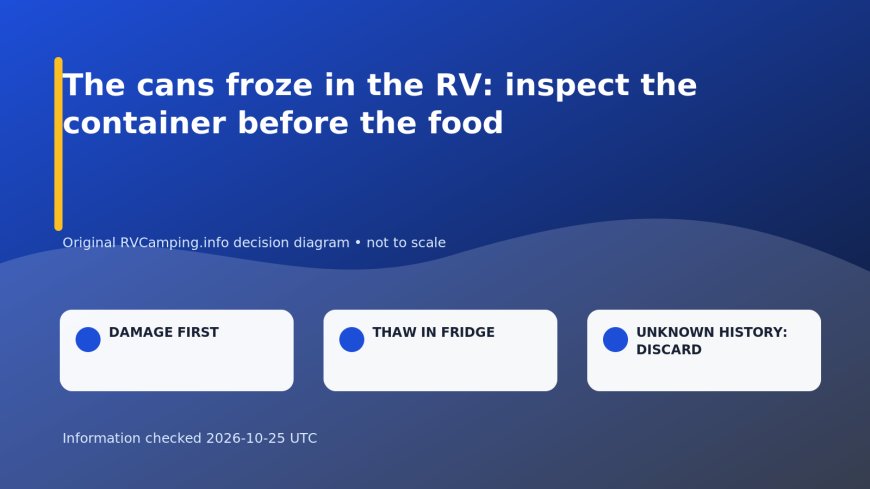
An intact can with a known frozen history has a narrow evaluation path; swelling, leaking, damage or unknown thaw history ends it.
Do not open the pantry evidence
Start while the containers are still cold. FDA treats swelling, leakage, punctures, fractures, deep rust and severe crushing as can damage; CDC says leaking, bulging or swollen containers can signal contamination.[7][8] Do not open or taste those containers.
Use a conservative public rule for swelling: discard the can. USDA pages contain a narrow inconsistency about swelling caused only by freezing, but its dedicated shelf-stable guidance says not to use any swollen can.[5][6] A camper cannot reliably identify the cause of pressure by sight.
Only an intact, still-frozen can enters the thaw path
USDA says an intact can that remains frozen may be thawed unopened in the refrigerator.[5] When a can has thawed at 40°F or warmer, or thawed and froze again, belongs in the discard branch.[5] Counter thawing, a heater vent and warm water do not fit that guidance.
Temperature history matters because a closed RV can cycle across freezing as weather changes. If nobody can establish when the can thawed or how warm it became, discarding it is safer than inventing a timeline.
Inspect after refrigerator thawing, not by tasting
After the intact can thaws in the refrigerator, reject abnormal appearance, odor, spurting or forceful hissing without tasting.[5][8] A normal smell does not rescue a damaged container because you cannot detect botulinum toxin by sight, smell or taste.[8]
USDA’s shelf-stable guidance includes a post-thaw cooking route for a can that passes every earlier screen.[5] That downstream instruction is not a salvage method for a swollen, leaking, burst or temperature-abused can.
Prevent the next freeze-thaw cycle
Utah State University Extension recommends storing food warmer than 32°F but cooler than 70°F; it also cautions that expansion during freezing may split metal, shatter glass or disturb the lid seal.[10] An unheated RV pantry is therefore not a winter freezer with predictable control.
Move commercial cans to conditioned storage before winter. Keep home-canned glass jars outside this decision tree because seal failures and processing history create a different evaluation.[9] The useful campsite rule is short: damage first, history second, refrigerator thaw only for the narrow intact case.
Source credit: RVCamping.info reviewed the linked primary and supporting materials on 2026-10-25. The decision sequence and recommendations are original editorial analysis.
Sources
- USDA shelf-stable food safety — Accessed 2026-10-25.
- USDA packaging guidance — Accessed 2026-10-25.
- FDA storing food safely — Accessed 2026-10-25.
- CDC botulism and home-canned foods — Accessed 2026-10-25.
- NCHFP storing home-canned foods — Accessed 2026-10-25.
- USU food storage in the home — Accessed 2026-10-25.
What's Your Reaction?