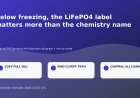



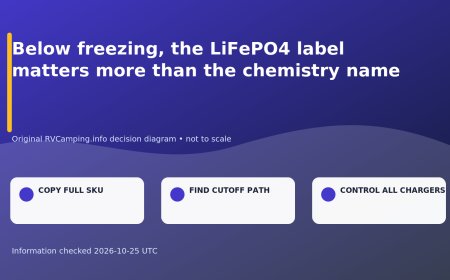










Below freezing, the LiFePO4 label matters more than the chemistry name
Compare exact cold-charge rules for Renogy heated and unheated batteries and Victron Lithium Smart before an RV charger, solar controller, or alternator turns on.

Below freezing, the LiFePO4 label matters more than the chemistry name
Three LiFePO4 products publish three different cold-charge systems, so the safe campsite decision starts with the complete model number.
“LiFePO4” is not an operating instruction
Renogy’s unheated RBT12100LFP-US publishes a 32°F charge cutoff and 41°F recovery point.[1] Its heated RBT12100LFP-H publishes a broader operating envelope but also spells out heater-current, start, stop and BMS conditions.[2] Victron’s Lithium Smart manual sets a 41°F minimum and relies on an approved external BMS.[3]
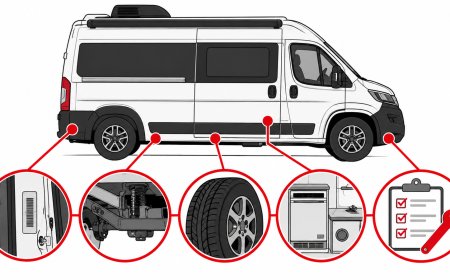
Those are different answers for the same battery chemistry. Photograph every label and copy the complete SKU before opening a manual. A suffix can distinguish an unheated cutoff-only pack from a self-heated model.
Separate discharge, charge and recovery
The unheated Renogy example may discharge below freezing while charging remains prohibited below 32°F.[1] A discharge range is not a charge range. Its 41°F recovery point also does not grant permission to force current into the battery between the cutoff and recovery thresholds.
The heated Renogy manual says its heater starts below 41°F and stops above 50°F, requiring a stable charge current greater than 10 amps per battery in a parallel bank.[2] A small solar trickle is not automatically enough to run that system as designed.
Find the device that stops every source
An RV house bank can receive charge from shore power, solar, the alternator or a DC-to-DC charger, and a portable charger. Disabling one path does not make the bank safe if another remains live.
Victron’s example uses battery monitoring plus an approved external BMS that must control the charge sources.[3] A battery marked Smart does not prove that the installer completed that path. Check the BMS model, wiring and commissioned shutdown behavior.
A cold-morning log entry that works
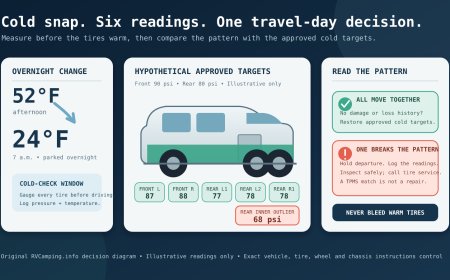
Write one line: model and manual revision, battery-temperature limit, cutoff and recovery, heater requirement, and the device that disables all charging. Ambient weather is only a warning; the applicable manuals use battery temperature.[1][2][3]
Do not bypass protection, spoof a sensor or press a heater against the case. Warm the battery only by a method allowed by the battery and RV makers. If the exact model or protection path is unknown, stop charging and get the correct documentation before resuming.
Source credit: RVCamping.info reviewed the linked primary and supporting materials on 2026-10-25. The decision sequence and recommendations are original editorial analysis.
Sources
- Renogy RBT12100LFP-US manual — Accessed 2026-10-25.
- Renogy RBT12100LFP-H self-heating manual — Accessed 2026-10-25.
- Victron Lithium Smart battery manual — Accessed 2026-10-25.
What's Your Reaction?