






A cold snap dropped your RV tire pressure: make the travel-day decision cold
An overnight cold snap can lower every RV tire reading, but one wheel-position outlier may signal a leak. Check cold, use the approved target, and do not bleed warm tires.

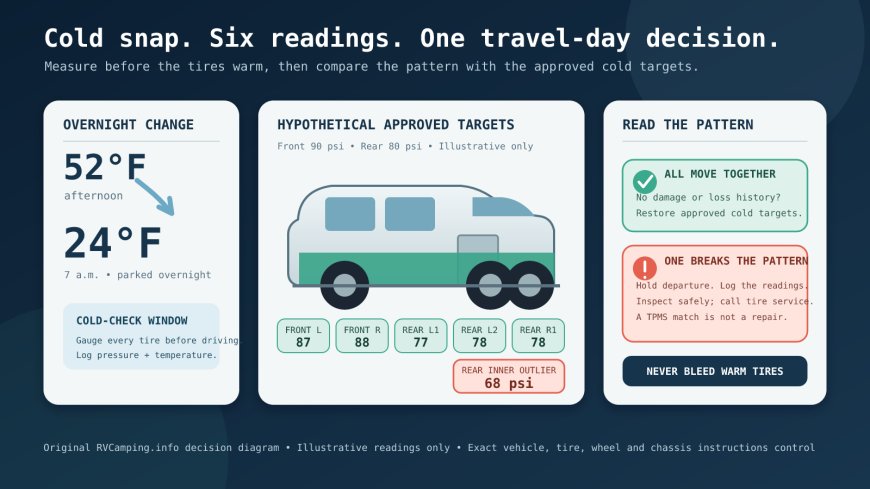
A cold snap dropped your RV tire pressure: make the travel-day decision cold
By Romana | October 23, 2026
Yesterday's tire readings are not today's departure clearance after an overnight temperature drop. The useful response is neither "the cold did it" nor "add air until the warning goes away." Check every tire before it warms, compare the pattern with the approved cold targets for this loaded RV, and hold the trip when one wheel position does not follow the others.
That last comparison is what separates an ordinary weather-related pressure change from a possible leak. It also keeps the load/inflation chart, tire-pressure monitoring system (TPMS), and hand gauge in their proper roles.

The 7 a.m. reading decides the morning
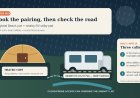
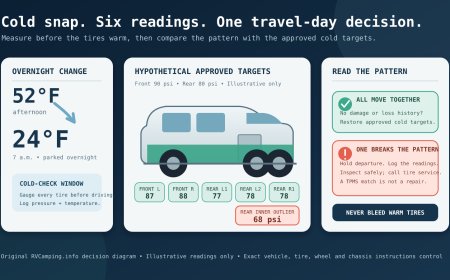
Consider a motorhome that has sat at its campsite all night. The afternoon temperature was 52°F; dawn arrives at 24°F. Its owner already has a dated pressure card based on the loaded RV, the exact installed tires, the applicable tire-maker table, and the vehicle and wheel limits. The approved cold targets on that card are 90 psi at the front and 80 psi across the rear axle. Those figures are hypothetical, not values to copy.
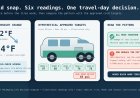
A calibrated hand gauge shows 87 and 88 psi at the front. Three rear tires read 77 or 78 psi, but the right inner dual reads 68 psi. Most positions moved together by roughly the amount the temperature change could explain. The 68 psi tire did not.
Ford's 2024 motorhome chassis manual gives a useful chassis-specific rule of thumb: a 10°F temperature drop can produce about a 1 psi pressure drop.[3] It still directs owners to check frequently and adjust to the proper label pressure.[3] The rule of thumb can explain a broad pattern; it cannot diagnose one low tire or authorize a new pressure target for another chassis.
Departure waits. Record all six readings and the ambient temperature, inspect the low position and its dual mate from a safe, ground-level position, and call a qualified tire service provider. Do not repeatedly top up an unexplained loss and treat the matching display as a repair. Michelin says pressures across an axle should be the same and gives 5 psi as the maximum allowable difference across an axle in its RV guidance.[2] It also warns that an underinflated tire in a dual arrangement loads its mate.[2]
If all six readings had fallen together, with no damage, leak history, valve problem, or outlier, the response would be different: restore each axle to its already approved cold target, remeasure with the same gauge, replace the valve caps, and leave only after every position is accounted for. Cold weather explains why air may be needed. It does not change the load each tire must support.
Use the chart that established the target, not a fresh guess
A load/inflation table is not a weather correction chart. It links the actual load to the cold pressure required for an exact tire size, load range, and single or dual application.[2] Michelin's RV guide recommends weighing each axle end, using the heavier end to choose the axle's cold pressure, and then keeping the same pressure across that axle.[2] It also says the result must not exceed the wheel manufacturer's limits.[2]
That work belongs in the RV's standing pressure record, before a rushed travel morning. Keep the loaded scale ticket with a note naming the installed tire, the table edition, the selected load cell, and the resulting approved cold target. Revisit the calculation after a meaningful load change, tire or wheel replacement, chassis work, or conflicting manufacturer instruction.
The completed vehicle's labels and manuals remain part of the decision. Ford's motorhome chassis manual points to its certification or tire label for the recommendation, sends the owner to the completed vehicle manual to locate that label, and says the cold pressure should not be set below the stated value.[3] A tire sidewall's maximum pressure is not a substitute target. Nor should a generic article overrule an RV maker, chassis maker, tire maker, or wheel maker.
If the record is missing, the tire does not match the recorded table, or the sources disagree, today's job is not to improvise a number from the sidewall. Use the vehicle label and exact manuals, then have the RV, tire, wheel, or chassis maker or a qualified commercial/RV tire professional resolve the conflict before travel.
TPMS can report the problem without clearing the trip
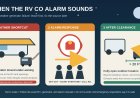
NHTSA treats a tire as cold after it has remained undriven for three hours or longer.[1] It warns that a TPMS lamp means a tire is already significantly underinflated, says the system does not replace gauge checks, and specifically notes that a cold-morning warning can disappear as the tire warms.[1] The disappearing lamp is still a reason to inspect and check pressure.
That limit matters on an RV travel day. A dashboard without a warning is not proof that every tire is at its approved target. The original-equipment system may not cover a trailer, towed vehicle, spare, or every wheel position on a larger motorhome. An add-on system has its own sensor coverage, alert settings, update behavior, and service instructions. Michelin directs RV owners to the original-equipment maker or dealer for system-specific TPMS guidance and still requires manual inspection.[2]
Use TPMS for trend and change detection while underway. Before departure, use an accurate gauge on every accessible tire, including inner duals and the spare, and compare the readings with the documented cold targets. If a tire cannot be measured, fix the access problem rather than assuming the sensor has covered it.
A flashing malfunction indication is not a low-pressure clearance either. NHTSA says a TPMS malfunction may appear as 60 to 90 seconds of flashing followed by a steady lamp on covered vehicles. The system needs inspection; until its exact coverage and condition are known, the driver has lost a warning layer.[1]
Once the tires are warm, do not chase the morning number downward
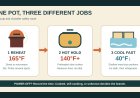
Driving generates heat and pressure rises.[2] Michelin says its table values are cold pressures at ambient temperature and warns never to bleed hot tires because doing so leaves them underinflated when they cool.[2] Ford gives the same boundary: after more than one mile of driving, do not reduce pressure merely because the tires are hot and above the cold recommendation.[3]
Suppose the motorhome leaves after all cold readings are restored and verified. At a fuel stop, the display now shows higher pressures across the axles. That broad rise is expected. Do not vent each tire back to 90 or 80 psi. Watch for a tire that departs from its axle mates, loses pressure, triggers an alert, or accompanies vibration, pulling, heat, odor, visible damage, or handling change. Stop in a safe place and arrange professional inspection rather than trying to normalize a hot tire at the pump.
A warm tire at or below the approved cold target is a different signal. Ford's manual calls that condition potentially significantly underinflated.[3] Michelin likewise treats a low or uneven operating pattern as a reason for inspection, not casual pressure adjustment.[2]
The travel-day decision is simple only after the paperwork is done. A uniform cold-weather drop can be corrected to established cold targets. A lone outlier, repeated loss, damage, inaccessible tire, unresolved chart conflict, or TPMS malfunction holds the departure. The afternoon reading then becomes a trend check, never an invitation to bleed away the pressure the cold morning required.
Sources
- Tire Safety Ratings and Awareness | TireWise — NHTSA — cold-pressure definition, cold-morning TPMS behavior, malfunction indication, gauge checks, and TPMS limitations; source text archived October 23, 2026 from the official page capture.
- Michelin RV Tires: Guide for Proper Use and Maintenance (May 2025) — current official RV tire guide covering cold checks, load/inflation tables, axle-end loading, duals, warm-tire pressure, and TPMS.
- 2024 Ford Motorhome Chassis Owner's Manual — official chassis guidance on labels, cold checks, temperature-related pressure change, warm tires, and completed-vehicle instructions; archived from the October 21, 2026 retrieval after the live host returned HTTP 403 on October 23.
What's Your Reaction?