




Yellowstone RV campgrounds compared: Fishing Bridge, Madison, Mammoth, or Lewis Lake?
Compare Fishing Bridge, Madison, Mammoth, and Lewis Lake by hookups, full rig length, generator rules, booking channel, season, and park access.

By Romana | Updated September 9, 2026
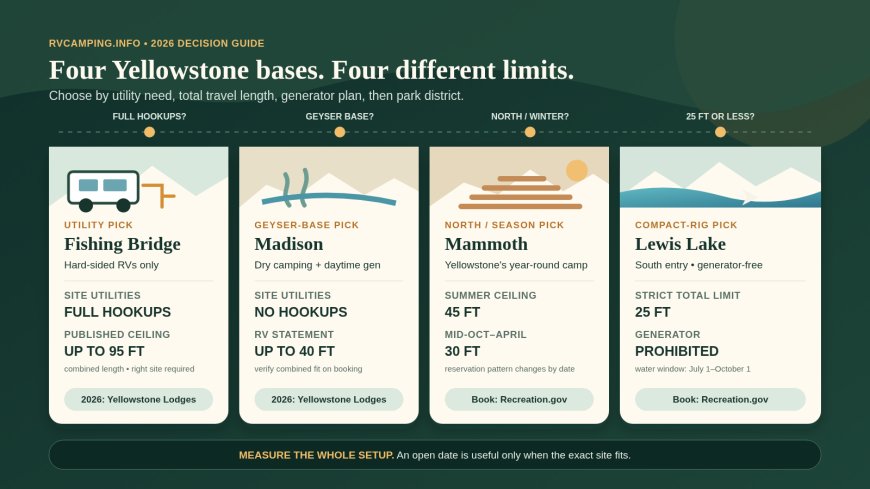
Yellowstone's best campground for an RV is the one that survives three tests: your complete travel length, your power plan, and the part of the park you intend to use most. Fishing Bridge is the clear choice when full hookups are non-negotiable. Madison is the broad dry-camping base for geyser-basin plans. Mammoth is the northern, year-round option. Lewis Lake works only for compact rigs that can live without a generator.
That short answer hides an important booking change. Fishing Bridge and Madison still take 2026 reservations through Yellowstone National Park Lodges, while their operator says 2027 reservations will move to Recreation.gov and open approximately six months ahead.[2][3] Mammoth and Lewis Lake are already booked through Recreation.gov.[1][4][5]
Start with the eliminators
Use these four questions in order. They remove unsuitable campgrounds faster than a list of scenic pros and cons.
- Do you need electricity, water, and sewer at the site? Fishing Bridge is Yellowstone's only campground with all three.[1] If the answer is yes, the comparison ends there.
- What is the length of the whole traveling setup? Lewis Lake strictly caps total vehicle length at 25 feet. Mammoth's NPS limit is 45 feet from May through mid-October and 30 feet from mid-October through April. Fishing Bridge can place combined setups up to 95 feet when the correct site size is available.[1][2][5]
- Can you camp without a generator? Lewis Lake prohibits generators.[5] Madison permits them at RV or combination sites from 8 a.m. to 8 p.m.; Mammoth prohibits them from 8 p.m. to 8 a.m.[3][4]
- Which entrance and park district reduce towing? Mammoth is five miles from the North Entrance, and Lewis Lake is twelve miles north of the South Entrance.[4][5] Madison's nearest services are fourteen miles away in West Yellowstone and sixteen miles away at Old Faithful.[3] Fishing Bridge sits in the lake district near the Yellowstone River's outlet.[2]
The four-campground comparison
| Decision factor | Fishing Bridge RV Park | Madison Campground | Mammoth Campground | Lewis Lake Campground |
|---|---|---|---|---|
| Best fit | Hard-sided RV that needs full hookups | Dry-camping RV focused on the geyser basins | Northern base or a stay outside the main summer season | Van or compact RV entering from the south |
| 2026 booking channel | Yellowstone National Park Lodges | Yellowstone National Park Lodges | Recreation.gov | Recreation.gov |
| Reservation pattern | Reservations for 2026 | Reservations for 2026 | Reservations required April 15-October 15; NPS lists first-come, first-served outside that span | Advance reservation required |
| Site utilities | Full electric, water, and sewer hookups | No electric, water, or sewer hookups at sites | No full hookups; potable-water spigots and flush toilets | No full hookups; potable-water spigots only during the published summer window, vault toilets |
| Published size boundary | Combined RV and other/towed vehicle up to 95 ft, subject to right-size-site availability | Operator says RVs up to 40 ft; NPS comparison table lists 60 ft for RV plus vehicle | 45 ft May to mid-October; 30 ft mid-October through April | 25 ft total vehicle length, strictly enforced |
| Generator rule | Allowed within campground rules; temporary power outages are possible | RV/combination sites only, 8 a.m.-8 p.m. | Off 8 p.m.-8 a.m. and when the renter is away | Prohibited |
| 2026 published base rate | $94 plus tax | $38 plus tax | $25 | $20 |
| 2026 published dates | NPS: May 8-Oct. 17 | NPS: May 1-Oct. 17 | Open year-round | June 15-Oct. 11 |
The dates, rates, site counts, amenity symbols, and maximum-length notes in the park-wide table were last updated February 25, 2026.[1] Rates and operating dates are not promises of inventory. Use the live booking record for the specific site and night.
Fishing Bridge: choose utilities, then verify the site class
Fishing Bridge has 310 hard-sided-RV-only sites and is the only campground in Yellowstone with full hookups.[1][2] The operator lists 30- or 50-amp electricity, water, and sewer at the sites, plus a dump station, coin laundry, and pay showers nearby.[2] Two showers per night are included in the rate.[2]
The 95-foot figure needs careful reading. It is a combined-length ceiling, not a promise that any open site can accept a 95-foot combination. The operator says rigs and tow vehicles up to that length can be accommodated only when the right-size site is available; the upper loop ranges from 40 to 95 feet, while lower-loop back-ins are 30 to 35 feet.[2] Enter the RV and every tow or towed vehicle when reserving, then read whether the assigned class expects side-by-side parking or a single-width pad.[2]
Fishing Bridge also has restrictions that make it unlike an ordinary commercial RV park. Tents and tent-style slideouts are not allowed. Open flames and portable fire pits are prohibited, although charcoal and propane grills are permitted. Only Loop E has picnic tables.[2]
Full hookups reduce tank and battery pressure, but they do not guarantee flawless utility service. The operator warns that heavy air-conditioner demand can cause temporary power outages and suggests bringing a generator for permitted hours.[2] Travelers whose medical equipment requires uninterrupted electricity still need an independent backup plan.
Choose Fishing Bridge when utilities or a long combination drive the decision. Skip it if you have a pop-up, hybrid with canvas sleeping ends, or ground-tent companion.
Madison: the flexible geyser-basin base, without hookups
Madison is a dry campground at 6,800 feet and a practical base for Old Faithful plus the park's three major geyser-basin districts.[3] It has flush toilets, nearby water, dishwashing stations in most restroom buildings, and a dump station. It does not have campsite hookups or onsite pay showers.[3]
The published capacity figures differ. NPS lists 276 sites in its comparison table, while the operator page says 278 individual sites plus three group sites.[1][3] That discrepancy should not affect a site-level reservation, but it is a reason not to use a campground-wide count as an availability forecast.
Rig fit deserves the same caution. Yellowstone National Park Lodges says its mix of back-in and pull-through layouts can take some RVs as long as 40 feet, while the NPS table displays a 60-foot RV-plus-vehicle maximum.[1][3] The operator also requires the combined length of the RV and any other or towed vehicle during booking and warns that sites may not be level.[3] Do not turn either campground-wide number into permission for a particular pad. The exact reservation must fit the RV, tow vehicle, slideouts, and parking arrangement.
Generator use is allowed only at RV or combination sites from 8 a.m. to 8 p.m., with a 60-decibel-at-50-feet limit.[3] Tent-only sites do not permit generators.[3] For a several-night stay, estimate furnace-fan, refrigerator-control, water-pump, device-charging, and inverter loads before choosing Madison over shore power.
Madison makes sense when the geyser basins set the itinerary and the RV can dry camp. Its operating season is also longer than most seasonal Yellowstone campgrounds.[1][3]
Mammoth: the northern and year-round option
Mammoth is the only Yellowstone campground listed as open year-round.[1] Recreation.gov places it five miles from the North Entrance near Gardiner and lists 82 sites, potable-water spigots, year-round flush toilets, and no showers.[4]
Its reservation status changes with the calendar. The current NPS table says reservations apply April 15 through October 15 and the rest of the year is first-come, first-served.[1] Recreation.gov currently describes Mammoth as open and requiring a reservation.[4] For a September trip, reserve. For an October-through-April trip, check both the NPS page and Recreation.gov before arrival rather than assuming the shoulder date from an old trip still applies.
Winter access is not access to the entire Grand Loop. NPS says regular traffic can typically use only the road between Mammoth and the Northeast Entrance year-round, if weather allows; the route closes east of Cooke City in winter.[6] Mammoth can be a winter campground without being a winter base for driving to Old Faithful, Yellowstone Lake, or the park's south and west entrances.
The rig ceiling also tightens seasonally: 45 feet from May through mid-October, then 30 feet from mid-October through April.[1] That seasonal reduction should be an early filter for long motorhomes and trailers. Mammoth permits generator use during the day but requires shutdown from 8 p.m. to 8 a.m. and whenever the renter is away from the site.[4]
Choose Mammoth for the North Entrance, Mammoth Hot Springs, or a date when the summer-only campgrounds are unavailable. Do not choose it merely because "year-round" appears to solve a winter road plan.
Lewis Lake: compact, quiet, and strict
Lewis Lake is the narrowest fit in this group. Recreation.gov says the campground is twelve miles north of the South Entrance and enforces a 25-foot total vehicle-length limit.[5] That wording counts the whole vehicle arrangement, not only the trailer box. A compact Class B may fit; a 25-foot trailer behind a tow vehicle does not.
The campground has 84 sites, vault toilets, food lockers, trash and recycling collection, and a boat launch.[5] Recreation.gov says it has no cell reception or showers. It prohibits generators.[5] Those facts make Lewis Lake a poor fallback for an RV that missed a hookup reservation but still depends on daily generator charging.
Water is unusually date-sensitive. The listing publishes potable-water spigots from July 1 through October 1, then separately warns that water will be unavailable after October 1 and may shut down earlier because of weather.[5] Lewis Lake opens June 15 in the 2026 NPS table, so an early-season reservation can predate the listed water service.[1][5] Carry the full potable-water requirement when your stay falls outside the service window, and keep a reserve even within it.
Choose Lewis Lake for a genuinely compact, generator-independent setup approaching from the South Entrance. The hard size limit and seasonal water window are screening rules, not minor inconveniences.
A booking sequence that avoids false choices
- Write down the RV length, tow vehicle length, total connected length, height, width, slideout needs, and whether a tent-style section is part of the sleeping space.
- Eliminate Lewis Lake above 25 feet total. Apply Mammoth's 30- or 45-foot seasonal ceiling. For Madison, reconcile the operator's 40-foot RV statement with the NPS 60-foot combined figure by checking the exact bookable category.[1][3][5]
- If full hookups are required, search Fishing Bridge and match the site class to the whole combination.[1][2]
- If dry camping works, choose the park district before price. Madison reduces repeated towing for geyser-basin plans.[3] Mammoth fits northern plans, while Lewis Lake fits a south-entry itinerary.[4][5]
- Use the correct reservation system. For 2026 Fishing Bridge and Madison stays, book with Yellowstone National Park Lodges. For 2027, follow the announced move to Recreation.gov and its approximately six-month window.[2][3] Mammoth and Lewis Lake remain Recreation.gov searches.[4][5]
- Recheck the official campground page, live reservation, Yellowstone current conditions, and road status shortly before departure.[6] Download confirmations and rules before entering areas with limited service.[2][3][5]
If two options still fit
Use resource margin as the tiebreaker. Fishing Bridge buys electrical and tank capacity. Madison trades those utilities for a geyser-basin base and daytime generator access. Mammoth trades centrality for northern access and a year-round operating pattern. Lewis Lake trades generator use, water certainty, and rig length for a compact south-side base.
Do not score scenery, shade, quiet, wildlife sightings, cell performance, or site levelness as guaranteed differences. Official pages describe general settings, but they do not verify what a specific site will deliver on a specific night. The reservation's dimensions and rules are hard evidence; a campground reputation is not.
Source credit: RVCamping.info compared current National Park Service, Recreation.gov, and Yellowstone National Park Lodges pages retrieved September 9, 2026. The constraint-first decision framework, eliminator sequence, and RV resource analysis are original editorial work.
Sources
What's Your Reaction?