





RV awning wind inspection: a stop, stow or use checklist
Inspect the exact RV awning, check weather and supervision, run one calm test cycle, and verify that the final stow is secure without relying on a universal wind number.

By Romana
RV awning wind inspection: a stop, stow or use checklist
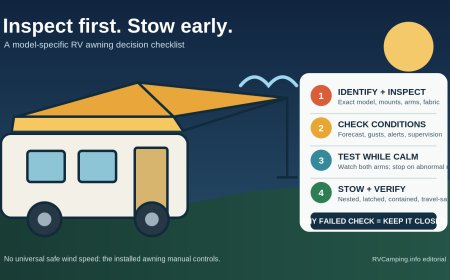
An awning decision starts before anyone presses the switch or pulls the strap. Check the hardware, fabric, surroundings, forecast and your ability to close it. If any one of those checks fails, keep the awning stowed.
This is the inspection companion to RVCamping.info's storm and wind stowing guide. The earlier guide covers weather timing. This one answers a different question: what should you inspect, and what should stop the awning from being used even on a pleasant afternoon?
The 30-second decision
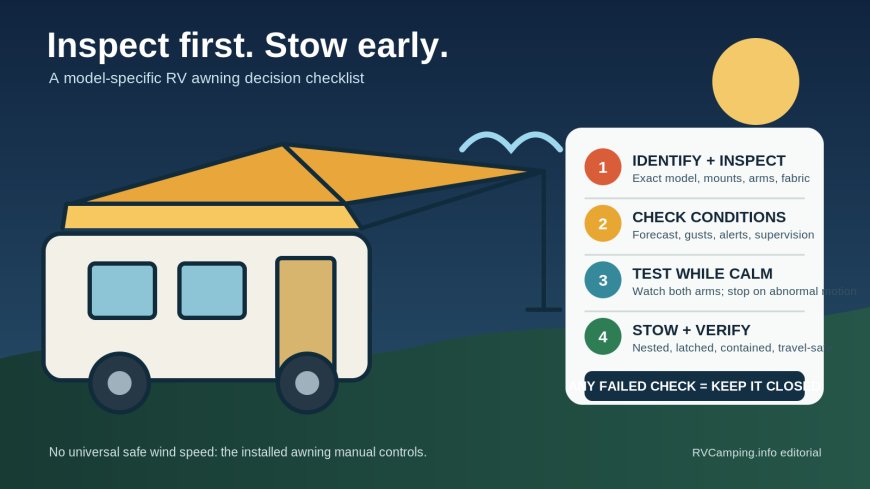
Use the awning only when all four statements are true:
- The installed model is identified and its instructions are available. The RV brochure is not enough if the coach could have been built with more than one awning option.
- The ground-level inspection finds no damage, uneven fit, sagging, loose part or abnormal movement. Dometic's 9100 manual says to examine the product frequently for imbalance, wear and damage to critical parts, and not to use it when adjustment or repair is needed.[2]
- Conditions fit the exact manual and the awning can be closed before they worsen. Neither Dometic nor Carefree supplies a universal number for every awning. Their cited manuals instead direct owners to stow for wind and severe weather or expected wind and extended rain.[2][3]
- A responsible adult will remain able to monitor and close it. Dometic says never to leave its 9100 open unattended; Carefree recommends retracting the Travel'R when the occupants will be away from the RV.[2][3]
A "no" means stow. Damage, binding, a failed lock, a loose mount or an abnormal closing path means stow and arrange service. A warning already in effect, strong gusts underway or flying debris means leave the exterior work and shelter people.
Step 1: identify the awning before inspecting it
Photograph the data label and record the manufacturer, model, serial number and any controller or wind-sensor model. Check the RV owner's packet and the manufacturer's current document library. Keep the correct operating and emergency-close instructions offline.
Model identity matters because the mechanisms differ. The cited Carefree Travel'R uses a worm-gear motor and says it does not need travel locks. The Dometic 9100 manual includes a motorhome ignition-interlock test and a model-specific manual-closing procedure.[2][3] A latch, emergency terminal or override method shown in a different manual may not exist on your awning.
Do not release springs, remove arm hardware or improvise an override from a generic video. Dometic directs owners to a qualified technician when malfunctions cannot be corrected through its operating instructions.[2]
Step 2: inspect it while closed
Stay on the ground unless the RV and awning maker provide a safe access procedure. Do not climb on a wet roof or lean a ladder against the awning assembly.
Walk from one end to the other and look for:
- an arm that sits proud of the RV, a head cover out of place or two sides that do not nest evenly;
- loose, missing or backed-out fasteners that can be seen without disassembly;
- cracked brackets, bent channels, damaged wiring or sealant gaps at wall mounts;
- fabric protruding from the roll, a crooked roll or a protective wrap that no longer closes evenly;
- evidence of impact, rubbing, water staining or movement at the wall;
- accessories, lights, straps or clips that could snag during extension.
Carefree tells Travel'R owners to check fasteners periodically and keep the arms clean. Dometic's travel check calls for looking for loose parts and any sign of instability.[2][3] If a fastener is loose, use only the torque, sealant and repair method specified for the installation. Tightening an unknown wall fastener by feel can strip a backing point or hide a mounting problem.
Stop here if the assembly is bent, pulling from the wall, partly open or visibly unstable. Keep people out of the swing and drop area. Do not cycle a damaged awning to see whether it fixes itself.
Step 3: check the use zone and weather
Before extending, move chairs, grills, bicycles and people outside the path of the arms and roller. Check the door, slide room and nearby branches for conflicts. Dometic specifies clearance from permanent objects for its 9100 and warns against door contact with the fabric.[2] Use the clearance in your own manual rather than copying that model's dimension.
Open the National Weather Service point forecast for the campground and inspect the hourly wind and gust forecast plus active alerts. A High Wind Watch means strong wind is possible and outdoor items should be secured; a Wind Advisory means strong wind is occurring; a High Wind Warning calls for shelter.[1] Those alert descriptions are preparation signals, not awning ratings.
Use this decision order:
- If the exact manual gives an operating limit or sensor setting, follow it. Do not borrow a number from another product.
- If the manual says to close for expected wind or severe weather, close before those conditions arrive.[2][3]
- If a watch gives you a calm preparation window, stow the awning and loose campsite gear then.
- If hazardous wind is already occurring, do not stand outside wrestling with hardware. Follow local shelter instructions.
A wind sensor does not change the inspection result. If the fabric is torn, the arms bind or the mount is loose, automatic retraction is not a repair. It also does not justify leaving camp with the awning open unless the exact manual explicitly says so.
Step 4: make one calm test cycle
If the closed inspection and weather check pass, extend the awning while watching both arms. Keep hands away from joints and pinch points. Stop the control if one side hesitates, the fabric tracks sideways, an arm jerks, the roller reverses direction, a mount moves against the wall or the motor makes a new grinding sound.
Once open, inspect from below without loading the fabric or arms:
- fabric centered on the roller and rail, with no fresh tears, loose seams or deep pocket;
- arms aligned, joints seated and pitch hardware behaving as the manual describes;
- no water, leaves or heavy debris on top;
- no door edge, branch or slide topper touching the fabric;
- no unexplained sag, rattle or movement at a wall bracket.
Light-rain pitch is not permission to remain open for a storm. Dometic says the 9100's water-shed position is for light rain and calls for stowing when heavy rain or snow is expected. Carefree warns that wind and rain effects are unpredictable and says to roll up the Travel'R for expected wind or extended rain.[2][3]
Run only the test needed to observe normal travel. Repeated cycling can trigger a motor's thermal protection; the cited Carefree manual describes that behavior for the Travel'R.[3] If operation is not normal, close it while conditions are calm and schedule service.
Step 5: stow, then prove it is secure
Clear the area and remove only accessories that your manual permits. Watch both arms as the awning closes. Do not put fingers between nested channels. Stop if fabric bunches, an arm meets an obstruction or the assembly twists.
After the motor stops or the manual awning is rolled up, walk outside again:
- Confirm both arms are fully nested and the fabric is contained.
- Engage the installed travel locks, latches or power isolation exactly as the manual requires. Some models use them; others do not.
- Look for loose parts, instability, a head cover out of place or a fabric edge protruding.
- For a motorhome, complete any ignition-interlock test required by its manual. Dometic says a 9100 that responds to its switch with the ignition on must be disabled and serviced before travel.[2]
- If the awning was closed wet to escape weather, reopen it to dry as soon as safe conditions return. Both manufacturer manuals address drying before long-term stowage.[2][3]
"The switch stopped" is not the same as "secure for travel." Dometic expressly tells owners to verify travel security and look for loose parts or instability.[2]
Stop-use conditions to put on the setup card
Write these five red flags beside the awning control:
- model or manual cannot be confirmed;
- bracket, arm, fastener, fabric, wiring or wall attachment appears damaged or loose;
- motion is uneven, binding, noisy or different from the last normal cycle;
- forecast, alert or current conditions call for stowing under the exact manual;
- nobody will remain present and able to close it safely.
The card should also list the correct fuse, the manual-close tool or approved auxiliary-power method, and the service contact. Those details must come from the installed awning's documents. A campsite is a poor place to discover that the saved instructions belong to another motor head.
The practical rule is simple: inspect closed, test only in calm conditions, and verify the final stow from outside. Do not search for one mph number that can overrule damage, a bad forecast, an unattended site or a model-specific warning.
Sources
What's Your Reaction?