









Snow chains for an RV: plan the device, axle and stop before the pass
A state-by-state planning method for matching an RV's weight, drivetrain, trailer brakes and tire positions to current snow-chain controls.

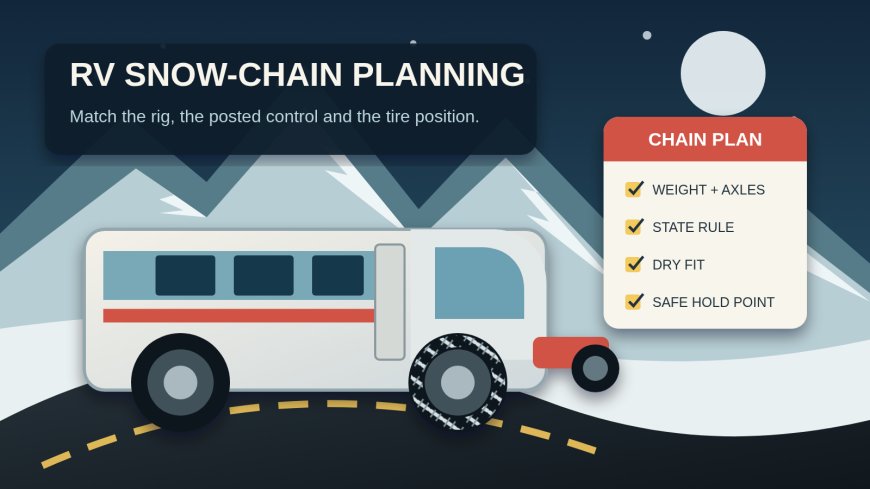

Snow chains for an RV: plan the device, axle and stop before the pass
By Romana Category: Tips and Trends
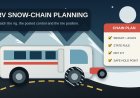
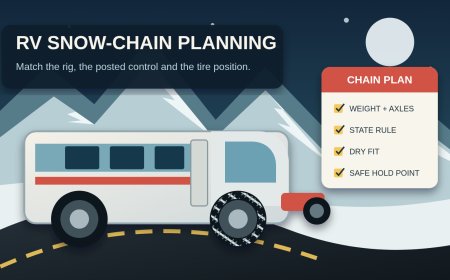
A chain-control sign is a bad place to discover that the new cables do not clear a brake hose, that the motorhome falls into a heavier weight class, or that the trailer needs its own chains. Build the plan at home: identify the exact RV configuration, read the current rule for every state on the route, test-fit the approved device, and choose a safe hold point before the grade.
There is no useful one-line "U.S. snow-chain law." California, Oregon, Washington and Colorado use different thresholds, definitions and sign language. The posted control and an officer's direction can also be more restrictive than the general summary. Treat every state border and every change in the connected rig as a fresh check.
Start with the configuration, not the product listing
Write a configuration card for each way the rig will travel. A motorhome by itself, a motorhome towing a car, and that detached car are three different cases. A pickup alone and the same pickup hitched to a travel trailer may also land in different chain instructions.
Record:
- tow vehicle or motorhome year, make, model and drivetrain;
- GVWR from each vehicle's certification label, plus the combined vehicle-and-trailer figure when a state uses it;
- actual loaded axle weights from a recent scale ticket;
- tire size exactly as molded on every relevant sidewall;
- single or dual rear wheels, number of drive axles, and which wheels receive power;
- whether the trailer or towed vehicle has brakes;
- tire markings and measured tread depth;
- the owner's-manual instructions for chains or traction devices; and
- clearance around the tire at full steering lock and near brake lines, suspension parts, fenders and wiring.
Do not substitute curb weight for a posted GVW or GVWR threshold. Washington's mountain-pass guidance, for example, separates vehicles below and above 10,000 pounds GVW/GVWR, and tells a vehicle-and-trailer combination above 10,000 pounds to consult the commercial-vehicle placement rules even when the rig is not commercial.[4] Oregon's placement page has a distinct medium-duty category for vehicles over 10,000 and under 26,001 pounds, explicitly including RVs.[3]
Those examples are not interchangeable. They show why the number and its definition must come from the state page you are using.
Read the route state by state
Use the examples below as a planning map, then open the linked agency page immediately before travel. They are not a 50-state legal summary.
California: control level and towing status both matter
Caltrans describes three chain-control levels. At R-1, its published rule requires all vehicles towing trailers to chain one drive axle, and at least one axle of a braked trailer must be chained. At R-2, the stated exception covers four-wheel- or all-wheel-drive vehicles only when snow-tread tires are fitted at all four corners, but those vehicles must carry traction devices in the control area. R-3 requires chains or traction devices on every vehicle without exceptions.[5]
Caltrans also says local areas may vary the designations and that drivers must follow posted signs or Caltrans and California Highway Patrol instructions even when they differ from a broadcast report.[5] For an RV traveler, the practical reading order is: current control level, towing status, vehicle weight and drivetrain, then the instructions at the checkpoint.
Oregon: towing can remove the traction-tire substitute
Oregon allows traction tires in place of chains in typical winter conditions only for vehicles rated at 10,000 pounds GVW or less that are not towing or being towed.[2] Its chain-law page says a vehicle at or below that threshold must use chains when towing, and the trailer or towed vehicle must be equipped as described in the state's minimum-placement rules.[2]
For light-duty towing, Oregon's placement page calls for the primary powered axle to receive a chain on a tire at both the left and right, with the same left-right treatment on one axle of a braked trailer.[3] It gives separate placement for medium-duty RVs over 10,000 and under 26,001 pounds.[3] Oregon may also impose a conditional closure with instructions that are stricter than the usual categories, so the live sign still controls.[2]
Washington: an RV may cross a weight-based line
Washington requires a vehicle over 10,000 pounds GVW to carry at least two chains or one set over a mountain pass from November 1 through March 31, whether or not a chain-up requirement is posted.[4] Under a "traction tires required" posting, the state says vehicles over 10,000 pounds GVW/GVWR need chains or an approved alternative. Under "tire chains required," that weight class needs chains or an approved alternative even with four-wheel or all-wheel drive.[4]
Washington's page sends noncommercial RVs and trailers under 10,000 pounds to the regular chain rules. It sends combinations over 10,000 pounds to the commercial-vehicle placement instructions because the threshold is based on weight rather than business use.[4] Check which weight the linked instructions use; do not decide from the word "commercial" alone.
Colorado: distinguish traction law from chain law
Colorado's passenger-vehicle traction law and passenger-vehicle chain law are separate stages. Under the current CDOT summary, a traction-law vehicle must meet one of the listed tire-and-drivetrain combinations with at least 3/16-inch tread, or use chains or an approved alternative traction device.[1] During the more restrictive passenger-vehicle chain law, CDOT says all vehicles need chains or a qualifying alternative device.[1]
That passenger page is not the place to resolve a heavy RV's classification. If the rig could fall under a weight-based or commercial rule, use the configuration card and follow CDOT's linked heavy-vehicle guidance or ask the agency before departure. Avoid assuming that a privately used motorhome is covered by whichever page has the friendlier wording.
Choose a device that is both legal and compatible
"Fits the tire size" is only the first test. The device must meet the state's definition or approved-device list, comply with the chassis and tire instructions, clear the wheel well, and cover the required number and location of tires.
Washington says a chain alternative must appear on the Washington State Patrol approved list to satisfy its chain requirement.[4] California advises owners to check the vehicle manufacturer's specifications and notes that it does not recommend brands.[5] Oregon defines chains broadly enough to include link chains, cable chains and other devices designed to increase traction, but its placement and live restrictions still determine how many are needed and where they go.[2][3]
Before buying, ask the manufacturer or supplier for all of the following in writing:
- the exact tire-size fitment;
- the device's required inside and outside clearance;
- compatibility with dual wheels, if present;
- the maximum installation and travel speed;
- whether the device is approved in each state on the route; and
- whether one package contains enough devices for the tow vehicle, motorhome, trailer or toad under the most demanding planned state rule.
An owner's manual that says conventional chains are not recommended does not create a roadside exemption. Washington explicitly says drivers still must follow its traction and chain laws and points owners of vehicles that cannot use chains to approved alternatives.[4] If no legal, manufacturer-compatible device can be confirmed, the workable plan is to avoid chain conditions, change vehicles, or hold before the control area.
Practice on the actual loaded rig
Test-fit every set in a dry, level place. Lay out the parts in installation order. Confirm that the labeled inside connection really can be reached behind the tire and that the tensioner does not contact a valve stem. Turn steering tires from lock to lock. On duals, inspect both the inner and outer gaps. Follow the device instructions for tightening and any required stop-and-retighten interval.
Do not crawl under an RV supported only by leveling jacks. Do not practice at the edge of a live road. If installation requires a posture or reach the traveler cannot safely manage, arrange a different device or a different winter route before leaving.
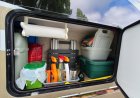
Pack each axle set in a separate waterproof bag marked in large type: MOTORHOME DRIVE, TRAILER BRAKE AXLE, TOW CAR FRONT, or the labels that match the configuration. Add waterproof gloves, insulated work gloves, a kneeling pad, headlamp, reflective vest, wheel chocks, a small tarp and the manufacturer's instructions. Keep the gear accessible without unloading the campsite bins onto the shoulder.
Photograph the completed dry fit from both sides. The photo is a reminder, not proof of legal compliance, but it is much better than trying to remember the connector path in blowing snow.
Plan the chain-up stop and the turn-back point
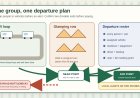
Mark three places on the route:
- the last large parking area where the rig can wait without blocking traffic;
- the official chain-up area; and
- the last safe place to turn around before traffic funnels into the control.
A passenger-car turnout may not provide enough length or a safe merge for a motorhome and toad. Check the satellite view only as orientation; confirm current access and restrictions through the state travel system. Save the highway number, pass name, mileposts, phone number and live-condition page offline.
Caltrans tells drivers to pull completely off the roadway before installing chains and to continue beyond the "End of Chain Control" sign to a safe pull-off before removal.[5] That is sound stop planning, but do not assume another state uses the same signs or removal point.
Set a personal hold rule before the trip. Examples include an unplowed campground road, no verified chain-up space for the combination, an unavailable approved device, a forecast that would put the rig at the pass after dark, or a driver's decision that conditions exceed their experience. Compliance with a chain sign is permission to proceed, not evidence that proceeding is wise.
The RV snow-chain departure checklist
One week before the route
- List every state and mountain pass on the primary and alternate routes.
- Make a configuration card for the motorhome or tow vehicle, every trailer, and the toad.
- Photograph certification labels and record GVWR, drivetrain, tire sizes, axles and trailer brakes.
- Read the owner's manuals for chain location, clearance limits and prohibited device types.
- Open each state DOT's current chain page; save the link and note the state's exact weight terms.
- Verify that each traction device is accepted for that state and exact tire size.
- Count devices by required tire position, not by boxes.
- Dry-fit every set and inspect for contact at steering lock and around dual wheels.
- Replace worn, corroded, tangled or incomplete parts.
- Identify a lower-elevation route and a place to wait.
The evening before departure
- Check the official state travel map, pass report, forecast and posted control language.
- Recheck the campground or forest access road separately from the highway.
- Put chain bags where they can be reached with slides in and the toad attached.
- Charge lights and phones; save screenshots and agency phone numbers offline.
- Confirm fuel, propane policy for any tunnels, washer fluid, tire pressures and battery condition.
- Tell passengers what they should do during installation and where they must stand.
At the last safe stop
- Read the live sign; do not rely on last night's screenshot.
- Match its wording to the correct state, weight class and connected configuration.
- Engage the required drivetrain mode before the control area if the manufacturer instructs it.
- Install only in a designated or fully protected area, never in a travel lane.
- Follow the device instructions, check clearances, and secure loose ends.
- Observe the posted and device speed limits.
- Stop where safe to inspect and retighten if the device maker requires it.
- Remove devices only after the control ends and a safe pull-off is available.
- If the rule, fit or stopping place is unclear, hold and contact the road agency.
Keep the decision narrow
The planning question is not "Are chains required in this state?" Ask: "For this connected RV, at this weight, on this pass, under the control posted now, which approved devices go on which tires?"
That sentence forces the useful checks. It also leaves room for the safest answer: wait below the snow line.
Sources
- [1] Colorado Department of Transportation: Passenger Vehicle Traction and Chain Laws (accessed September 16, 2026).
- [2] Oregon Department of Transportation TripCheck: Oregon Chain Law (accessed September 16, 2026).
- [3] Oregon Department of Transportation TripCheck: Minimum Chain Requirements (accessed September 16, 2026).
- [4] Washington State Department of Transportation: Tires and chains (accessed September 16, 2026).
- [5] California Department of Transportation: Chain Controls / Chain Installation (accessed September 16, 2026).
What's Your Reaction?