


Boil-water advisory in an RV kitchen: protect the tank, lines, and ice
An RV kitchen response plan for a campground boil-water advisory, including safe-water uses, fresh-tank exposure, plumbing lines, filters, ice, and recovery.
Boil-water advisory in an RV kitchen: protect the tank, lines, and ice
By Romana
Category: Cooking
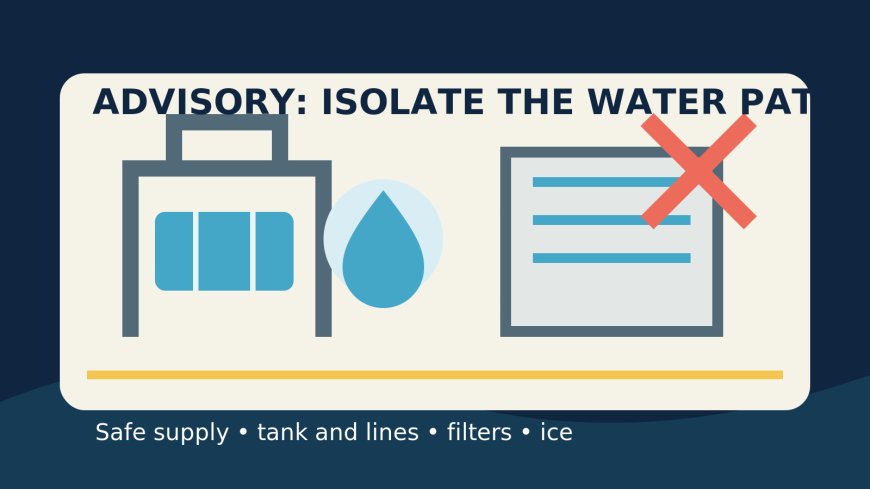
When a campground posts a boil-water advisory, stop treating every RV faucet as a drinking-water source. Use commercially bottled water or water prepared exactly as the notice directs for drinking and food work. Isolate the campground connection, identify what entered the fresh tank and plumbing, retire suspect ice, and wait for the issuing authority's all-clear and recovery instructions.
The notice itself controls. A boil-water advisory, a do-not-drink advisory, and a do-not-use advisory are different. CDC says boiling addresses germs, while water affected by chemicals or toxins may remain unsafe after boiling.[1] If the campground office paraphrases the notice, ask for the issuing utility or health department's exact text, affected area, start time, permitted uses, and update channel.
First, classify the notice
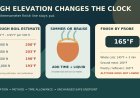
A boil-water advisory generally means commercially bottled water or properly boiled tap water can be used for consumption. CDC's general method is a full rolling boil for one minute, or three minutes above 6,500 feet, followed by cooling before use.[1] Some issuing authorities specify a different duration. Follow the notice that applies to the campground.
A do-not-drink advisory usually calls for bottled water for drinking and cooking because chemicals or toxins may be involved. A do-not-use advisory can prohibit any contact with tap water.[1] Do not upgrade either one into a home boil-water project. Boiling cannot remove most chemicals and can concentrate some contaminants as water evaporates.[1][4]
Take a photo or screenshot of the notice. Record when you learned of it and when your RV connected to the supply. Those times help determine whether the fresh tank, hose, filter, water heater, refrigerator line, or ice maker may contain affected water.
Stop adding campground water
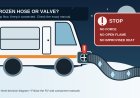
If the rig is on city water, turn off the campground spigot and disconnect the potable-water hose after relieving pressure according to the RV's instructions. Cap or bag the hose ends so they do not drip onto the food-work area. This is a containment step, not proof that the RV plumbing is clean.
If the fresh tank was filled from the campground during the affected period, label the tank DO NOT DRINK - ADVISORY and switch to bottled water for the uses named in the notice. If the fill happened before the advisory's stated contamination window, do not declare it safe yourself. Ask the issuing authority whether stored water filled at that time can be used.
Turning on the pump moves tank water into more lines and fixtures. Avoid pumping suspect water merely to see how it looks or smells. Clear water can still carry germs.
CDC's RV water guidance says to confirm campground water is safe before connecting and to fill tanks only from a safe drinking-water source.[3] It also tells owners to follow their RV maker's directions for draining, disinfecting, and flushing the water system, including the storage tank.[3]
Make a safe-water station for the kitchen
Set commercially bottled water on one side of the galley and suspect-water containers on the other, if the notice allows any use of suspect water. A strip of tape across the RV faucet is a useful physical reminder.
Use the safe supply specified by the notice for:
- drinking and filling reusable bottles;
- cooking, including pasta water, rice, soup, and coffee;
- rinsing produce and making beverages;
- brushing teeth;
- mixing infant formula when the notice allows prepared water rather than requiring another product;
- pet water; and
- any ice that might touch food or drinks.[1][2]
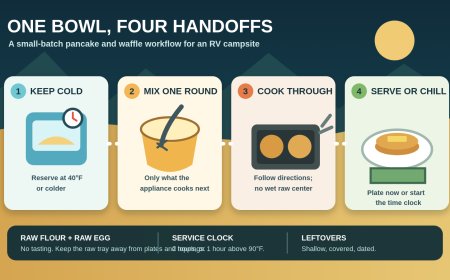
Remember the quiet uses. Water added to pancake batter, a wet cloth used on a cutting board, and a quick rinse of a tasting spoon all enter the food workflow.
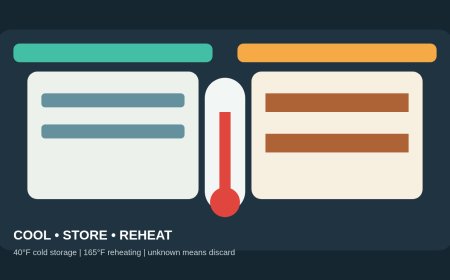
If boiling is allowed, use a stable burner with ventilation and clearance required by the RV and appliance manuals. Bring the water to the boil specified in the notice, cool it in a clean, covered container, and label it with the preparation time. Avoid carrying an open pot of boiling water through the RV.
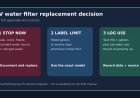
Filters are not a substitute for the advisory. CDC directs people to boil tap water during a boil advisory even after it passes through a home filter.[1][2] CDC's RV fact sheet adds that many taste-improving filters do not remove germs.[3]
Ice is food, not a cooling accessory
Stop the RV refrigerator ice maker and water dispenser if they are supplied by the affected campground line. CDC advises against using water or ice from appliances connected to a water line during drinking-water advisories.[1][2]
Discard ice made from affected water, plus ice made during any look-back period stated by the authority. Empty the bin rather than adding commercial ice on top. A cube can melt into a drink, a cooler, or a bowl of food.
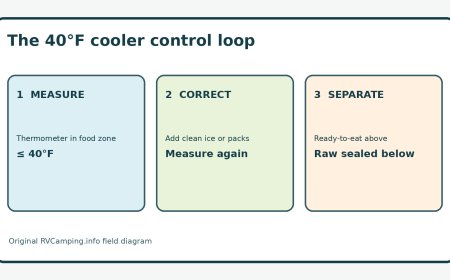
Use sealed, commercially manufactured ice when permitted by the notice. Keep food in watertight containers so cooler meltwater does not enter packages. Do not assume freezing killed the organisms that triggered the advisory.
The ice maker's recovery is a separate job. After the authority lifts the notice, follow its flushing or disposal instructions and the refrigerator or ice-maker manual before returning the unit to service. Do not invent a number of dump cycles.
Dishwashing in a small RV galley
The local notice decides whether unboiled tap water may be used for dishwashing. CDC suggests disposable plates, cups, and utensils when possible during a boil advisory.[1][2] That option also protects scarce safe water and keeps the gray tank from filling quickly.
Where the issuing authority permits handwashing dishes with tap water, CDC's general household guidance says to wash and rinse normally, then soak items for at least one minute in a separate basin containing one teaspoon of unscented household liquid bleach per gallon of warm water; let them air-dry completely.[2] Measure rather than pour by eye, keep bleach away from children, never mix it with other cleaners, and use only when this method fits the product label and the current notice.
Do not assume an RV dishwasher reaches CDC's general threshold. CDC says a household dishwasher is generally safe during a boil advisory when the final rinse reaches at least 150°F or the machine has a sanitizing cycle.[2] Check the exact appliance manual and the notice before using it.
For handwashing, CDC says tap water and soap are often allowed during a boil-water advisory, but the local authority may say otherwise.[1] Keep boiled or bottled water at the sink if the notice requires it, especially for anyone likely to swallow water.
What the tank and lines mean during the advisory
An RV system is not one container. Water can remain in the hose, inlet, filter housing, pump, accumulator, cold lines, water heater, exterior shower, refrigerator supply, and fresh tank. Exposure depends on how the rig was configured when affected water arrived.
Make an inventory instead of choosing a universal treatment:
| Component | Question to record | During the advisory |
|---|---|---|
| City-water hose and inlet | Were they connected in the affected period? | Isolate and label pending authority and manual instructions. |
| Fresh tank | Was it filled or topped off from the affected source? | Do not use for consumption unless the authority says it is safe. |
| Pump and fixtures | Was the pump run after a suspect fill? | Assume downstream lines may have received that water. |
| Water heater | Was affected water drawn into it? | Do not drain, heat, or bypass it contrary to the RV manual. |
| Filter or softener | What does its label remove, and was it exposed? | A taste/odor filter does not clear a boil notice. |
| Refrigerator line and ice maker | Did they receive campground water? | Stop service and discard affected ice. |
This record gives the issuing authority, RV maker, appliance maker, dealer, or qualified technician something concrete to work with.
After the all-clear: advisory recovery is not automatic sanitization
Wait for the authority that issued the notice to lift it. A campground social post, a neighbor's clear water, or a missing sign is not the same as an official rescission. Read the all-clear for fixture flushing, filter replacement, ice disposal, or other site-specific directions.
Then use the manual for the exact RV and installed equipment. CDC tells RV owners to follow the RV maker's instructions for draining, disinfecting, and flushing.[3] A 2026 Winnebago Solis manual, for example, has a model-specific water-panel configuration, water-heater steps, concentrations, contact times, and faucet sequence.[5] Those Solis instructions are evidence that details matter, not a recipe for every motorhome or trailer.
Do not pour bleach into a tank during the advisory and call the problem solved. Boiling or emergency treatment prepares batches of water for permitted uses; RV-system disinfection treats tank and plumbing surfaces. The issuing authority decides when the source is acceptable again. The RV and component manuals govern what to do with the rig afterward.
Before restoring drinking service, close the loop:
- Confirm the official advisory is lifted for the campground's exact water system.
- Carry out the authority's recovery directions.
- Follow the exact RV, filter, water-heater, refrigerator, and ice-maker instructions for exposed components.
- Refill only from a source confirmed safe.
- Remove faucet warning tape only after the planned recovery is complete.
That sequence avoids two dangerous shortcuts: drinking because the water looks normal, and applying a generic bleach recipe to a plumbing system it was never written for.
Sources
- Drinking Water Advisories: An Overview | CDC — live page content archived September 3, 2026.
- Preventing Crypto at Home During a Boil Water Advisory | CDC — live page content archived August 6, 2026.
- Safe RV Water from Tank to Tap | CDC — PDF archived July 26, 2026.
- Emergency Disinfection of Drinking Water | U.S. EPA — accessed September 10, 2026.
- 2026 Winnebago Solis Operator Manual | Winnebago Industries — accessed September 10, 2026; model-specific example, not universal RV instructions.
What's Your Reaction?