


At high-elevation camp, add time, not a new doneness temperature
Use campsite elevation to budget extra simmering time and liquid while keeping federal safe internal temperatures unchanged.
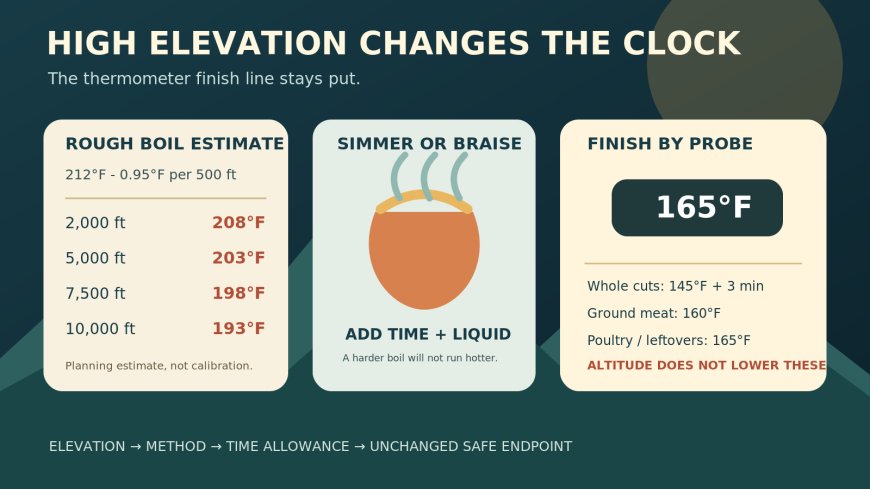
At high-elevation camp, add time, not a new doneness temperature
By Romana | Information checked 2026-10-26 UTC | Cooking
Water can be at a full rolling boil and still be cooler than you expect. At 7,500 feet, USDA says it boils at about 198°F rather than 212°F. That changes how quickly a pot cooks. It does not lower the safe internal temperature for the chicken, burger or casserole inside it.[1][2]
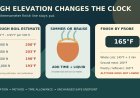
The boiling point moves with elevation. The food-safety finish line does not. Original RVCamping.info calculation card.
A common campsite mistake is to answer a slow pot with a harder boil. Once water has reached its local boiling point, more burner output makes it evaporate faster; it does not make the liquid hotter. USDA recommends more cooking time for boiling and simmering at elevation, along with a lid to retain moisture.[1]
Put the campsite elevation on the recipe card
USDA says water's boiling point falls by just under 1°F for every 500 feet of elevation. The agency gives two useful checks: 208°F at 2,000 feet and about 198°F at 7,500 feet.[1]
For trip planning, RVCamping.info used 0.95°F per 500 feet, a deliberately rough interpretation of "just under 1°F":
estimated boiling point = 212°F - (elevation in feet / 500 × 0.95°F)
That produces this pocket card:
- Sea level: about 212°F
- 2,000 feet: about 208°F
- 3,000 feet: about 206°F
- 5,000 feet: about 203°F
- 7,500 feet: about 198°F
- 10,000 feet: about 193°F
This is a planning estimate, not a calibration standard. Weather changes atmospheric pressure, and the USDA rule itself is approximate. Its useful message is the gap: a simmer at 7,500 feet transfers heat at roughly 14°F below a sea-level boil.
Write the campground elevation next to any meal that depends on simmering, braising, hard-cooking eggs, pasta or rice. If the booking page does not list it, get the elevation from an official park or land-manager page before the trip. The calculation tells you to protect extra time and liquid. It cannot predict an exact finish time for a particular pot, burner, windscreen, lid or portion.
Use the 25% figure as a schedule allowance, not a recipe command
For meat and poultry cooked with moist heat, USDA says cooking at 5,000 feet may take up to one-fourth longer, depending on the food's size and density.[1] A sea-level braise estimated at 60 minutes therefore deserves a 75-minute schedule slot:
60 minutes × 1.25 = 75 minutes
That extra 15 minutes is a planning reserve. It is not permission to stop at 75 minutes, and it is not a universal multiplier for every elevation or cooking method. USDA says sea-level oven time and temperature guidance still applies when oven-roasting meat and poultry because oven temperatures are not changed by altitude.[1]
The practical camp workflow is simple. Start earlier. Carry enough fuel to cover the longer run. Keep the lid on unless the recipe requires attention, and hold back some potable water or cooking liquid for evaporation. If dinner has a hard deadline, choose a meal with small, uniform pieces rather than one dense roast in a pot.
The thermometer keeps its sea-level numbers
Altitude changes the path to doneness, not the federal safe minimums. FoodSafety.gov lists 145°F plus a three-minute rest for steaks, roasts and chops of beef, pork, veal, goat and lamb; 160°F for ground meat and sausage; and 165°F for poultry, casseroles and leftovers.[2]
Measure the center or thickest part, avoiding bone and fat. For a thin burger or chicken breast, USDA advises inserting an instant-read probe from the side so the sensing area reaches the center. Irregular foods need checks in more than one place.[1]
This distinction prevents two opposite failures. Pulling food when the clock expires can leave it undercooked. Leaving it on until a sea-level texture appears can dry it out. The clock is for planning and the probe is for the finish.
A pot of chicken stew at 7,500 feet illustrates the handoff. The rough card estimates a 198°F boil. That explains why potatoes and meat may soften more slowly. It does not mean chicken may be served below 165°F. Check several large pieces in the center before service, using the same endpoint shown on the federal chart.[1][2]
Appliances need their own altitude branch
Slow cookers deserve more caution because water and steam carry heat through the food. USDA says to thaw food before it enters the cooker, consult the manufacturer, start on high for the first hour when the appliance has high and low settings, avoid lifting the lid, allow longer at elevation and verify that the food reaches 165°F. A removed lid can take 20 minutes or longer to recover lost heat and steam.[1]
Pressure cooking works differently: added pressure raises water's boiling temperature. USDA directs cooks to use the altitude adjustment for the exact pressure cooker. Depending on the gauge design, that may mean more time or a higher weight. If the manual has no altitude instruction, contact the manufacturer rather than inventing a pressure setting.[1]
Do not transfer home-canning adjustments to dinner cooking. Canning has process-specific pressure and time rules. This article's rough boiling-point card is only for ordinary meal planning; it is not a canning schedule.
A four-line note is enough
Before a high-elevation campsite meal, write:
- ELEVATION: campground feet above sea level.
- METHOD: simmer/braise, oven, slow cooker or pressure cooker.
- ALLOWANCE: extra time, liquid and fuel for moist heat; a manufacturer adjustment for pressure cooking.
- FINISH: the unchanged safe internal temperature for the actual food.[1][2]
At elevation, a boiling pot may look familiar while behaving differently. Give it time. Save the final decision for the thermometer.
Source credit: RVCamping.info reviewed the linked federal guidance and archived evidence on 2026-10-26. The pocket-card estimate, 60-minute scheduling example and four-line campsite note are original editorial calculations and synthesis.
Sources
- High Altitude Cooking — USDA Food Safety and Inspection Service — boiling-point change, moist-heat planning, thermometer placement and appliance adjustments; official page evidence archived October 4, 2026.
- Cook to a Safe Minimum Internal Temperature — FoodSafety.gov — federal temperature endpoints; official page evidence archived October 14, 2026.
What's Your Reaction?