














One bowl at a time: safer pancakes and waffles at an RV campsite
A small-batch campsite workflow for keeping pancake or waffle batter cold, containing raw flour and egg mess, cooking fully, serving on time, and handling leftovers.

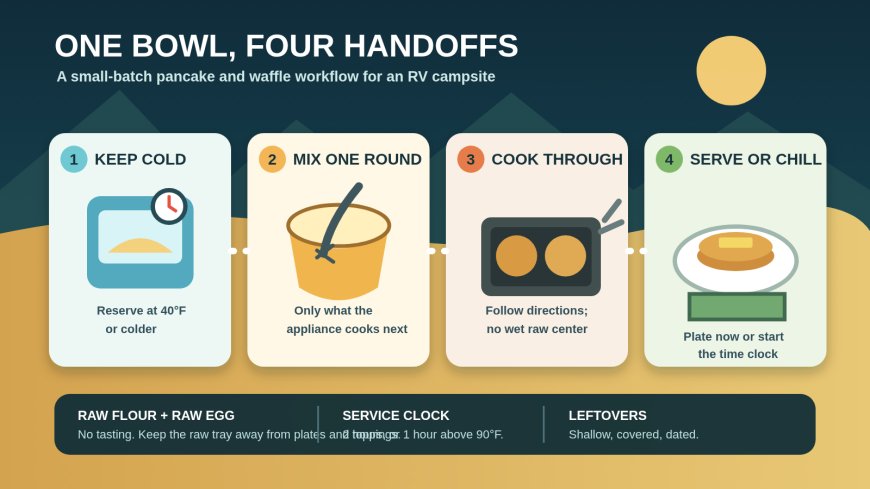
One bowl at a time: safer pancakes and waffles at an RV campsite
By Romana
Pancake breakfast looks easy until one bowl of batter sits beside the griddle, the coffee line grows, and somebody reaches in for a "tiny taste." At an RV campsite, the safer plan is not a heroic mountain of pancakes. It is a short loop: keep most ingredients cold, mix a small bowl, cook every portion completely, send it straight to the table, then decide promptly what is worth chilling.
That loop controls two raw ingredients at once. Ordinary flour is a raw food and may carry harmful bacteria; milling does not kill them. Raw eggs may also contain harmful bacteria. FDA's advice is blunt: cooking is what makes foods made with flour and raw eggs safe, and raw batter should not be tasted.[1]
Treat the flour bag as part of the raw zone
Camp kitchens often reserve the "raw" side of the table for meat and forget the flour. That is a mistake. Flour drifts, coats spoons, and settles on the cutting board without looking dirty. FDA says to keep flour and eggs away from ready-to-eat food and to wash hands, bowls, utensils, boards, and counters after contact with them.[1]
Give the batter job one compact zone:
- Put the flour or mix, eggs, measuring tools, bowl, and whisk on one washable tray or table section.
- Keep fruit, syrup, butter, cooked pancakes, clean plates, and eating utensils on the other side.
- Use one utensil for the raw bowl and a different spatula for cooked food. Do not let the batter spoon become the serving spoon.
- Close the flour bag before the wind or a passing elbow can spread it through the galley.
- Wash with soap and running water after cracking eggs or handling batter. A quick wipe does not turn a batter-coated surface into a clean serving surface.
This setup is more useful than trying to sanitize the whole campsite after breakfast. The mess stays small because the raw work stays small.
Keep the bowl cold, not just the egg carton
FDA advises storing shell eggs at 40°F or below and checking the refrigerator with a thermometer.[2] Once eggs and milk go into a batter, the bowl belongs under the same cold control. A shady picnic table is not refrigeration.
Set a hard boundary before mixing: the active bowl holds only what the griddle or waffle iron can finish in the next round. The reserve ingredients stay in the RV refrigerator or a well-iced cooler that is actually holding 40°F or below. FoodSafety.gov says perishable food should not remain unrefrigerated for more than two hours, or more than one hour when exposed to temperatures above 90°F.[3]
Count all warm exposure, not just the final stretch. Ten minutes during setup, forty minutes beside the stove, and another half-hour while everyone talks are part of the same clock. Returning an over-time bowl to the refrigerator does not reset it.
A practical exception is a dry, premeasured mix with no egg or dairy added yet. Keep that covered and dry. It becomes perishable when the cold ingredients go in, so mix later rather than making the full trip's batter at home and asking an RV refrigerator to protect a large container.
Use a four-round breakfast workflow
The batch size should match the appliance, not the appetite of the whole group.
- Stage the next round. Preheat the griddle or waffle iron according to its manual or the mix instructions. Set out one clean plate for finished food. Keep toppings covered and away from the raw tray.
- Mix only the next few portions. For a two-burner griddle, that may be enough batter for four pancakes. For a single waffle iron, a smaller bowl may be better. Return milk and eggs to cold storage as soon as the bowl is mixed.
- Cook and clear. Use the raw-batter scoop only over the cooking surface. Move cooked food with a clean spatula to the clean plate. Do not put it back on a plate that held cracked eggs, wet measuring tools, or spilled batter.
- Reset before another bowl. Either wash the bowl and raw tools or use a second clean set. Check the serving queue before mixing more. If plates are backing up, stop the batter line rather than creating another perishable bowl.
Small batches are not merely tidy. They reduce the amount of raw batter warming at once, shorten the gap between cooking and eating, and make the final leftover decision obvious.
There is no honest universal pancake temperature
Do not borrow a meat temperature or turn one line from an egg chart into a made-up pancake rule. FDA lists 160°F for casseroles and other egg dishes, but its flour guidance tells consumers to follow the directions on a baking mix or flour-containing product for the specified cooking time and temperature.[1][2] Neither page establishes a single internal-temperature endpoint for every pancake thickness, recipe, griddle, altitude, or waffle iron.
For a commercial mix, follow its package directions completely. For a recipe, use its tested cooking directions and the appliance instructions. The first item in a batch is your process check: split the thickest part and look for wet or gummy raw batter. If it is still raw inside, it needs more cooking and the heat or portion size needs adjustment. Browning alone is not proof of safety, and a raw center is a clear failure, not a preference.
This distinction matters in an RV kitchen. A small burner can heat unevenly, a cast-iron griddle may have hot and cool zones, and a heavy scoop can create a thick center. Make smaller, uniform portions; allow the appliance to recover between loads; and never shorten the specified cook because the outside is getting dark. If a recipe is meant to remain runny or undercooked, use a different campsite recipe. Pasteurized egg product can reduce the egg risk, but it does not make raw flour safe.[1][2]
Serve a round, then cook the next one
Pancakes and waffles are best served straight from the appliance. That also avoids building a lukewarm stack with an uncertain clock. FDA advises serving cooked egg-containing foods promptly. If service will be delayed, federal guidance says hot food should stay at 140°F or above; otherwise, start the time-out clock and refrigerate or discard within two hours, or one hour above 90°F.[2][3]
For a group breakfast, send two or three plates at a time. Keep the toppings table separate so people do not crowd the batter tray. If somebody is late, pause and mix their portion when they arrive. A foil-covered plate on a picnic table is neither controlled hot holding nor cold storage.
Make the leftover decision while the clock is clear
Treat unused batter and cooked leftovers as two different problems.
Unused batter: There is no universal federal refrigerator life for every homemade pancake or waffle batter in the cited guidance. Recipe ingredients, leavening, and manufacturer directions vary. The cleanest camp rule is to avoid leftovers by mixing small batches. If batter has exceeded the two-hour limit, or the one-hour limit above 90°F, discard it.[3] If it is still within time and you choose to save it, refrigerate it promptly at 40°F or below in a closed container and follow the shortest storage instruction among the mix, egg product, milk, or tested recipe. Do not taste it later to decide whether it is safe.
Cooked pancakes or waffles: Refrigerate what you intend to keep within the same two-hour or one-hour window. Use shallow, covered containers rather than a deep, steaming stack. USDA says refrigerated leftovers can be kept three to four days and should reach 165°F when reheated.[4] Label the container with the breakfast date; an RV refrigerator full of unmarked foil packets is a guessing game.
Do not save food merely because throwing it away feels wasteful. When the cold space is tight, the better move is often to cook one last measured round, stop, and wash the raw bowl. The breakfast ends with fewer leftovers, less cleanup, and no mystery container rolling around beside tomorrow's lunch.
The campsite breakfast card
Before the first egg is cracked, put these six lines where the cook can see them:
- Raw flour and batter stay on one tray.
- No tasting the batter.
- Reserve eggs, milk, and mixed batter stay at 40°F or below.
- Mix only what the appliance can cook next.
- Follow the mix or tested recipe; reject any wet, raw center.
- Serve now, hold at 140°F or above, or chill on time.
That is the whole system. It works for pancakes and waffles, on an indoor RV cooktop or an outdoor appliance, because it controls the handoffs: raw to cooked, cold to hot, and appliance to plate.
Sources
- Handling Flour Safely: What You Need to Know — U.S. Food and Drug Administration — accessed 2026-09-27.
- What You Need to Know About Egg Safety — U.S. Food and Drug Administration — accessed 2026-09-27.
- 4 Steps to Food Safety — FoodSafety.gov — accessed 2026-09-27.
- Leftovers and Food Safety — USDA Food Safety and Inspection Service — accessed 2026-09-27.
What's Your Reaction?