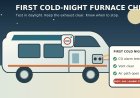







First cold night? Give the RV furnace a daylight check first
A daylight first-start check for RV furnace power, carbon-monoxide alarm readiness, clear combustion intake and exhaust, normal cycling and firm service stop points.


First cold night? Give the RV furnace a daylight check first
By Romana
Category: Tips and Trends
The worst time to discover a furnace problem is after dinner, with the temperature dropping and every service shop closed. Put the first startup of the season on the afternoon schedule instead. That leaves enough light to inspect the outside vent, enough time to read the alarm label, and enough margin to stop if the furnace does something it should not.
This is an owner-level readiness check, not a repair guide. You can clear ordinary campsite clutter, confirm power and propane availability, test the installed alarm as its manual directs, and watch one normal heat cycle. Burner work, gas adjustments, disassembly, electrical diagnosis and vent-system repair belong to a qualified RV technician. Suburban assigns all furnace repair and maintenance to a dealer or qualified technician; Jayco likewise says owners should never attempt furnace repair.[1][5]
The short answer
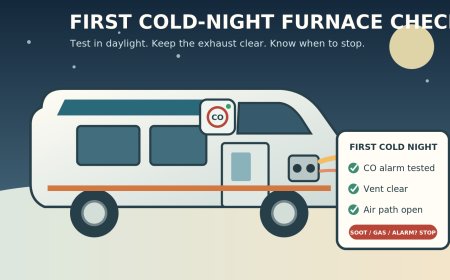
Before the first cold-night run, identify the exact furnace and alarm models, read their manuals, test the CO alarm, confirm usable 12-volt power and propane, and inspect the furnace intake/exhaust from outside without removing parts. Make sure a slide, cargo door, cover, mud, nests, snow or stored gear cannot block the vent. Inside, uncover the heat registers and return-air path.
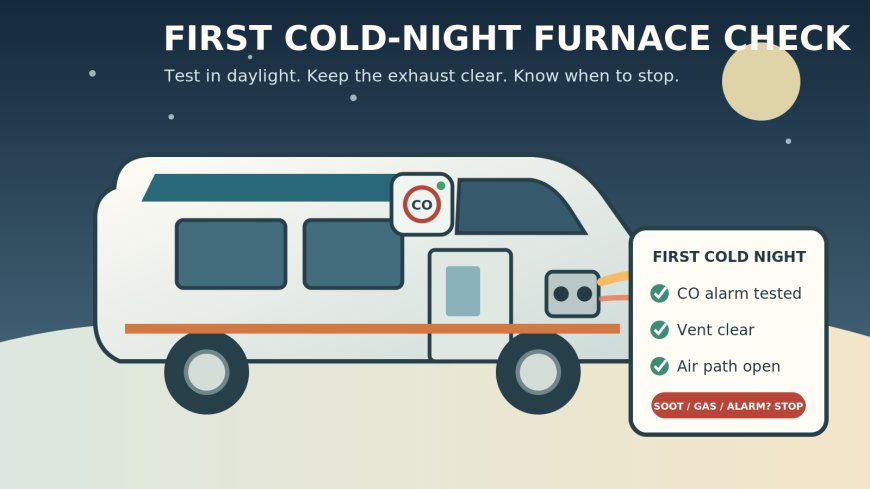
Start the furnace while you are awake, dressed and able to go outside. Observe startup and a complete thermostat cycle. Stop and seek service for a gas odor, soot, a blocked or damaged vent, repeated failure to ignite, delayed or rough ignition, erratic cycling, overheating, an alarm that will not pass its test, a malfunction/end-of-life signal, or any CO alarm. A CO alarm is an evacuation signal, not a prompt to continue troubleshooting inside.
Find the manuals before touching the thermostat
RV furnaces and CO/propane alarms do not all use the same controls, signals or replacement interval. Photograph the appliance data labels and save the exact manuals offline. The RV builder's general manual helps with coach-specific power and control details, while the furnace and alarm manuals govern the components themselves.
For example, Jayco's 2024 towable manual says its installed furnace needs both 12-volt power and propane. It also directs owners to the component maker's manual and calls for annual furnace maintenance by a qualified RV technician.[5] Your rig may differ, especially if it has a heat pump, hydronic heat, diesel heat or a replacement thermostat.
Do not treat the checklist below as permission to remove an access panel or bypass a safety control. If the manual limits a task to service personnel, that boundary wins.
Owner check 1: prove the CO alarm is ready
Start with the alarm because the furnace is a fuel-burning appliance. Locate every CO or combination CO/propane alarm in the RV. Read the model number, production or installation date, normal-status light, test instructions, trouble pattern and end-of-life pattern from that model's label or manual.
The SAFE-T-ALERT 25-741 manual gives RV-specific timing: test after storage, before each trip and at least weekly while the RV is in use.[2] Broader CPSC and NFPA guidance calls for monthly CO-alarm testing; CPSC also recommends annual battery replacement for alarms with replaceable batteries, while NFPA says to replace an alarm according to its maker's instructions.[3][4] Follow the more frequent schedule in your installed RV alarm's manual.
Before startup:
- Confirm the alarm has power and shows its documented normal indication.
- Press the test button exactly as the alarm manual directs. Keep children and pets away from the horn.
- Check the replacement date. One SAFE-T-ALERT model recommends replacement after five years of service, but that number is model-specific, not a universal RV-alarm life.[2]
- Keep bedding, bags, curtains and furniture from covering the alarm.
- If the test fails, the unit shows trouble or end-of-life, or its age cannot be established, replace or service it according to the manufacturer before sleeping with the furnace running.
A test button proves only what the manual says it proves. On the 25-741, the button checks the alarm's electrical functions, not the CO sensor itself, and the maker warns owners not to generate CO for a test.[2] Never test an alarm with vehicle exhaust, a stove, a candle or another improvised combustion source.
Owner check 2: inspect the outside intake and exhaust
Turn the thermostat off before walking around the rig. Find the furnace's exterior intake/exhaust assembly by matching it to the manual, not by guessing which wall fitting belongs to which appliance.
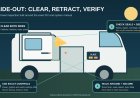
Look without taking anything apart. The openings and their immediate discharge area should be free of insect nests, leaves, mud, snow, ice, covers and campsite gear. Look for damage, staining or black soot. Confirm that an open baggage door, entry door, slide room or aftermarket cover cannot cross the vent area. Suburban says its venting must be unobstructed, free of soot and routed outside; it also warns never to run the furnace with a covered vent and not to add a screen over it.[1]
Do not poke tools into the vent, blow debris deeper into it, remove the vent assembly or install insect screening unless the furnace maker specifically approves that exact part and installation. An obstruction you cannot clear from the exterior with a simple, non-invasive action is a service call.
Combustion clearance also includes the campsite around the vent. Move chairs, tarps, hoses, firewood, portable fuel containers and other belongings away from the discharge path. Use the clearances in the exact furnace and RV manuals; do not borrow a distance from another model.
Owner check 3: clear the indoor air path
A furnace needs an unobstructed return-air path and open heat outlets. Move shoes, pet beds, bags and loose blankets away from registers and return grilles. Do not close every adjustable register to force heat into one area. Jayco tells owners to keep heat discharges, registers and return-air grilles clear and not to shut closeable registers completely.[5]
Check the furnace compartment only to the extent the RV manual gives the owner normal access. Do not store paper products, cleaners, gasoline or other flammable materials against the appliance. Do not remove burner covers or reach into control and combustion areas.
Owner check 4: make one controlled daylight start
Choose a time when everyone is awake and the RV can be evacuated easily. Keep the exterior vent in view or check it promptly after startup without standing in the hot exhaust stream.
- Confirm the CO alarm is in normal status.
- Confirm adequate house-battery voltage by the method provided by the RV maker. A blower that sounds weak or coach power that is already unstable is a reason to pause, not to keep cycling the thermostat.
- Confirm the propane system is in normal service with no gas odor. Do not open appliance fittings or perform a leak test as part of this owner check.
- Set the thermostat modestly above room temperature and listen for the sequence described in the furnace manual.
- Let the furnace produce warm air, satisfy the thermostat and shut down normally. Check that outlets remain open and that nothing near them is overheating.
In Suburban's general guide, the blower starts first and the burner ignites automatically after about 30 seconds; owners must not light the burner by hand. That timing is an example for covered Suburban models, not a standard for every furnace.[1]
Do not turn the thermostat off and on repeatedly to force ignition. Suburban says that after three unsuccessful attempts, the owner should turn the furnace off and contact an RV service agency rather than continue cycling it.[1] Use your exact manual's limit if it differs.
Stop now: faults that need service or emergency action
Leave and call for help
If a CO alarm sounds, move everyone to fresh air, account for all occupants and call for help from outside. Stay out until emergency personnel say it is safe to return. NFPA gives the same fresh-air and re-entry guidance.[4] Do not silence the alarm and resume the test.
If you smell propane, do not operate electrical switches, start the engine or generator, or keep trying the furnace. Evacuate, shut off the gas supply only if that can be done safely from the documented location, and contact the propane supplier, fire department or qualified service provider. Suburban's emergency instructions say not to restore gas until the leak has been repaired.[1]
Seek medical help for possible CO exposure. Headache, nausea, confusion or unusual drowsiness during appliance operation should not be written off as fatigue or the flu.
Shut the furnace down and arrange qualified service
Stop for any of these:
- black soot at the vent;
- a crushed, loose, corroded, altered or persistently blocked vent;
- delayed ignition, a bang or rumble at light-off, or erratic cycling;
- repeated failure to ignite or a lockout;
- overheating, melting, scorching or smoke;
- a blower that does not follow the manual's sequence;
- water intrusion or evidence that an animal or insect nest extends inside;
- an alarm trouble/end-of-life signal that does not clear by the manual's approved owner action.
Suburban calls soot a visual sign of unsafe combustion and directs the owner to shut down and contact qualified service. Its guide also calls for service when cycling is erratic or ignition is delayed.[1] Jayco gives the same shut-down instruction for soot and assigns furnace maintenance to a qualified RV technician.[5]
What an owner can do, and what a technician should do
| Owner readiness check | Technician-only work |
|---|---|
| Read data labels and exact manuals | Remove or service burner and combustion components |
| Test the installed alarm by its documented button procedure | Measure combustion performance or adjust gas pressure |
| Confirm documented normal lights and replacement date | Diagnose control boards, igniters, limit switches or wiring faults |
| Clear ordinary loose objects from around exterior vent and indoor registers | Remove, alter or repair venting and gas fittings |
| Confirm coach power and propane availability using normal controls | Bypass safeties or repeatedly reset a lockout |
| Observe one normal thermostat cycle | Decide that soot, delayed ignition or abnormal flame behavior is safe |
If you cannot place a task confidently in the left column using the manuals for your rig, stop. A cold evening is not the time to learn propane-appliance repair by trial and error.
The five-minute card to keep by the thermostat
Before the first heat call of the season, run this compact check:
- Exact furnace and alarm manuals saved.
- CO alarm powered, in date and passing its documented test.
- Exterior intake/exhaust visible, undamaged and unobstructed.
- No door, slide or campsite item can cover the vent.
- Interior return and heat outlets open.
- House power steady and propane in normal service, with no gas odor.
- Startup observed in daylight through one complete cycle.
- Emergency exit, fresh-air meeting spot and service number known.
A successful test does not certify the furnace for the season. It only shows that the owner-visible checks and one observed cycle did not reveal a stop condition. Keep the alarm powered, keep the vent clear, and schedule the maintenance interval required by the RV and furnace makers.
Sources
- Suburban Gas Furnace Operation Guide (retrieved 2026-09-18; archived locally)
- SAFE-T-ALERT Model 25-741 RV CO/LP Alarm Manual (retrieved 2026-09-18; archived locally)
- CPSC: CO Alarms (retrieved 2026-09-18; archived locally)
- NFPA: Keeping Your Community Safe with Carbon Monoxide Alarms (retrieved 2026-09-18; archived locally)
- Jayco 2024 Towable Owner Manual (retrieved 2026-09-18; archived locally)
What's Your Reaction?