



Power Watchdog RV2130-SP review: a 10% lift, not a bad-pedestal cure
Research-based Power Watchdog RV2130-SP review with a five-voltage rescue table, campground-rule check and exact-generation feature boundary.
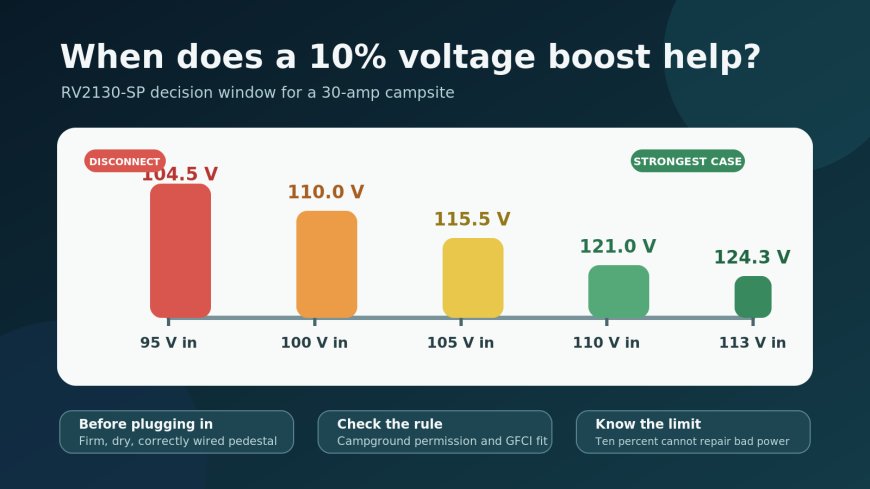
The Power Watchdog RV2130-SP is useful when a 30-amp campsite pedestal sags a little under load. At 110 volts, its advertised 10% boost produces about 121 volts.[1] That can keep an otherwise usable site from turning into an afternoon of dim lights and an unhappy air conditioner.
It is much less useful when the pedestal is loose, miswired, GFCI-protected, soaked by heavy rain or so far below normal that adding 10% still leaves poor power.[1][2] The exact RV2130-SP has diagnostic lights and replaceable surge protection, but it does not have the automatic power cutoff, WiFi or phone controls found on the newer Watchdog Power Center.[1][2]
This is a research-based review. RVCamping.info did not buy, install or physically test the unit.
As an Amazon Associate, RVCamping.info may earn from qualifying purchases. The reviewed listing is ASIN B06W55ZKB6, model RV2130-SP. Check the exact RV2130-SP on Amazon.[8]
The rescue window is narrower than the marketing sounds
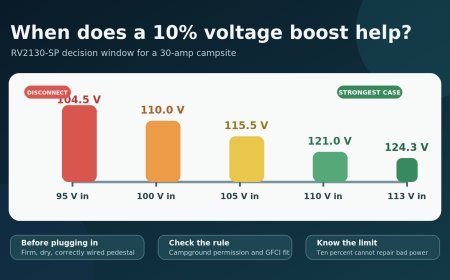
Hughes says the unit switches to a 10% boost when incoming voltage falls to 113 volts or below, then leaves boost mode when the pedestal reaches 115 volts or above.[1] Ten percent sounds substantial until it is applied to a genuinely weak pedestal.
| Pedestal voltage | Calculated output at 10% boost | What that means |
|---|---|---|
| 113 V | 124.3 V | A modest sag becomes normal-looking voltage |
| 110 V | 121.0 V | This is the product's strongest case |
| 105 V | 115.5 V | The output improves, but the site still deserves attention |
| 100 V | 110.0 V | Better, yet still not a convincing all-day supply for heavy loads |
| 95 V | 104.5 V | Ten percent cannot rescue a severely weak pedestal |
These are arithmetic outputs, not test measurements, and real voltage moves as loads switch on and off. The table still gives buyers a better decision rule than "boosts low voltage." This unit is for a shallow sag, not permission to stay connected to any pedestal that happens to energize.
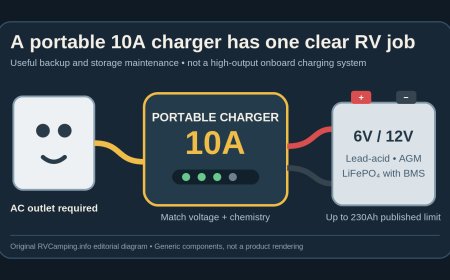
The product also does not create more campsite capacity. It remains a 30-amp device, weighs about 21 pounds and has a roughly 54-inch cord.[2] A dog-bone adapter can change plug fit, but it cannot turn a 15- or 20-amp receptacle into 30-amp service. When the source breaker is smaller, load planning still follows the smaller source.
The current-draw argument is more complicated than either side's slogan. Electrical educator Mike Sokol explains that a voltage-boosting transformer changes the source-side current relationship, while compressor behavior varies with voltage, loading and control hardware.[4] In one preliminary air-conditioner test, current fell as voltage dropped when a soft-start controller remained in the circuit. After he restored the stock starting capacitor, current rose from 14.21 amps at 120.8 volts to 18.62 amps at 85.8 volts.[5] That is useful evidence precisely because it refuses a universal answer: the booster, the load and the controls all matter.
Walk the pedestal before carrying 21 pounds to it
Imagine arriving on a hot Friday afternoon. The pedestal reads 118 volts with the RV disconnected, then settles near 110 after the air conditioner starts. The plug fits firmly, the receptacle is dry, the campground allows a voltage booster and all three RV2130-SP diagnostic lights are green.[1] That is the clean use case. The calculated boosted voltage is about 121 volts.[1]
The manufacturer's sequence starts with the pedestal breaker off.[1] Plug in the RV2130-SP, check that the connection is snug, turn the breaker on and read its diagnostic lights before connecting the RV.[1] Any red diagnostic light means the RV stays disconnected while park management checks the pedestal.[1] If all three are green, turn the breaker off again, connect the RV, then re-energize the circuit.[1]
A loose receptacle ends the exercise. The manual warns that a poor connection can become excessively hot.[1] A booster cannot repair worn contacts. The same goes for missing ground, reverse polarity or missing neutral indications. Those are pedestal faults, not low-voltage opportunities.
The RV2130-SP also has fit boundaries that are easy to miss in a marketplace listing. The current specification says it is not compatible with GFCI outlets and should be kept out of heavy rain or water.[2] That matters at state parks and newer facilities where the available receptacle may be GFCI-protected. It also changes outdoor placement: the unit needs ventilation and weather protection without being wrapped into an insulating bundle.
Campground permission belongs on the same checklist. The 2020 National Electrical Code included an autotransformer prohibition, which fueled years of conflicting advice.[4] During the 2023 revision, the code panel said cord-and-plug-connected autotransformers should not be prohibited and retained an informational warning that several boosters on one feeder can increase campground distribution current.[6] Electrical Contractor Magazine's 2023 change summary says the prohibition was deleted.[7] Local adoption dates and park rules still vary, so the practical answer is to ask before connecting rather than arguing code editions at the office.
The surge module helps, but this is not the new Power Center
The RV2130-SP combines voltage boosting with a 2,400-joule replaceable surge module.[2][3] If the surge-capacity light turns red, Hughes directs the owner to replace that module.[1] The replacement procedure requires disconnecting the unit completely, drilling three lid rivets, swapping three keyed connectors and reinstalling the lid with supplied screws.[3]
That modular design is worth something. A consumed surge component does not automatically turn the 21-pound booster into scrap. It does not make the product equivalent to an electrical management system with automatic low- and high-voltage shutoff.
The naming is unusually easy to muddle. Hughes now sells the Watchdog Power Center, which adds input and output displays, current monitoring, Emergency Power Off, WiFi, Bluetooth and automatic restoration after a fault.[2] Those features should not be transferred backward to Amazon ASIN B06W55ZKB6.[8] Buyers who want remote alerts or automatic disconnection need to compare the newer product rather than assuming every black Watchdog-branded box works alike.
Who gets value from the RV2130-SP
The best buyer has a 30-amp RV, camps often enough to encounter mild voltage sag, can spare 21 pounds and storage room, and is willing to inspect the pedestal before every hookup. A built-in voltmeter or downstream electrical management system makes the result easier to watch, provided the equipment order follows each manufacturer's instructions.
Skip it when low voltage is rare, the available outlets are commonly GFCI-protected, or the goal is remote monitoring and automatic cutoff. It is also the wrong response to a loose, scorched, wet or miswired pedestal. Ask for another site, reduce load or disconnect.
The RV2130-SP earns its space when the problem is specific: sound 30-amp hardware, permitted use and a modest sag that 10% can move back into a comfortable range. The five-row rescue table is the purchase test. If the campsite voltage you expect starts around 108 to 113, the booster can make a meaningful difference. If it is hovering in the mid-90s, the arithmetic has already made the decision.
Sources
- Hughes RV2130-SP operating instructions (accessed November 2, 2026)
- Hughes Autoformers 30 Amp Voltage Booster with Surge Protection (accessed November 2, 2026)
- Replacement Surge Module for RV2130-SP (accessed November 2, 2026)
- Is the Hughes Autoformer a cure for low voltage? Part 1 (accessed November 2, 2026)
- Hughes Autoformer Study: Part 2 (accessed November 2, 2026)
- NFPA 2023 NEC panel second-revision statements (accessed November 2, 2026)
- 2023 NEC Changes - Chapters 5 & 6 (accessed November 2, 2026)
- Amazon US listing for Power Watchdog RV2130-SP (accessed November 2, 2026)
What's Your Reaction?