







Plan an RV route day around fatigue, daylight and a backup stop
A practical RV route-day worksheet for driver readiness, real breaks, a daylight arrival cutoff, personal fatigue stop triggers and a verified backup overnight stop.

Plan an RV route day around fatigue, daylight and a backup stop
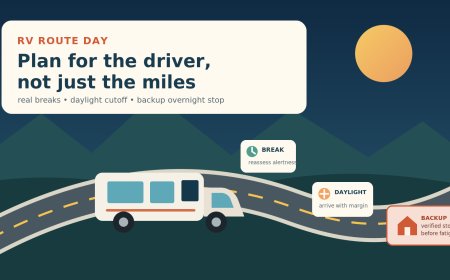
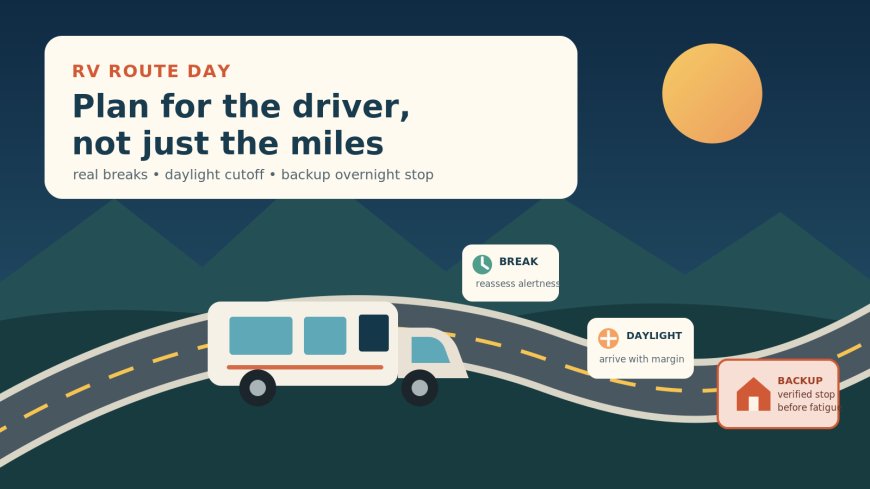
An RV route day should fit the driver's alert hours, the slow parts of RV travel, and the time needed to park before the chosen arrival cutoff. Start with the arrival time and work backward. Add real breaks, fuel and food stops, traffic margin, and setup time. Then choose a verified backup overnight stop before departure. If the arithmetic does not fit, shorten the route. Do not turn a commercial driver's hours-of-service rule into a personal target or assume that reaching a planned number of hours makes continued driving safe.
This is a planning method, not a universal maximum driving time. A familiar 150-mile day can be too much after poor sleep, while another day may feel different. Weather, mountain roads, construction, a new tow vehicle, illness, medication, passengers and the driver's own alertness all change the answer.
Start with fitness to drive, not miles
Route software can estimate motion. It cannot know how well the driver slept, whether a new medication causes drowsiness, or whether yesterday's difficult drive carried into today.
Do a departure check before calculating the day:
- Did the driver get enough good-quality sleep for their normal needs?
- Is the driver alert now, without repeated yawning, heavy eyelids or trouble focusing?
- Could alcohol, cannabis, an over-the-counter product or a prescription affect driving?
- Is there illness, pain, stress or a sleep problem that makes fatigue more likely?
- Is the intended driving window within times when this driver is normally awake?
NHTSA training material identifies warning signs such as repeated yawning, drooping or frequent blinking, wandering thoughts, failure to remember the last few miles, lane weaving and rumble-strip strikes. It also says radio volume, chewing gum and an open window do not provide a lasting fix.[1] If any warning sign is present before departure, delay, change drivers or change the trip.
Do not borrow a commercial-driver limit
Federal or state hours-of-service rules may apply to covered commercial operations. They are not a ready-made personal endurance allowance for every private RV trip. CDC/NIOSH notes that regulated work-hour maximums apply to jobs such as large-truck driving, leave individual sleep and health differences unresolved, and do not cover most other workers.[2]
That distinction matters in both directions. A private RVer should not say, "The truck rule allows this many hours, so I am safe." A commercial operator should not use this article to decide whether an exemption applies. Anyone driving an RV for business, compensation or another regulated purpose should check the rules for that operation and jurisdiction.
For a personal trip, use a conservative plan plus live stop triggers. The clock is a prompt to reassess; it is not proof of fitness.
Build the day backward from the arrival cutoff
Choose an arrival cutoff that leaves enough light and attention for the last interchange, campground road, check-in and setup. It may be earlier than sunset. Drivers who dislike backing in low light, are entering an unfamiliar campground, or expect a difficult site should add more margin.
The U.S. Naval Observatory provides location- and date-specific sunset and civil-twilight times.[4] Use the destination's local time zone, and check the date. Civil twilight is useful context, but it is not a promise of easy visibility. Clouds, smoke, rain, tree cover and terrain can make a site dark sooner.
Complete this worksheet the evening before, then revise it in the morning:
| Route-day input | Your entry | How to choose it |
|---|---|---|
| Driver ready time | ____ | After sleep, breakfast, medication check and a walk-around |
| Personal arrival cutoff | ____ | Before the light or attention conditions you do not want |
| Campground arrival rule | ____ | Office closing, gate, check-in and late-arrival procedure |
| Setup margin | ____ min | From entrance to parked, leveled and utilities handled |
| Fuel and meal time | ____ min | Use the actual stop style of this crew, not a car-trip guess |
| Planned recovery breaks | ____ min | Enough time to get out, move, hydrate and reassess |
| Pet, child or mobility stops | ____ min | Include the people and animals actually traveling |
| Traffic/weather buffer | ____ min | Increase for construction, cities, passes or poor weather |
| Route app's driving estimate | ____ | Verify the route is suitable for the RV's dimensions and restrictions |
| Backup-stop decision time | ____ | The latest time to divert without rushing or driving past the backup |
Now calculate:
Available route window = arrival cutoff minus driver ready time
Available wheel time = available route window minus every non-driving block and buffer
Compare the available wheel time with the route estimate. If the estimate is longer, the route does not fit. The fixes are an earlier start only if the driver will still be rested, a shorter destination, a different route, a second qualified driver, or an overnight split. Removing breaks or setup margin is not a sound fix.
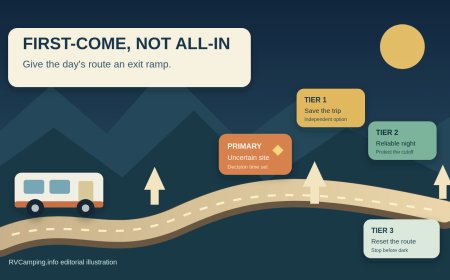
Run the same calculation for the backup stop. Its decision time should come before the turnoff, while there is still fuel, daylight and attention to reach it without haste.
Plan breaks as real stops
A break is not the extra six minutes a fuel pump happens to take. Name likely stopping places and allow enough time to park the full rig, use the restroom, walk, eat or drink, and decide whether the driver is still fit to continue.
Choose a planned check-in interval that is comfortably inside the driver's known attention span. Shorten it for poor sleep, monotonous highways, demanding wind, heat, mountain driving or an unfamiliar rig. The interval is only a scheduled question: "Am I still alert?" It never overrides symptoms.
AAA Foundation's evidence review found support for sufficient sleep, napping and caffeine, while evidence for numerous other behavioral countermeasures was insufficient or mixed.[3] That is why a stretch, snack or lively playlist should not become permission to keep driving when sleepiness has arrived.
At each break, ask:
- Can I recall the last stretch of road clearly?
- Am I holding speed and lane position without repeated correction?
- Are my eyelids heavy, is my head nodding, or am I yawning repeatedly?
- Am I missing signs, exits or navigation prompts?
- Am I bargaining with the plan: "just one more exit" or "I can push to the reservation"?
- Has weather or road difficulty used more attention than expected?
A "yes" to a fatigue sign ends the current driving block. Do not wait for the next scheduled break.
Write stop triggers before you are tired
Decision-making gets worse when the person making the decision is already impaired. Put the triggers on the worksheet and share them with the other traveler before departure.
Pull over at the next safe, legal place for repeated yawning, heavy eyelids, drifting, a missed exit, a rumble-strip strike, difficulty remembering the last miles, head nodding, or any momentary loss of awareness. NHTSA treats these as warnings, not milestones to push through.[1]
End or materially reset the day when symptoms continue after a safe stop, the driver cannot become reliably alert, a second driver is not qualified and rested, the route has moved past the backup decision point, or the remaining drive would violate the crew's light/weather margin.
CDC/NIOSH advises a fatigued driver to pull over; it describes coffee plus a 15- to 30-minute nap as a temporary measure and says sleep is the only cure for fatigue.[2] That is an emergency response, not a technique for extending an overfull itinerary. After a nap, allow time to become fully awake and reassess honestly. If alertness does not return, stay put or arrange another way to finish the trip.
Give the backup stop a job and an address
"We will find something" is not a backup. Choose one primary backup and, on remote routes, a second option. Save the address and phone number offline along with the turnoff, distance from the route and decision time.
Verify each backup against the actual rig:
- Overnight use is legal and available; do not assume a highway rest area, store lot, trailhead or roadside pullout permits sleeping.
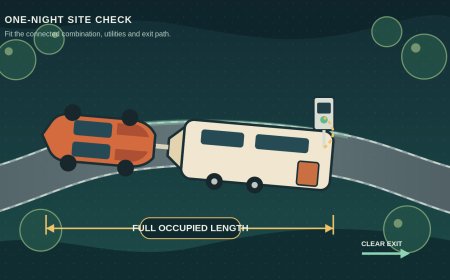
- The site or parking space accepts the RV type, total length, height and number of vehicles.
- The approach road, gate and internal turns suit the rig.
- The campground's office, gate, check-in, late-arrival and no-show rules are known.
- A reservation exists if required, or current same-day availability has been confirmed.
- The driver can reach it before the written stop trigger or daylight cutoff.
- Fuel range leaves a reserve rather than arriving on fumes.
- The plan still works with weak or absent cell service.
Campground rules are local. Yosemite, for example, tells visitors to match the site to their equipment, warns that many large RVs will not fit many standard sites, and gives a specific procedure for arriving after staff have left.[5] Use that as a reminder to read the chosen campground's own current rules, not as a rule for every campground.
A backup can be a campground closer to the route, an RV park near the highway, or another lawful overnight option that has been confirmed for the date and rig. A safe stop for a short fatigue break and a legal place to stay overnight are different things. Verify both.
Make the reservation serve the driver
A prepaid site can create pressure to continue. Treat the reservation cost as spent money, not a command to drive. Save the cancellation and late-arrival instructions before leaving. If the primary campground needs notice, call while safely parked, not while driving.
Tell travel companions the rule in plain language: the driver can stop the day without debate. A passenger can help by monitoring planned break times, checking the backup's availability and making calls, but should not pressure the driver or use conversation as a substitute for sleep.
Two drivers do not automatically double the route. Each driver needs to be rested, legally qualified for the vehicle and comfortable with the rig. Switching seats also takes time, and the off-duty person may not sleep well while the RV is moving.
A five-minute departure card
Write this on paper or save it where every traveler can open it offline:
- Primary campground, phone and confirmed arrival procedure: ____
- Sunset at destination and source/date checked: ____
- Personal arrival cutoff: ____
- Planned break locations or exits: ____
- Backup overnight stop, phone and confirmation: ____
- Divert decision point and latest decision time: ____
- Fatigue stop triggers: ____
- Who may drive this rig today: ____
- Conditions that cancel departure: ____
The useful route plan is not the one that extracts the most miles from a day. It is the one that still works after lunch takes longer, traffic steals half an hour, the driver tires early, or the campground is farther from the interchange than the map made it look.
Sources
What's Your Reaction?