












RV trailer breakaway switch check: cable routing, battery test, and replacement triggers
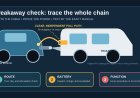
Trace the whole breakaway chain: route the cable for a clean independent pull, verify the exact battery or power source, run the manufacturer test, and replace failed parts before towing.

RV trailer breakaway switch check: cable routing, battery test, and replacement triggers
Safety scope: A breakaway system is emergency equipment, not a parking brake and not a substitute for a working service-brake system. Use the instructions for the exact trailer, switch, battery or onboard power source, brake controller, and brake type. If those instructions conflict with this field guide, the equipment manuals control. Do not tow after a failed test.
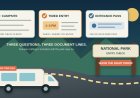
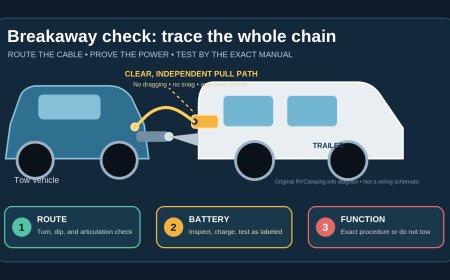
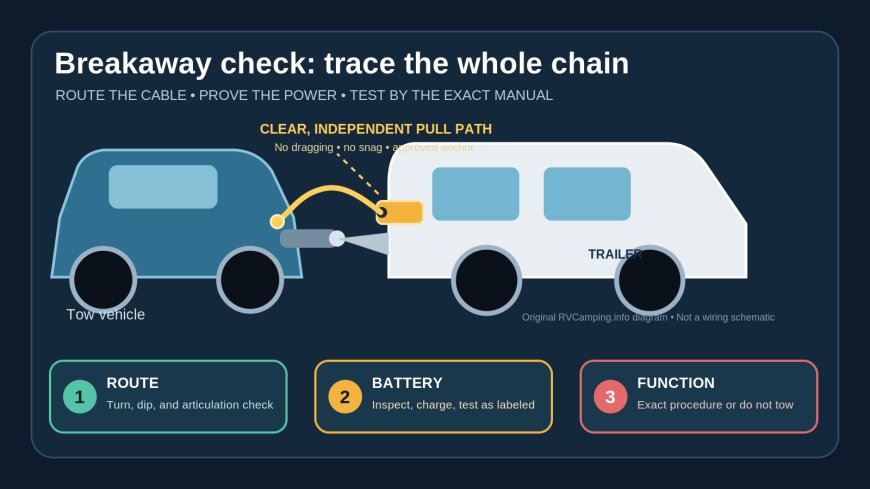
A useful breakaway check has three separate questions: Can the cable pull the pin if the trailer truly separates? Can the independent power source carry the brake load? Do the brakes actually apply when the pin is removed? A green battery light answers only part of that chain.
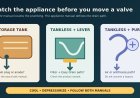
The check also has to match the installed hardware. The 2026 Winnebago towables manual tells owners to test before each trip and describes a hitched pull-pin test. CURT's current 52044 kit manual says its battery test and breakaway test must be done with the trailer's 7-way connector disconnected to avoid possible system damage.[5][6] Those procedures are not interchangeable. Identify the switch and power package first, then use its procedure exactly.
Start with the law, then move to the manual
NHTSA's consumer towing brochure says many states require a separate braking system and breakaway switch for trailers with a loaded weight above 1,500 pounds. It does not present that figure as one national threshold.[1] State rules differ by weight, manufacture date, brake type, duration, and exceptions.
California, for example, requires power brakes on a post-1955 trailer that is otherwise required to have brakes to apply automatically on breakaway and stop and hold the trailer for at least 15 minutes.[3] Washington uses a different structure: its breakaway provision covers trailers over 3,000 pounds manufactured or assembled after January 1, 1964, as well as trailers with air- or vacuum-actuated brakes, and also specifies automatic, prompt application for at least 15 minutes.[4]
Those are examples, not a 50-state chart. Check the statutes and agency guidance for every state or province on the route, plus the trailer's certification and owner documents. A manufacturer may specify an inspection or replacement practice beyond the legal minimum.
NHTSA recall records add another reason to look beyond the visible switch. Recall 25V-538 covered seven 2026 Forest River Flagstaff and Rockwood trailers whose switches were wired to the wrong side of the battery disconnect, leaving the breakaway switch inoperative.[2] A clean lanyard could not fix that electrical fault. Run the VIN through NHTSA's recall lookup and have any open remedy completed.
Make an equipment card before testing
Write down what is actually installed:
- trailer make, model, model year, VIN, and brake type;
- switch brand and part number, including the correct replacement pin;
- dedicated breakaway-battery or onboard-battery arrangement;
- battery chemistry, voltage, capacity, charger, and date code;
- trailer manual, component manual, and any service bulletin or recall;
- the exact test sequence and test interval in those documents.
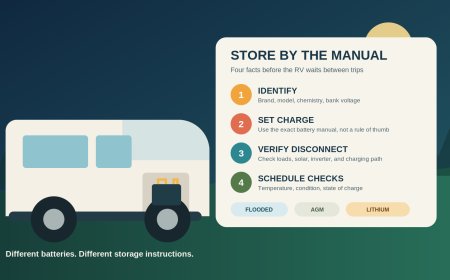
Do not infer the battery requirement from appearance. The cited Winnebago manual calls for a power source equivalent to or greater than an automotive-type 12-volt, 12-amp-hour wet-cell battery for the trailers covered by that manual.[5] CURT 52044 is a different package with its own battery box, charger, indicators, and instructions.[6] Neither specification should be copied to another trailer without confirmation.
Cable routing: prove the path, not just the attachment
The cable has to remain attached to the tow vehicle, avoid accidental pin pulls during normal motion, and produce a clean pull if the trailer separates. Follow the exact hitch and trailer instructions for its independent anchor point.
With the rig hitched on level ground, chocked, and secured against movement:
- Find the switch body, pin, cable, tow-vehicle anchor, safety chains, 7-way cord, coupler, weight-distribution hardware, and jack.
- Turn the steering through the range needed for a tight turn while a spotter watches the cable. Also consider driveway dips and hitch articulation. Stop if any person would enter a pinch or roll path.
- Verify that the cable cannot drag, wrap around the tongue jack, pass through a chain, rub a sharp edge, snag a weight-distribution bracket, or become the normal turning limit.
- Confirm the pull approaches the switch in the direction its manufacturer permits. The switch must not be jammed against the frame or clamped so tightly that a pivoting model cannot align.
- Check that the tow-vehicle attachment cannot fall off or leave with a removable hitch part that the applicable manual excludes.
The cable-length rule is equipment-specific. Winnebago's 2026 manual says the lanyard should be longer than the extended safety chains and secured to the permanent vehicle frame or a non-removable hitch part, not the ball.[5] CURT 52044 warns against attaching its cable to mounting hooks, trailer safety chains, or the trailer ball, and says the routing must avoid both dislodging and an accidental pull during ordinary motion.[6] Copying one sentence without the rest of the installed system's instructions can create the wrong geometry.
Replace or professionally correct the cable setup if the cable is frayed, kinked, crushed, badly corroded, heat-damaged, dragging, too short for normal articulation, so long that it can snag, or fitted with an improvised clip that cannot stay secured. Replace a missing or wrong pin with the exact approved part; a nail or cotter pin is not a road repair.
Battery check: indicator first, loaded function second
A battery can show voltage and still collapse under brake load. Treat the test button, if fitted, as one check in the manufacturer sequence, not proof of the entire system.
For the CURT 52044 package, the manual says to check charge with its Test button before connecting for towing, and to use that button only while the 7-way is disconnected.[6] Its recharge-light and charge procedure belong to that product. Do not transfer its LED meanings or charge times to a different box.
Use this decision path:
- Identify whether the breakaway circuit uses a dedicated battery or an approved onboard source.
- Inspect the case, hold-down, cover, terminals, fuse or breaker arrangement, ground, charger wiring, and brake-feed wiring. Look for swelling, leakage, cracked insulation, green corrosion, loose splices, overheated connectors, and wires pinched by the battery lid.
- Put battery disconnects and charger connections in the positions required by the trailer and breakaway manuals. The 2026 NHTSA recall is a warning that a battery disconnect can be wired into the wrong side of the circuit.[2]
- Perform the kit's battery test. Record the result rather than accepting a quick flash from an unlabeled indicator.
- Perform the manual's functional brake-application test, which proves more than state of charge. Keep the activation as brief as the manual requires and reinsert the pin immediately afterward.
- Recharge after testing if the component instructions call for it.
If the exact procedure calls for a meter, brake-current measurement, raised-wheel check, or controlled pull test, use the specified method and limits. Do not invent a voltage threshold or wheel-drag test. Electrical diagnosis near an energized brake circuit, unfamiliar battery chemistry, or electric-over-hydraulic actuator belongs with a qualified trailer technician.
Functional test: stop if the manuals are unclear
Before activating the switch, secure the trailer as the manufacturer requires. Keep people clear of wheels, coupler, chains, tongue jack, and the space between vehicles.
Then follow one documented procedure from start to finish. Winnebago directs owners of the cited 2026 towables to hitch the trailer, remove the pin, and attempt to drive away to confirm brake activation; it also says to reinsert the pin before towing and not to tow if the switch malfunctions.[5] CURT 52044 requires disconnecting the 7-way before its breakaway test to protect the tow-vehicle brake controller.[6] Your trailer may use another process.
Do not leave the pin out while troubleshooting. Winnebago warns that leaving it out for more than a few minutes drains the battery.[5] Do not use the switch to hold the trailer at a campsite. If the brakes do not apply, reinsert the pin, keep the trailer parked, and diagnose the battery, switch, wiring, ground, brake adjustment, and actuators under the correct manuals.
Replacement triggers: condition beats guesswork
Replace the affected component or have the system serviced before towing when any of these is found:
- the switch fails the prescribed functional test, activates intermittently, or the pin will not seat and retain normally;
- the switch housing is cracked, loose, water-filled, melted, heavily corroded, or cannot align for an unobstructed pull;
- the lanyard has broken strands, a crushed sheath, a kink that stops free movement, a damaged end fitting, or incompatible improvised hardware;
- wiring is loose, abraded, overheated, corroded, shorted, open, or routed through a moving or sharp area;
- a battery is swollen, leaking, cracked, will not reach or retain the manual's specified state after proper charging, or fails the prescribed loaded test;
- the charger or test indicator behaves outside its manual, the ground is suspect, or a battery disconnect can disable the emergency circuit when the design says it must remain powered;
- the exact part has reached its manufacturer's time limit, service interval, or date-based replacement recommendation;
- the VIN, switch, battery, charger, or wiring is covered by an open recall or service campaign.
Time limits are product-specific. One Tekonsha 2010-P instruction sheet recommends replacing breakaway devices every three to five years for optimal performance.[7] That is useful only if 2010-P is the installed switch or its manufacturer has applied the same interval to the exact replacement. It is not a universal expiration date for every switch, battery, or complete breakaway system.
A failed battery does not automatically mean the switch is bad, and a new switch does not cure weak brakes. Breakaway performance depends on the complete path: power source, charger, disconnect logic, switch, wiring, grounds, brake assemblies or hydraulic actuator, and mechanical adjustment.
The 60-second predeparture readout
Before the final walkaround is complete, the driver should be able to say:
- the VIN recall check is clear or remedied;
- the pin is fully seated;
- the switch body and cable pass their condition check;
- the cable is on the approved independent attachment and has a clear pull path through turns;
- the battery or approved power source passed its specified check;
- the complete system passed the exact manual's functional test;
- the 7-way is reconnected after testing, if the procedure required disconnection;
- no warning light, open circuit, damaged brake part, or unresolved test failure remains.
If any answer is uncertain, the trailer stays parked. The breakaway switch is the last braking system available after separation; "probably powered" is not a test result.
Sources
- NHTSA: Towing a Trailer, Being Equipped for Safety
- NHTSA Recall 25V538: Incorrectly Wired Breakaway Switch
- California Vehicle Code §26304
- Washington RCW 46.37.340
- Winnebago Towables Owner’s Manual, Model Year 2026
- CURT 52044 Breakaway Kit Installation Manual
- Tekonsha 2010-P Breakaway Switch Installation Instructions
What's Your Reaction?