









Cooling and reheating a big pot of soup or chili at an RV campsite
A practical RV campsite plan for dividing soup or chili into shallow containers, checking refrigerator capacity, cooling promptly, reheating safely and discarding uncertain leftovers.

Cooling and reheating a big pot of soup or chili at an RV campsite
By Romana
Category: Cooking
A full Dutch oven can feed the whole campsite. It can also overwhelm a compact RV refrigerator. The safe plan starts before dinner: know how much cold space you have, set out several shallow containers, and decide whether any uneaten food will fit without crowding the refrigerator or warming everything already inside.
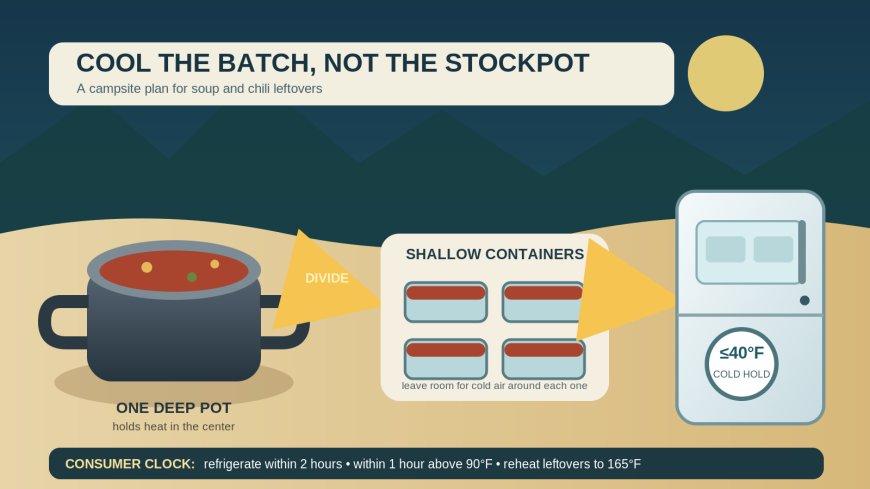
The short answer: Do not put one deep, lidded stockpot in the RV refrigerator and hope the center cools in time. Divide soup or chili into clean, shallow containers and refrigerate promptly. USDA and CDC tell consumers to refrigerate cooked leftovers within two hours, or within one hour during exposure to heat above 90°F. Keep the refrigerator at 40°F or below. Reheat leftovers to 165°F; USDA also says soups, sauces and gravies should reach a rolling boil. If the refrigerator or cooler cannot keep the food cold, if the time limit has passed, or if you cannot verify its history, discard it.[1][2][3]

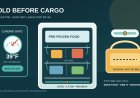
Split the pot before it goes into cold storage. Shallow portions expose more food to cold container walls and leave room for air to move. Original illustration by RVCamping.info.
Decide whether leftovers are realistic before serving
An RV refrigerator may be cold enough but still be the wrong tool for a large pot. The question is not whether the door closes. It is whether several shallow containers can sit with cold air around them while the appliance holds 40°F or below.[1][3]
Check four things before cooking more than the group will eat:
- Put an appliance thermometer in the refrigerator and confirm that it is holding 40°F or below.
- Make a shelf-space plan for the actual containers. Do not count the floor under the produce drawer or a door bin that cannot hold them level.
- Leave gaps around the containers. A tightly packed shelf slows heat removal and can warm nearby milk, meat and other perishables.
- Confirm that shore power, propane operation, battery capacity or generator rules will keep the appliance running through the cooling period and overnight.
If that plan does not work, cook less. A cooler is a fallback only when it has enough ice or frozen packs and a thermometer confirms 40°F or below. USDA's camping guidance says leftover food in a cooler is safe only while the cooler still has ice; otherwise, discard it.[2] An unmonitored cooler with a little cool water in the bottom is not a refrigerator.
Divide the pot, not just the servings
USDA advises putting large amounts of food into shallow containers so they cool quickly. Its example is a big pot of soup: leaving the food in the pot takes too long, while smaller containers shed heat faster. Hot food may go directly into the refrigerator, or it may be chilled rapidly in an ice or cold-water bath first.[1]
CDC gives the same basic consumer direction: package warm or hot food in several clean, shallow containers, then refrigerate it. Small portions of hot food are acceptable in the refrigerator because they chill faster.[3]
At camp, use this sequence:
- Set clean, food-safe shallow containers on a stable surface before the meal ends.
- Ladle the remaining soup or chili into several containers. Do not stack one deep container's worth of food into another deep shape.
- Put only a manageable amount in each container. The goal is a shallow food layer with a short path from the center to the cold container wall and surface.
- Arrange the containers in the refrigerator with space around them rather than stacking them while hot.
- Protect the food from drips and dirt. During active cooling, avoid trapping steam under a tight lid; once chilled, cover or seal the containers for storage. USDA tells consumers to cover or wrap refrigerated leftovers, while the FDA Food Code allows loose covering during cooling when food is protected from overhead contamination.[1][4]
- Mark the date. Use refrigerated soup or chili within three to four days, or freeze it sooner.[1]
Federal consumer pages do not give a universal container depth for every home or RV setup, so this guide does not invent one. “Shallow” is a heat-removal strategy, not a magic measurement. Container material, fill depth, starting temperature, refrigerator airflow and batch size all change the result.
Use an ice bath when the RV refrigerator needs help
An ice-water bath can remove a large share of the heat before the containers enter a small refrigerator. USDA says hot leftovers may be chilled rapidly in a bath of ice or cold water before refrigeration.[1] FDA's Food Code also lists stirring food in a container set in an ice-water bath among approved cooling methods for food establishments.[4]
For a campsite batch:
- Put the pot or smaller heat-safe containers into a clean basin of ice and water. Keep bath water below the rim so it cannot splash into the food.
- Stir the food with a clean utensil so hotter soup from the center reaches the cooler sides.
- Add ice to the bath as it melts. Do not assume a few cubes under a hot stockpot can absorb the heat from several quarts of chili.
- Divide the food into shallow storage containers before refrigeration if it is still in the cooking pot.
- Keep the cooling setup away from raw-meat prep, dust, insects and children.
Adding clean ice directly as an ingredient is another Food Code cooling method, but it dilutes the food and requires ice made from safe water.[4] It is rarely the best fix for finished chili. Do not add stream water, non-potable campground water or loose cooler ice to food.
Where the FDA two-stage rule fits
The FDA Food Code is a model for retail and food-service regulators. It is not the USDA consumer instruction for a family's campsite leftovers, and a jurisdiction may adopt or modify a particular edition. Still, its cooling limits explain what controlled, measured cooling looks like in a food establishment.
For cooked food that needs time and temperature control for safety, the 2022 Food Code calls for cooling from 135°F to 70°F within two hours, then to 41°F or below within a total of six hours. It lists shallow pans, smaller or thinner portions, rapid-cooling equipment, ice-water baths, heat-conductive containers and ice as an ingredient among the methods.[4]
That rule should not be misread as permission to leave a campsite pot on the picnic table for six hours. USDA and CDC consumer guidance says to refrigerate perishable leftovers within two hours, or one hour when exposed to temperatures above 90°F.[1][3] The one-hour hot-weather limit matters at a sunny campsite even if the evening air later cools.
Campers who choose to monitor a batch can use a clean, calibrated food thermometer to check the center of representative containers. Record the time that active cooling began. A temperature log can show that the plan is working; it cannot rescue food that already sat out too long. The conservative consumer choice is to discard food when the time or temperature history is uncertain.
Do not overload the cold space
A compact refrigerator can maintain cold food yet struggle when several quarts of steaming liquid arrive at once. Splitting the food helps, but it does not create cooling capacity.
Use a simple capacity test: place the empty shallow containers where they will cool before dinner. If they fill the shelf edge to edge, touch the back wall, block an air outlet, or require hot stacking, the batch is too large for that refrigerator. Reserve freezer space if you plan to freeze portions, but cool food promptly rather than using a crowded freezer as a substitute for a cooling plan.
Do not cool the pot by setting it outside overnight. Wildlife, dust and insects are obvious problems, but outdoor air is also not controlled refrigeration. A cool-feeling night can still be warmer than 40°F, and the center of a large pot retains heat long after the air changes.
The same caution applies to turning off the RV refrigerator while driving or during quiet hours. If continuous cold holding is doubtful, make a no-leftovers meal. Waste is frustrating; foodborne illness on a trip is worse.
Reheat the portion you will eat
Keep the cold batch cold. Move only the amount needed for the next meal into a saucepan or microwave-safe dish. Repeatedly warming the entire container and returning it to the refrigerator adds handling and creates another cooling problem.
USDA tells consumers to reheat leftovers to 165°F as measured with a food thermometer. For sauces, soups and gravies, it also says to bring the food to a rolling boil. Covering food during reheating retains moisture and helps it heat through.[1]
On an RV stove:
- Transfer one meal's portion to a saucepan.
- Stir frequently, scraping the bottom and folding the cooler center toward the sides.
- Bring soup or chili to a rolling boil, then verify 165°F in more than one spot. Thick chili can form hot and cool pockets.
- Serve immediately, or keep it hot at 140°F or above under USDA consumer guidance.[1]
In a microwave, use a vented cover, pause to stir and rotate the dish, and check several places with a clean food thermometer. USDA notes that microwaves can leave cold spots.[1] A steaming edge does not prove that the center reached 165°F.
The Food Code has a narrower rule for food reheated for hot holding in a food establishment: generally, all parts must reach 165°F for 15 seconds, and reheating must be rapid.[4] Home and campsite consumers should follow USDA's 165°F leftover guidance rather than borrowing food-service exceptions.
When not to keep the leftovers
Discard the soup or chili when any of these applies:
- It stayed out more than two hours, or more than one hour in temperatures above 90°F.[1][3]
- You cannot say when cooking or hot holding ended.
- The refrigerator was above 40°F long enough that safe cold holding cannot be established.
- The cooler no longer has ice, or no thermometer confirms that it remained at 40°F or below.[2]
- The only way to store the batch is one deep pot, crowded hot containers or an unpowered refrigerator.
- Raw meat juices, dirty water or other contamination entered the food.
- Refrigerated leftovers are older than three to four days.[1]
- Someone says, “It smells fine,” but the time-and-temperature history is unknown.
Smell, taste and appearance cannot certify safety. Do not taste a spoonful to decide whether uncertain leftovers are safe. Reheating is not a reset button for food that was cooled or held improperly.
The campsite plan in one minute
Before dinner, confirm 40°F or below and reserve space for several shallow containers. After serving, start the clock, divide the pot, use an ice-water bath if the refrigerator needs help, and refrigerate within the consumer time limit. Keep a thermometer in both the appliance and the food kit. Reheat one portion to 165°F and bring soup or chili to a rolling boil. If the cold chain or clock is uncertain, do not keep the batch.
Evidence note: USDA FSIS and CDC provide the consumer rules in this article. FDA Food Code provisions are identified separately as food-establishment standards and explanatory benchmarks, not substituted for the consumer guidance. RVCamping.info created the RV refrigerator capacity test, container-placement plan and campsite workflow.
Sources
- USDA FSIS: Leftovers and Food Safety — consumer guidance on prompt refrigeration, shallow containers, storage life and reheating.
- USDA FSIS: Food Safety While Hiking, Camping & Boating — campsite cooler and leftover guidance.
- CDC: Preventing Food Poisoning — consumer guidance on shallow containers, refrigeration temperatures and the two-hour/one-hour limits.
- FDA: Food Code 2022 — §§ 3-501.14, 3-501.15 and 3-403.11 for food-establishment cooling methods and reheating for hot holding.
What's Your Reaction?