
























Jerky is dry, not automatically safe: a kill-step plan for RV trips
Build a measured kill step into homemade jerky before an RV trip, with separate temperature rules for ordinary meat, poultry and wild game.

Jerky is dry, not automatically safe: a kill-step plan for RV trips
By Romana | October 17, 2026 | Cooking
Jerky feels made for an RV pantry. It is compact, does not leak like raw meat and looks finished when the surface turns dark and leathery. That appearance says nothing about whether the batch received enough heat to destroy bacteria or parasites before it was packed.
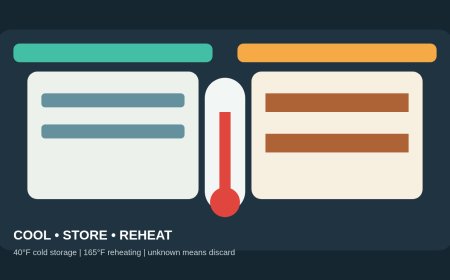
Quick answer: Give homemade jerky a measured kill step, then dry it under controlled conditions. In USDA's home method, the internal target before dehydration is 160°F for meat. Poultry has a 165°F target. The dehydrator then needs to hold 130°F to 140°F. Wild game has a different risk context: CDC says wild game must reach at least 165°F internally to kill Trichinella. Record the food, temperature and measurement point for each batch. If nobody can verify the kill step, do not treat dryness, marinade, freezing or extra drying as substitutes.[1][2][3]

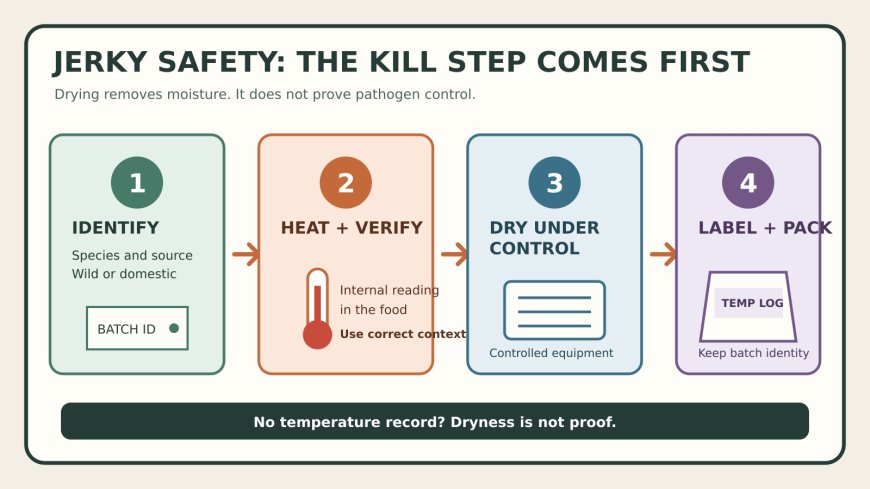
The kill step comes before the road. Original RVCamping.info process graphic.
Drying and killing pathogens are different jobs
Drying removes moisture. A kill step uses time and heat in a validated context to reduce pathogens. Those jobs can happen in the same process only when that process has evidence behind it. They should not be assumed to be interchangeable.
USDA warns that pathogenic bacteria can survive the dry heat used for home jerky, especially the 130°F to 140°F range common in dehydrators. Its consumer method puts the heating step before dehydration: steam or roast ordinary meat until its internal temperature reaches 160°F. For poultry, the stated internal target is 165°F. Check the food with a thermometer. The dehydrator should then maintain at least 130°F to 140°F during drying.[1]
Those numbers describe two stages. The 160°F or 165°F reading is the pre-drying lethality target for the food. The 130°F to 140°F range is the operating temperature for the drying stage. A dehydrator set to 140°F does not prove that a strip reached a kill temperature, and a high dial setting does not replace an internal measurement.
Marinade is not the missing proof. Neither is texture. The 2026 CDC investigation of a North Carolina bear-jerky outbreak reported that the process used only marination and dehydration. Investigators wrote that the jerky likely did not reach the suggested internal temperature above 165°F needed to kill Trichinella parasites.[2]
Keep the temperature contexts separate
Food-safety numbers become dangerous when they are copied without their subject and process.
- USDA home jerky method for meat: steam or roast to 160°F before dehydrating.[1]
- USDA home jerky method for poultry: steam or roast to 165°F before dehydrating.[1]
- USDA drying stage: hold the dehydrator at 130°F to 140°F.[1]
- CDC wild-game parasite control: cook wild game to an internal temperature of at least 165°F to kill Trichinella.[3]
- The 2026 bear-jerky investigation: the authors described a suggested internal temperature above 165°F in their discussion of that implicated batch.[2]
These statements are not a menu of interchangeable settings. The CDC wild-game threshold is stricter than USDA's 160°F consumer instruction for ordinary meat jerky because it addresses a specific parasite hazard in wild game. For bear or other wild game, use the CDC wild-game context rather than borrowing the lower ordinary-meat number.
This article does not supply a recipe, strip thickness, drying duration or shelf-life. Those details depend on the meat, formulation, equipment, humidity and validated process. A fixed number of hours in an RV dehydrator would be a guess, not a safety control.
Put the kill step in the home kitchen
An RV can have a capable oven, stable shore power and a good dehydrator. It can also have voltage drops, a small oven with wide temperature swings, limited counter space and no clean place to separate raw strips from finished food. The safer trip plan is to finish the measured kill step and controlled drying before departure.
Set up the batch around evidence, not memory:
- Identify the species and whether the meat is ground or whole-muscle. Do not label a package only "jerky."
- Choose guidance that covers that meat and process. Wild game stays in the wild-game branch.
- Use a calibrated food thermometer at the thickest or slowest-heating part of the meat. Record the actual internal reading, not the appliance setting.
- Keep raw utensils, trays and hands away from the post-kill-step side of the work area.
- Move the heated meat into a dehydrator that can maintain USDA's drying range. Follow the validated procedure used for that batch rather than inventing a time from appearance.
- Cool and package with clean equipment. Label the package before it enters the RV pantry.
USDA's sequence places the measured heating step before drying.[1] The batch record below is an RVCamping.info trip control, not a federal form. Its purpose is to stop an unlabeled bag from becoming a campfire argument about what someone "probably" did.
Make a batch card that survives the handoff
A useful card can fit on an index label:
- meat and species;
- wild or domestic source;
- date processed;
- kill-step method;
- required target and actual internal temperature;
- thermometer used and where the reading was taken;
- drying equipment and controlled range;
- storage instructions from the validated process or commercial label;
- preparer's initials.
If a friend hands over homemade jerky without that information, the absence is meaningful. More time in a dehydrator cannot reconstruct an unknown earlier temperature. Smell, color and bend do not reveal whether a pathogen survived.
Commercial jerky is a separate case. Keep the manufacturer's package and follow its printed storage instructions, including refrigeration after opening when the label calls for it. Do not transfer it to an anonymous bag and then rely on a generic homemade-jerky timeline. This package makes no shelf-life promise for either product.
Treat wild-game jerky as its own branch
The 2026 Emerging Infectious Diseases report is a direct warning against judging safety by the finished product. Six people ate implicated bear jerky; three developed trichinellosis, and one was hospitalized. Investigators identified Trichinella spiralis in meat from the same bear. The report says the jerky was made by marinating and dehydrating without prior freezing, and that the process likely missed the necessary heat.[2]
The earlier CDC wild-game report adds two controls that matter in camp kitchens. It says wild game needs an internal temperature of at least 165°F to kill Trichinella, and freezing might not be sufficient. It also cites an outbreak in which people who ate vegetables, but not the bear meat, became ill through cross-contamination.[3]
That means the kill-step plan has a clean-side rule. Once meat has received its validated heat treatment, do not return it to a raw-meat tray, cutting board, marinade container or pair of tongs. In a small RV galley, assign one landing zone for finished strips and clear the raw setup before that zone is used.
Freezer time is not a wild-game kill-step receipt. The 2026 investigation found larvae in frozen meat from the implicated bear, although the authors noted that the freezing conditions were unknown.[2] The 2024 CDC report is more direct: freezing might not be sufficient for wild game, while the measured 165°F internal temperature is the control it names.[3]
Run a departure check, not a taste test
Before the jerky goes into the RV, check four things:
- Identity: Does the label name the species and distinguish wild game from domestic meat or poultry?
- Kill step: Is there a recorded internal temperature from the correct context, measured in the food?
- Drying control: Was the batch dried in equipment able to maintain the prescribed range for the process?
- Handoff: Are the storage instructions, package and clean handling intact?
A failed identity or kill-step check is not fixed by tasting one piece. Leave the batch home or discard it. If the record is complete but the package is damaged, wet, moldy or otherwise questionable, do not serve it.
At camp, keep the card with the package. Use clean hands or utensils, close the package between servings and keep it away from raw-game prep. If several bags are open, serve one batch at a time so its identity and instructions do not get mixed.
What the plan does and does not prove
The plan proves only the controls that were measured and recorded. It does not certify a recipe, establish commercial shelf stability or turn an uncertain batch into safe food. It also does not replace state wildlife advice, a processor's validated instructions or a manufacturer's label.
Its value is narrower and more practical: every bag loaded into the RV should have an answer to three questions. What animal is this? Which kill-step rule applied? Where is the actual internal-temperature record? If any answer is missing, dryness is not evidence.
Sources
- USDA FSIS: Jerky and Food Safety - consumer guidance for pre-drying heat targets and the dehydrator's drying range (reviewed October 17, 2026).
- CDC Emerging Infectious Diseases: Trichinellosis Outbreak Linked to Undercooked Bear Jerky, North Carolina, USA, 2024 - July 2026 investigation of the bear-jerky process, illnesses and laboratory findings (reviewed October 17, 2026).
- CDC MMWR: Suspected Outbreak of Trichinellosis Associated with Undercooked Bear Meat, North Carolina, November 2023 - wild-game internal-temperature, freezing and cross-contamination context (reviewed October 17, 2026).
What's Your Reaction?