









Green River vs. Split Mountain, with Echo Park as the RV no-go
Compare Green River and Split Mountain by paved access, exact site lengths, dry-camping services and seasonal booking, with a clear Echo Park no-RV warning.

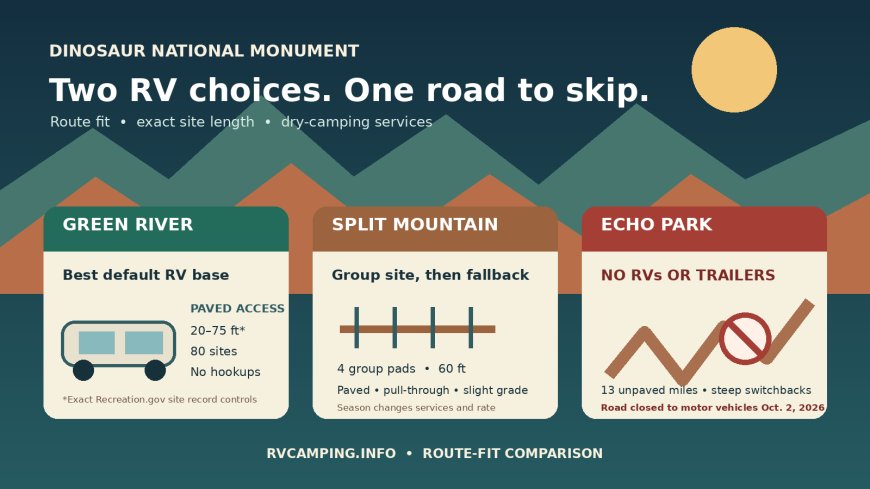

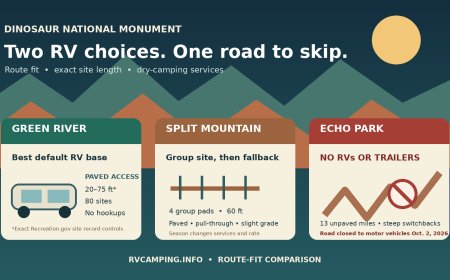
Bottom line: Green River is the normal choice for an individual RV crew that wants a paved approach, a regular campsite, and the easiest base near Dinosaur National Monument's quarry. Split Mountain is the better fit for an organized group in the main season and becomes a useful dry-camping fallback for smaller parties after its seasonal water system shuts down. Echo Park is not an RV alternative: the National Park Service says RVs and trailers are not allowed there, and the access road was closed to motorized vehicles when this comparison was researched.[1][2][3]
This is a comparison of route fit and campground function, not a scenery ranking. All three places sit near the Green River, but they ask very different things of a vehicle. Green River and Split Mountain are reached on the Utah side by paved roads. Echo Park requires a long Colorado-side approach followed, when open, by 13 miles of unpaved road with steep switchbacks.[3][4][6]
The quick decision
| Decision | Green River | Split Mountain | Echo Park |
|---|---|---|---|
| Practical RV role | Standard individual campground | Four group sites in the main season; off-season dry-camping fallback | Not an RV campground |
| Approach | About 12 miles north of US 40 on Utah SR 149; paved park approach | Same Utah-side corridor; Split Mountain Road was paved and open on October 2 | 24–25 paved miles from Dinosaur, Colorado, then 13 unpaved miles with steep switchbacks |
| Rig evidence | Recreation.gov inventory spans site-specific lengths from 20 to 75 feet; check the exact listing | Four named group sites show 60-foot paved pull-through driveways with slight grades | NPS says RVs and trailers are not allowed; only tents, vans, and trucks with camper tops |
| Hookups | None | None | None |
| Shared services | Seasonal drinking water and flush toilets; no RV tank fill or dump | Seasonal drinking water and flush toilets; vault toilet when water is off | Vault toilet and seasonal water when accessible; no trash service or cell service in current status notice |
| Booking pattern | Peak-season reservations in loops A and B, loop C first come; all first come after October 1 in the current update | Reservable group sites in the main season; current shoulder-season operation was first come | Individual sites first come; only the group site is reservable, but access controls whether any booking is usable |
| Generator window | 7 a.m.–9 p.m. | 7 a.m.–9 p.m. | Same monument-wide campground window when open |
Green River: the default for an individual RV trip
Green River's 80-site inventory accepts both tents and RVs. Recreation.gov says each site has a table and fire pit, while drinking water and flush toilets are shared campground services. It also states what is missing: no showers, no electric or water hookups, no dump station, and no facility for filling an RV's potable-water tank.[4]
The route is the easy part. Recreation.gov directs campers about 12 miles north of US 40 from Jensen on Utah State Route 149, and the current park report listed the relevant paved roads open.[2][4] That does not remove the need to inspect the exact campsite.
The current campsite dataset returns 81 records; one is the scan-and-pay entry. The RV or trailer length fields range from 20 feet to 75 feet, and the records carry individual driveway lengths rather than one honest campground-wide maximum.[5] Site 24, for example, lists 75 feet; site 73 lists 64; site 31 lists 30; and several records sit in the 20s.[5] Those numbers are reservation fields, not permission to squeeze a truck-and-trailer combination into any empty-looking pad. The facility notice requires all equipment to fit on the site pad and limits each site to two vehicles, only one of which may be an RV.[4]
Use Green River if you are one household, want the quarry area as the center of the trip, and have a rig that matches a specific listing. A long motorhome may find a suitable record, but it should not be booked from the campground overview alone. A towable owner should confirm whether the displayed maximum applies to the trailer, the complete parked combination, or the driveway, then save that exact site page with the reservation.
Green River's reservation status changes with the season. NPS says peak-season reservations are available for loops A and B while loop C remains first come, but the October 2 conditions update placed every loop on first-come status until the campground's mid-October closure.[2] A search result that still shows reservable summer inventory is not evidence that the campground will accept a future late-fall arrival.
Split Mountain: group infrastructure first, shoulder-season fallback second
Split Mountain is close to Green River, but it is not simply a quieter version of the same product. In the main season it is a group campground with four sites, each intended for as many as 25 people and six vehicles. The facility provides seasonal drinking water and flush toilets, but there are no electric, water, or sewer hookups, no dump station, and no way to fill an RV tank.[6]
The rig geometry is unusually consistent in the current booking data. Group sites A, B, C, and D each show a 60-foot paved pull-through driveway, a 60-foot maximum vehicle field, and a slight driveway grade.[7] One additional scan-and-pay record carries the same driveway values.[7] That makes Split Mountain easier to screen than Green River, but 60 feet still needs interpretation. Six vehicles may be allowed at a group site, yet that does not mean six full-size rigs fit. Recreation.gov says each group site accommodates recreational vehicles, and the exact parking arrangement remains the party's responsibility.[6]
The campground's operating identity changes when water is shut down. Recreation.gov describes an off-season period, roughly early October through early April, with no reservations, no water, and a vault toilet.[6] The live October 2 update was more precise for this year's transition: group sites were first come at $40 while drinking water remained on, then were scheduled to drop to $12 and a maximum of eight people after the water shutdown.[2] That makes Split Mountain a useful late-season dry-camping fallback after Green River closes, but only if the current conditions page confirms access and operation.
Pick Split Mountain during the main season when the party genuinely needs group capacity. For a couple in a single camper, paying the group rate while water remains on makes little sense unless Green River is unavailable and the park is allowing first-come use. Once the winter arrangement begins, the value changes, along with the services.
Echo Park: a van or truck-camper decision, not an RV decision
Echo Park belongs in this comparison because its name appears beside the other campgrounds and its location is tempting. The correct RV conclusion is still "skip it."
NPS gives an unusually direct equipment rule: RVs and trailers are not allowed at Echo Park. Permitted setups are tents, vans, and pickup-mounted campers.[3] The same page describes 22 sites: 17 tent sites, four walk-in or boat-in sites, and one group site. It lists zero RV-only sites.[1][3]
The road explains the rule. From the Canyon Visitor Center, the route follows about 25 paved miles of Harpers Corner Road before turning onto the 13-mile unpaved Echo Park Road. The dirt section descends steep switchbacks and becomes impassable when wet. NPS limits its recommendation to high-clearance vehicles and says current conditions may also call for four-wheel drive.[3] NPS says RVs and trailers are strongly discouraged because of the sharp turns, steep grades, and rough surface.[3] The campground's explicit equipment rule removes any remaining ambiguity.
Every travel trailer, fifth wheel, conventional Class A or Class C, and low-clearance camper should skip Echo Park. A camper van or truck camper should also skip it if it lacks high clearance, if the driver is not comfortable with tight unpaved switchbacks, if rain or snow is possible, or if turning around after a closure would be difficult. Even a capable four-wheel-drive van has no claim on the road when it is closed.
On October 2, that was the controlling fact. Storm damage had closed the road to motorized traffic between Chew Ranch and the campground. NPS listed Echo Park as inaccessible by motor vehicle, with no drinking water, no cell service, and pack-out trash service.[2] A group-site reservation does not override a road closure. When access eventually returns, individual sites remain first come and only the group site can be reserved.[3]
Power, water, and waste: all three are dry camping
Neither Green River nor Split Mountain has campsite hookups. Shared drinking water does not mean an RV can connect a hose or fill its onboard tank; both Recreation.gov pages say RV tank filling is unavailable.[4][6] There is no dump station at either campground.[1] Arrive with enough fresh water, enough waste capacity for the planned stay, and a verified dump plan outside the campground.
Echo Park has even fewer dependable services. When normally operating, it has vault toilets and seasonal spigots. Its current closure notice said the water was off and campers would have to pack out trash.[2][3] That service profile suits a self-contained high-clearance van only after the road reopens. It does not turn Echo Park into a destination for a larger RV.
Generator hours are simple across the monument: NPS allows generator operation from 7 a.m. to 9 p.m. daily.[1] Recreation.gov repeats the 9 p.m.–7 a.m. prohibition for Green River and Split Mountain.[4][6] Permission inside that window is not a promise that a generator solves the power plan. Build battery and fuel capacity around quiet nights, and confirm any separate fire restrictions before running combustion equipment.
A booking sequence that catches the expensive mistakes
- Check the live conditions page first. It decides whether a road and campground are usable now, and it can override an old reservation page.[2]
- Choose the correct campground role. Green River is for ordinary individual stays. Split Mountain is primarily group inventory in season. Echo Park is not for RVs or trailers.[3][4][6]
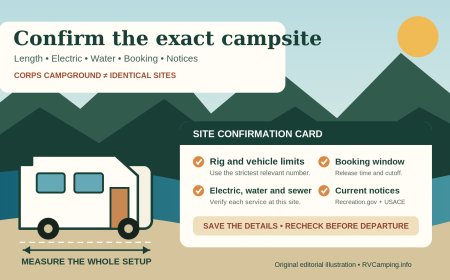
- Measure the actual setup. Record motorhome length, trailer body length, total truck-and-trailer length, height, width, rear overhang, and the space needed for slides and stabilizers.
- Open the exact site record. Green River's current length fields vary from 20 to 75 feet. Split Mountain's four group pads list 60-foot pull-through driveways and slight grades.[5][7]
- Treat water as carried supply. Shared seasonal spigots do not provide hookups or RV-tank filling.[4][6]
- Make a waste plan. None of these three campgrounds has a dump station.[1]
- Save the booking and road evidence offline. Cell service is absent at Echo Park and may be unreliable elsewhere. A screenshot of the site limits is more useful than trying to reconstruct them at the gate.
Green River wins for most RV travelers because the road, site inventory, and individual-campsite format line up. Split Mountain wins for an actual group and can serve as a shoulder-season fallback after its operating mode changes. Echo Park is the scenic place to visit only with the right non-RV vehicle, the right forecast, and an open road. The useful comparison is not which river view looks best. It is which campground your vehicle is legally and physically able to reach.
Sources
- Campgrounds — Dinosaur National Monument, National Park Service (accessed October 7, 2026)
- Current Conditions — Dinosaur National Monument, National Park Service (October 2, 2026 update; accessed October 7, 2026)
- Places to Go: Echo Park — Dinosaur National Monument, National Park Service (accessed October 7, 2026)
- Green River Campground — Recreation.gov (facility record accessed October 7, 2026)
- Green River Campground campsite inventory — Recreation.gov API (accessed October 7, 2026)
- Split Mountain Group Campground — Recreation.gov (facility record accessed October 7, 2026)
- Split Mountain Group Campground campsite inventory — Recreation.gov API (accessed October 7, 2026)
What's Your Reaction?