



















Does a Senior or Access Pass discount the RV site? Audit five checkout lines
Compare exact federal campground rules, then audit entrance, campsite, reservation, electric, and group fees before applying a Senior or Access Pass.

Does a Senior or Access Pass discount the RV site? Audit five checkout lines
The pass may cut one line while leaving entrance, electricity, group capacity, or another booking charge untouched. Check the exact facility before treating “50% off camping” as half off the stay.

A Senior Pass or Access Pass does not create one nationwide campground price. It can reduce an eligible camping charge, but the facility decides how that benefit meets its own fee structure. The useful question is not “Does this park take the pass?” It is “Which line on this reservation does this facility discount?”
That distinction matters at RV checkout. A booking can contain park admission, a basic campsite charge, a reservation or channel charge, an electrical surcharge, and a group-site price. Four official facility pages apply the passes in four different ways. The safest approach is to audit those lines separately before paying.
The short answer
For the facilities compared here, a pass does not always reduce the full amount shown at checkout.
- Sleeping Bear Dunes discounts camping and reservation fees for Senior and Access passholders, but it excludes the electrical hookup and group-site charges. Its entrance fee is separate from camping.[1]
- Chickasaw National Recreation Area has no entrance fee. Its page says Senior Annual, Senior Lifetime, and Access passes receive a 50% camping discount, but it does not promise another reduction beyond that benefit.[2]
- Arrowhead Campground applies the discount to the campsite portion of a single site. It leaves the electrical surcharge at full price, excludes double sites, and limits the benefit to the site occupied by the passholder.[4]
- Red Rock Canyon Campground discounts standard individual and RV sites for qualifying passholders who are onsite. Walk-to and group sites are excluded.[5]
The BLM's national pass page tells visitors to confirm requirements with the specific recreation site.[3] That is the right rule for any federal campground: the broad pass description gets you to the facility page, not to a final price.
What the exact facility rules say
| Facility | Entrance or access | Individual campsite | Reservation or booking | Electric | Group or other site type |
|---|---|---|---|---|---|
| Sleeping Bear Dunes National Lakeshore | Camping is additional to the park entrance fee | 50% discount | Included in the stated discount | Electrical hookup fee excluded | Group campsite fee excluded |
| Chickasaw National Recreation Area | No entrance fee | 50% discount for eligible Senior and Access passes | Not specified on the cited pass page | No separate treatment stated on the cited page | No separate treatment stated on the cited page |
| Arrowhead Campground, Uwharrie National Forest | Not itemized on the cited campground page | Discount applies to the base campsite fee on one occupied single site | Not itemized as a separate discounted line | Surcharge is not discounted | Double sites are not discounted |
| Red Rock Canyon Campground | A Scenic Drive visit can require a separate timed-entry reservation during the posted season | 50% discount on standard individual and RV sites | Online and call-center prices differ; the page does not say the channel difference receives the pass discount | RV sites have no hookups | Walk-to and group sites are not discounted |
“Not specified” is not the same as “included.” It means the cited page does not settle that line. Keep the full amount in the working total until the live checkout or facility staff confirms otherwise.
Sleeping Bear: the discount crosses one boundary, then stops
Sleeping Bear Dunes gives the cleanest example of why a single percentage is not a trip total. The park says its camping fee sits on top of the standard entrance fee. It then extends the 50% pass benefit to both camping and reservation fees, while excluding electrical hookup and group campsite fees.[1]
That creates five separate checkout decisions:
- Entrance: determine whether the pass covers the arriving party under the current entrance rules.
- Campsite: apply the campground's stated discount to an eligible individual site.
- Reservation: include this line in the discount because the facility explicitly says so.
- Electric: leave the hookup charge at full price.
- Group: leave the group-site charge at full price.
Do not apply the percentage to the bottom of the receipt. Apply it only where the park's wording places it. A group reservation does not become discountable because the booking includes a passholder, and an electric site can still carry a full hookup charge after the camping portion falls.
Chickasaw: no entrance charge does not mean no campsite charge
Chickasaw makes a different split. The recreation area charges no entrance fee and requires no ticket to visit. Eligible Senior and Access passholders receive 50% off camping fees. The page also says receipts, photographs, and copies of a pass are not valid for use.[2]
The first checkout line is therefore zero for everyone, not a pass savings. The camping line is where the pass matters. That distinction keeps a comparison honest: “free entrance” and “half-price camping” are two separate facts, not one large discount.
The page does not break out reservation, electric, or group charges in the cited passage. Do not fill those blanks with the Sleeping Bear rule. At Chickasaw, record the exact campsite selected, the discount shown by the booking system, and any remaining line that appears after the pass is entered. Bring the valid pass required by the facility rather than relying on a saved image.
Arrowhead: the electrical surcharge survives
Arrowhead Campground shows how a 50% camping benefit can produce much less than a 50% reduction in the displayed total. Its notice separates a single-site campsite component from a $7 electrical surcharge. The page gives a passholder total of $17: a $10 campsite component plus the full $7 surcharge.[4]
Arrowhead also narrows eligibility by inventory and occupancy. The discount applies only to a single site occupied by the passholder. Double sites are excluded, and one passholder cannot discount several sites for the same dates.[4]
This is the line-item pattern to watch at an RV campground:
| Arrowhead line | Pass treatment shown by facility |
|---|---|
| Single-site campsite component | Discounted |
| Electrical surcharge | Full price |
| Double site | No pass discount |
| Additional site for the same dates | No discount from the same passholder |
Choosing not to plug in does not remove the electrical line. Arrowhead says campers on electric sites pay the surcharge whether they use the hookup or not.[4] If the RV does not need shore power, compare a nonelectric site rather than expecting the fee to disappear at check-in.
Red Rock Canyon: inventory type controls the answer
At Red Rock Canyon Campground, the eligible site category matters more than the word “camping.” Senior Lifetime and Access passholders receive 50% off standard individual and RV sites, provided the passholder is onsite. The facility excludes walk-to sites and group sites.[5]
The posted prices also differ by booking channel: the call-center figures are one dollar above the Recreation.gov figures for standard/RV, walk-to, and group inventory.[5] The page does not explain whether that channel difference is part of the discountable camping fee. Treat the displayed checkout amount as the controlling quote rather than inventing a calculation.
There is another reservation boundary here. The campground page says a separate timed-entry reservation is required for the Scenic Drive during its posted seasonal window.[5] A campsite booking and a Scenic Drive booking are not interchangeable. Put them on separate audit rows even if the access reservation has no fee or the pass affects admission elsewhere.
Red Rock also has no electric, water-fill, sewer, or propane hookup service at its RV sites.[5] There is no electrical surcharge to discount, but there is also no utility service to value as part of the site price.
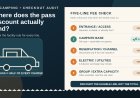
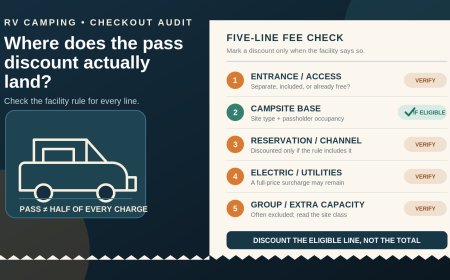
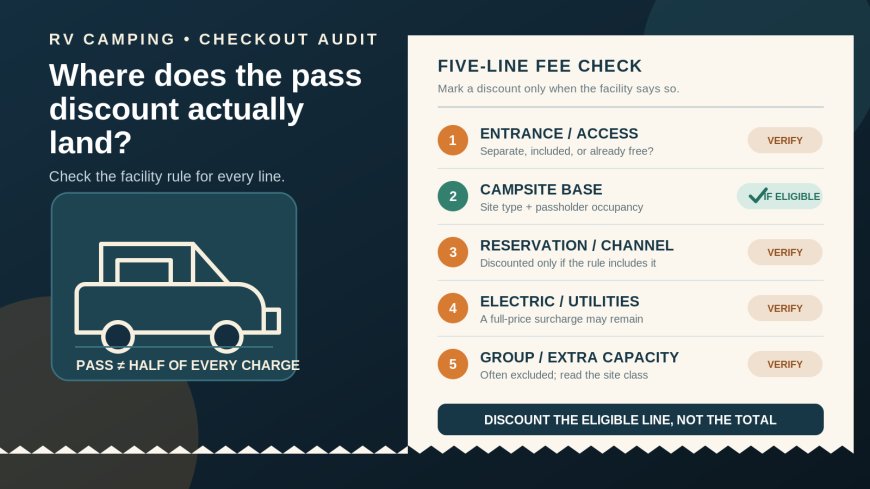
The five-line checkout audit
Run this audit for the exact campground, site type, dates, and booking channel.
1. Entrance or access
Write down whether entrance is charged separately from camping. Then record what the pass covers for the arriving vehicle or people. If a timed-entry reservation is required, give it its own row; access coverage does not automatically supply a reservation.
Evidence to save: entrance-fee page, pass coverage language, access-reservation confirmation, and arrival-vehicle details.
2. Campsite base
Identify the inventory class before applying a percentage: standard, RV, walk-to, double, group, cabin, or another label. Confirm that the passholder will occupy the eligible site for the required part of the stay.
Evidence to save: site number and type, nightly base, stay dates, pass selected in checkout, and discounted base shown.
3. Reservation or channel charge
Look for a booking fee, reservation fee, call-center difference, or other transaction amount. Discount it only when the exact facility says it is included or the checkout visibly reduces it. Sleeping Bear includes reservation fees in its pass treatment; that does not make the rule universal.[1]
Evidence to save: pre-discount and post-discount checkout screens, booking channel, and the label attached to each fixed charge.
4. Electric or utility line
Separate the basic pad from electricity, water, sewer, dump service, or other facility charges. An electric site may bundle those services into one rate, or it may show a surcharge that stays at full price. Arrowhead uses the second pattern.[4]
Evidence to save: utility description, amperage, mandatory-versus-optional wording, and the exact amount left after the campsite discount.
5. Group and extra-capacity fees
Check group, double, and multiple-site rules independently. Sleeping Bear excludes group campsite fees; Arrowhead excludes double sites; Red Rock excludes group and walk-to sites.[1][4][5] A pass tied to one person's occupied campsite should not be projected across several reservations without explicit facility language.
Evidence to save: site class, capacity, number of sites, passholder occupancy requirement, and each undiscounted amount.
Stop if the checkout total cannot be reconstructed
Before paying, the arithmetic should be explainable from the five rows. You should be able to point to the discounted campsite base, every full-price add-on, and any separate access requirement. If the system displays only a final number, capture both the rate details and the cart, then ask the facility which fee received the pass.
Use a simple notation:
entrance/access + discounted eligible campsite + reservation/channel charge + electric/utilities + group/extra capacity = expected checkout total
Do not put a percentage in front of the whole expression. Each term gets its own answer.
Save the valid pass, photo identification if required, and the reservation confirmation for arrival. Facility pages can change, but a dated copy lets you show which rule and price shaped the booking. Recheck shortly before the trip, especially if the reservation was made months ahead.
The Senior or Access Pass can cut an RV campsite bill. It does not promise to halve the entire stay. The discount is only as broad as the exact facility's eligible fee line.
Sources
What's Your Reaction?