





Grand Canyon winter RV camping: Mather or Trailer Village?
Compare Mather and Trailer Village for a Grand Canyon winter RV stay, including current closure status, hookups, reservations, rig fit, generators and snow access.

Grand Canyon winter RV camping: Mather or Trailer Village?
By Romana | October 23, 2026
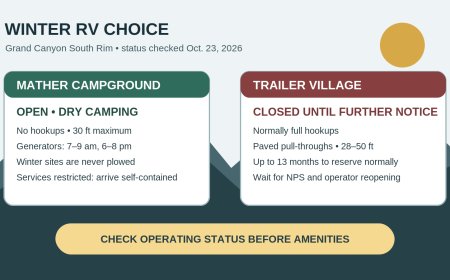
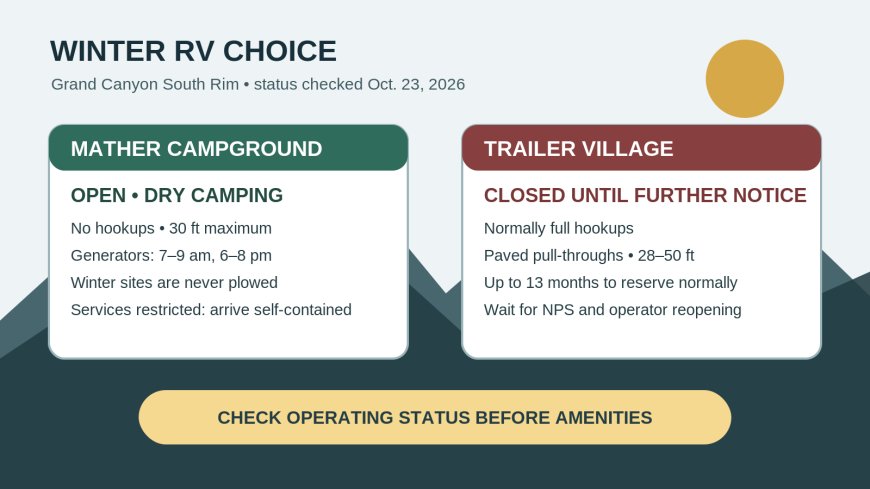
The usual Grand Canyon winter RV comparison has a lopsided answer right now. Mather Campground is open, but the National Park Service lists it as dry camping under Stage 4 water restrictions. Trailer Village, normally the South Rim's full-hookup option, is closed until further notice.[1] A reservation screen or a page that says "open year-round" cannot overrule that dated operating notice.
That makes the first decision availability, not hookups. If Trailer Village reopens, it is the easier fit for a large, utility-dependent RV. While it remains closed, an in-park winter stay means building a Mather plan around no site hookups, a 30-foot rig ceiling, limited generator windows, snow that may remain inside the campground, and services that can close independently.[1][2]
The comparison that matters on October 23
| Question | Mather Campground | Trailer Village RV Park |
|---|---|---|
| Current winter availability | Open all year, but dry camping until further notice under Stage 4 water restrictions.[1] | Closed until further notice under the same water restriction.[1] |
| Site utilities | No electric, water or sewer hookups.[2] | Normally water, sewer and 30/50-amp electric hookups.[5] |
| Published rig fit | Motorhome or trailer maximum is 30 feet; only sites 120, 121, 128, 172 and 185 take a 30-foot trailer.[2] | Paved pull-through sites are published for vehicles from 28 to 50 feet.[5] |
| Reservation path | Recreation.gov accepts winter reservations; unreserved sites may be sold at the kiosk one night at a time.[2] | The operator normally books as far as 13 months ahead, but a future booking is not evidence that the current closure has ended.[1][5] |
| Generator rule | 7-9 a.m. and 6-8 p.m.; Pine Loop permits generators during those hours in winter.[2] | The cited operator page publishes quiet hours but no generator schedule. Full hookups normally reduce the need for one; ask the operator for the actual rule if the campground reopens.[5] |
| Winter access | Campground roads may be plowed long after a storm, and individual sites are never plowed.[2] | The South Rim is generally open year-round, but current campground closure controls overnight use.[1][3] |
The table is a planning snapshot, not a promise about a future arrival. The NPS operations page is the status source to check first. The campground pages answer the second set of questions: what fits, what is supplied, and how a stay normally works.
Mather trades utilities for an in-park winter base
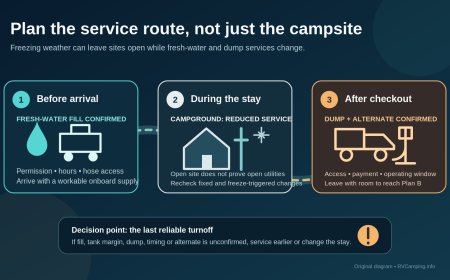
Mather is not a partial-hookup campground. Recreation.gov states that it has no electric, sewer or water connections at the sites. Under normal operations, a nearby Camper Services building provides a dump and water-fill station, but NPS currently lists Camper Services, showers and laundry as closed until further notice.[1][2] Fill and dump before entering the park unless the same-day status page clearly says those services have resumed.
The practical power budget starts with two short generator windows: 7-9 a.m. and 6-8 p.m. Quiet hours run from 10 p.m. to 6 a.m. Pine Loop is generator-free from March 1 through November 30, but Recreation.gov expressly allows generator use there during winter operations, inside the posted hours.[2] That seasonal exception matters in December, January and February; it does not create permission to run overnight heat from a portable generator.
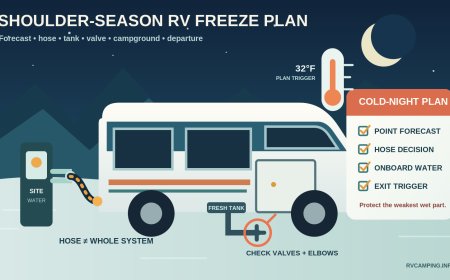
Cold-weather battery math can get unforgiving. Propane heat still draws from the house battery because the furnace blower and control board run on 12 volts. Lights, water-pump cycles and device charging add to the draw. The article cannot tell you how many amp-hours your RV needs without its battery capacity, furnace draw and forecast. It can tell you that Mather's two-hour evening window ends well before the coldest part of the night. Arrive with a charged bank and a backup that works without violating quiet hours.
Mather also asks more of the water and waste plan. "Dry camping" may affect available spigots and facilities beyond the permanent absence of site connections. NPS says the current restriction leaves the campground in dry-camping mode and bans outdoor wood fires.[1] Check what is available at the kiosk on arrival instead of stretching an older normal-operations description into a current promise.
Rig length is a site problem, not a campground label
Mather's published maximum is 30 feet for a motorhome or trailer. That number still overstates availability for a 30-foot trailer: Recreation.gov names only five compatible sites, 120, 121, 128, 172 and 185, and says the others will not fit one.[2] It also requires vehicles to stay on pavement and face the one-way direction of the loop.
Measure the camping unit the way the reservation record describes it, then inspect the individual site's equipment details. Bike racks, cargo boxes and tow bars can turn a nominal fit into an overhang. Hard, rocky terrain makes leveling equipment useful even after the length works.[2]
Trailer Village's normal design is far more forgiving. The operator publishes paved pull-through sites for vehicles from 28 to 50 feet, plus water, sewer, and 30- or 50-amp electrical service.[5] That is the logical choice for a 31- to 50-foot unit or an RV that cannot dry camp safely. At present it is only a future choice because NPS lists the campground closed.[1]
Reservations do not settle operating status
Mather reservations are available on Recreation.gov for both the December 1-February 28 winter period and the rest of the year. Any campsites not reserved online can be offered first-come, first-served at the kiosk, one night at a time; Recreation.gov warns that those sites can sell quickly and advises arriving near 8 a.m.[2] NPS separately recommends reservations during the December holiday period.[3]
Trailer Village normally accepts reservations up to 13 months ahead and recommends booking about a year ahead for May through October.[5] That long window is useful for planning only after the closure notice changes. A confirmation for a future date establishes a booking, not a guarantee that a water emergency or other operating restriction will be over.
Keep the cancellation terms and current contact number with the reservation. If the NPS update and operator page disagree, treat the more restrictive current status as controlling until the operator resolves it.
Snow changes the last mile inside the campground
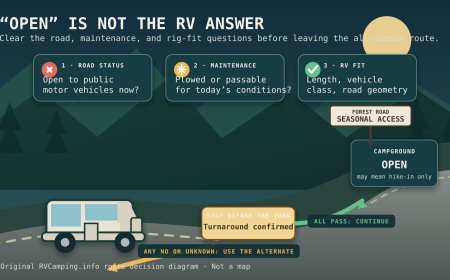
The South Rim stays open through winter, and NPS says park roads are drivable except during inclement weather. Road crews use cinders rather than salt or snow-melt chemicals. Chains are generally not required, though drivers may use them in snow or slippery conditions.[3] That general access statement does not mean every campsite is cleared.
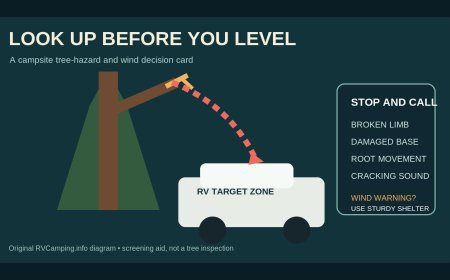
Recreation.gov warns that roads into Mather may not be plowed until long after a storm and that campsites are never plowed. It tells winter campers to bring a shovel.[2] For an RV, that means the problem may shift from Highway 64 to the loop entrance, the site apron or the space needed to deploy steps and stabilizers.
Do not use arrival as the traction test. Read the park's current conditions, road report and forecast while you still have a dependable place to stop. If the loop is not ready for your vehicle, wait somewhere legal rather than blocking a one-way campground road.
Day-use mobility has its own size limits. NPS calls vehicles over 22 feet and vehicle-trailer combinations over 22 feet oversized for South Rim parking. It designates three RV parking areas and tells drivers not to spread across ordinary spaces.[4] Market Plaza's Lot B accepts RVs 30 feet and under and sits 0.2 mile from Mather and 0.3 mile from Trailer Village.[4] A larger rig is better left in a campsite while the park shuttle is running, but winter route schedules must be checked for the actual travel date.
A workable arrival plan
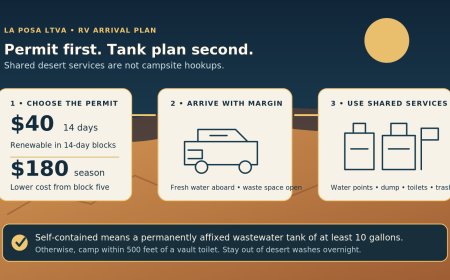
For Mather, arrive with enough water, holding-tank space and battery capacity to get through the first night without Camper Services. Carry leveling blocks, a snow shovel and traction equipment appropriate to the tow vehicle or motorhome. Save the reservation and campground map offline. At the kiosk, ask about potable water, restroom status, fire restrictions, dump access and the condition of your assigned loop.
For Trailer Village, do not drive to the check-in point until both NPS and the operator confirm reopening. Then verify the exact site class, electrical service and total rig length. The operator notes that electrical monitoring systems are not compatible with its Classic Sites, so owners who depend on an energy-management or surge-monitoring device should ask what that wording means for the assigned pedestal before arrival.[5]
The choice becomes simple once the status layer is applied. Mather can work for a rig of 30 feet or less whose crew can manage stored water, waste and overnight battery demand. Trailer Village is the stronger normal fit for longer RVs and travelers who need a pedestal, but it is not an option while the closure remains in force.[1][2][5]
Editorial note: This is a research-based planning guide. No firsthand stay, site measurement or winter road inspection is claimed. Conditions can change after the retrieval date; operating statements are tied to the cited official pages.
Sources
- Grand Canyon National Park Operations Update - Current campground and service status, retrieved October 23, 2026.
- Mather Campground, Recreation.gov - Reservations, site fit, hookups, winter access and generator rules, retrieved October 23, 2026.
- Visiting Grand Canyon During Winter - South Rim winter access and campground guidance; last updated September 21, 2026.
- Visiting the South Rim in an RV or Pulling a Trailer - Oversize parking and winter road-access context; last updated September 12, 2026.
- Trailer Village RV Park - Official concessionaire specifications and reservation policy, retrieved October 23, 2026.
What's Your Reaction?