
























Cooling campground leftovers when RV fridge space and power are tight
Use a four-gate test for the clock, shallow-container capacity, 40°F cold storage and backup power before saving campground leftovers.

Cooling campground leftovers when RV fridge space and power are tight
By Romana | October 16, 2026 | Cooking
The dangerous moment for campground leftovers often arrives before the refrigerator door opens. A full RV fridge, a large hot pot and uncertain overnight power create a capacity problem: the meal needs prompt cooling, but crowding warm food into an already marginal compartment can leave the whole plan unverified.
Quick answer: Decide before cooking whether cold storage has enough space, airflow and dependable power. Start the exposure clock when the food leaves active cooking or hot holding. Divide only the amount worth saving into clean, shallow meal-size containers, then refrigerate promptly. Keep the appliance and food zone at 40°F or below. If outdoor conditions exceed 90°F, the normal two-hour refrigeration window becomes one hour. When capacity or power cannot support safe storage, serve less, share food promptly, use shelf-stable ingredients next time or discard the excess on time.[1][2][3]

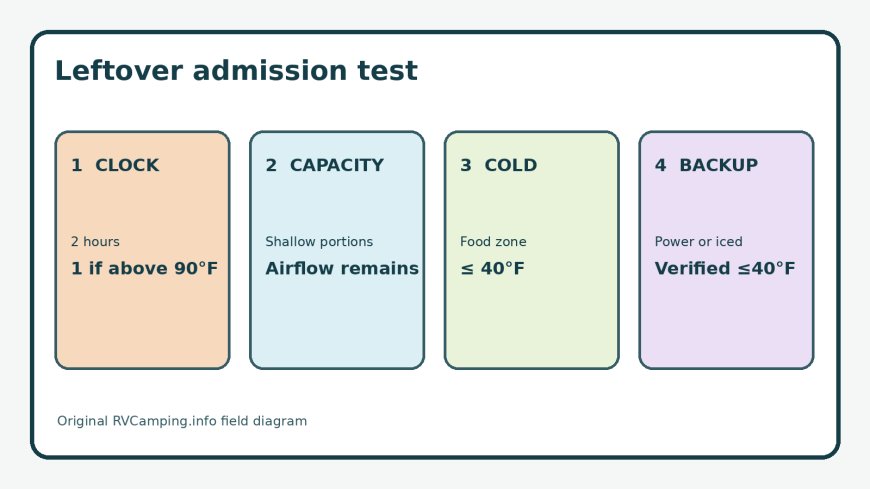
Leftovers enter cold storage only after the clock, capacity, portion and power gates pass. Original RVCamping.info diagram.
Make the storage decision before dinner
A campsite is a poor place to discover that six quarts of stew will not fit around the milk, eggs and breakfast supplies. Inventory the refrigerator before the stove is lit. Check the appliance thermometer, identify shelf space that allows air to circulate, and estimate the number of shallow containers the planned meal will require.
FDA says the refrigerator should hold 40°F or below and should not be packed so tightly that cold air cannot circulate.[2] In a compact RV refrigerator, usable cooling capacity is smaller than geometric shelf volume. A container that technically fits may block a vent, press against a door seal or force several other foods into a warm spot.
Set a leftover ceiling: the number of meal-size containers the refrigerator or a verified cooler can accept without crowding. Cook to that ceiling. If the group is likely to eat less than expected, hold back shelf-stable ingredients rather than creating a pot whose only destination is an overloaded refrigerator.
Start one honest clock
Perishable cooked food should be refrigerated or frozen within two hours. If it has been exposed to temperatures above 90°F, that window drops to one hour.[2][3] The clock does not restart when food moves from the picnic table to the RV counter.
Write the service time on a piece of tape before the meal begins. Count time spent portioning, talking, cleaning and waiting for refrigerator space. If a dish remains under verified hot holding, its cold-storage clock begins when that controlled holding ends, not when cooking originally stopped. An unmeasured pan on a turned-off burner is not hot holding.
The clock is a deadline, not a target. Cooling work should begin well before it expires. If the timing is unknown, smell, taste and a later reheat cannot reconstruct it. CDC advises discarding perishable food after four hours without refrigeration or another cold source during a power loss and warns against tasting food to judge safety.[3] For newly cooked leftovers, use the stricter prompt-refrigeration window rather than planning around emergency-outage limits.
Portion for the cold space you actually have
USDA and FDA advise dividing large amounts of leftovers into shallow containers so they cool faster.[1][2] Translate that into an RV process:
- Set out clean containers before serving begins.
- Reserve only the amount that fits within the declared cold-storage ceiling.
- Split dense food and liquids into shallow, meal-size portions instead of one deep tub.
- Leave lids arranged so the containers can be covered without touching dirty surfaces.
- Mark the food and storage date once it is cold-storage bound.
- Place containers where air can move around them; do not stack a warm tower that blocks circulation.
Do not leave a large pot on the counter until it reaches room temperature. FDA says hot food can go into the refrigerator, while smaller containers help it cool more quickly.[2] A very large hot load can still challenge a tiny RV refrigerator, which is why the leftover ceiling and portion plan come first.
An ice-water bath can help reduce the temperature of soup or sauce before refrigeration when it can be done cleanly. Put the food in a smaller clean pan, set that pan in a larger basin of ice water, and stir with a clean utensil. Keep cooling water out of the food. Do not perform this step on a dirty picnic table or extend it beyond the applicable refrigeration deadline.
Protect the rest of the refrigerator
Leftovers are not the only food at risk. A hot container pushed against dairy, deli meat or eggs can warm its neighbors. Do not cover vents or pin packages against the door. Keep raw animal products in sealed containers below cooked leftovers so a leak cannot drip into ready-to-eat food.[2]
Use the appliance thermometer to check the compartment, then spot-check the storage plan after the new load has had time to settle. If the refrigerator cannot maintain 40°F or below, reduce the load and move containers to another verified cold source. Do not respond by turning the control colder and assuming the result; measure it.
Door discipline matters during cooldown. Assemble all containers first, choose their positions, load once and close the door. Repeated rearrangement replaces cold air with warm campground air and consumes limited electrical or propane capacity.
Treat power as part of the recipe
A refrigerator that depends on shore power, a battery bank, an inverter, propane or a generator needs an overnight plan. The food-safety rule stays the same across energy sources: the stored food must remain at 40°F or below.[2][3]
Before saving food, answer four questions:
- Is the refrigerator already at or below 40°F?
- Can the approved energy source run through the cooling period and overnight?
- Are generator hours, quiet hours or campground rules likely to interrupt that plan?
- Is a cooler with ice or frozen packs ready if the primary source fails?
Follow the refrigerator and RV manufacturer's operating limits, including ventilation and leveling requirements. This food-safety article cannot determine whether a particular absorption refrigerator, compressor refrigerator, inverter or generator setup is safe to operate.
Keep a backup cooler pre-chilled when power is uncertain. CDC recommends having a cooler and frozen gel packs available so refrigerated food can be transferred and held at 40°F or below during an outage.[3] The backup cooler must have its own thermometer and adequate cold source; an empty insulated box is not backup refrigeration.
Use a power-loss transfer trigger
Do not wait for an outage to improvise. Set the trigger in advance: if refrigerator power is lost and recovery is not immediate, keep the door closed while you confirm the cause and prepare the backup. CDC says an unopened refrigerator can keep food safe for up to four hours during an outage, but this is an emergency boundary, not a reason to repeatedly open the door and sample temperatures.[3]
If the outage reaches four hours and a cooler with ice is available, CDC directs moving refrigerated perishables into it and keeping them at 40°F or below.[3] In an RV, act sooner when the refrigerator was heavily loaded with warm leftovers, the starting temperature was uncertain or the door had already been opened.
Transfer in one pass:
- Prepare the cooler with ice or frozen packs and verify its thermometer.
- Decide which high-value perishables fit; do not waste open-door time debating.
- Move sealed leftover containers and other perishables quickly.
- Close both units.
- Record the transfer time and cooler temperature.
- Add cold source as needed without exposing food to contaminated meltwater.
Discard perishable leftovers when their time or temperature history cannot be established. CDC notes that unsafe food may look and smell normal.[3]
Build a no-cold-space fallback meal
The best response to limited refrigeration is sometimes to create fewer leftovers. Keep a shelf-stable fallback meal for nights when the refrigerator is warm, the battery forecast is poor or the cooler is already committed to raw food.
Adjust the cooking plan by opening fewer cans, cooking fewer portions, or reserving dry ingredients for tomorrow. Serve seconds before portioning leftovers so the group makes one final choice while the clock is visible. Share excess immediately only if the recipient can eat it within the safe period or has verified cold storage.
Do not move warm leftovers into a raw-meat cooler without a separation plan. Cooked food belongs in watertight containers above a fully contained raw zone, or preferably in a separate clean cooler. Cold capacity and contamination control must both pass.
The four-gate leftover card
A leftover container enters the fridge only when all four gates pass:
- Clock: still inside two hours, or one hour above 90°F.[2]
- Capacity: shallow containers fit with airflow and do not block vents.[1][2]
- Cold: a thermometer shows the storage zone at 40°F or below.[2][3]
- Continuity: approved power or a thermometer-equipped iced cooler can maintain that temperature.
If a gate fails, do not crowd the container into storage and hope. Reduce the batch, use the food within the remaining safe window or discard it.
This article develops the leftover ceiling, four-gate admission test and transfer trigger as RV planning tools. Federal sources provide the refrigeration window, shallow-container method, cold-storage temperature, circulation guidance and outage boundaries.
Sources
- USDA FSIS: Leftovers and Food Safety — prompt refrigeration, shallow containers and leftover handling (archived source text reviewed October 16, 2026).
- FDA: Safe Food Handling — 40°F storage, time limits, refrigerator circulation and shallow-container guidance (retrieved October 16, 2026).
- CDC: Keep Food Safe After a Disaster or Emergency — appliance thermometers, cooler backup and outage discard guidance (archived source text reviewed October 16, 2026).
What's Your Reaction?