



Grand Canyon North Rim RV camping in 2026: inside the park or outside the gate?
Compare North Rim Campground, DeMotte, Kaibab Camper Village, and Jacob Lake by 2026 season, water, hookups, rig fit, and driving distance.

Grand Canyon North Rim RV camping in 2026: inside the park or outside the gate?

By Romana | Updated September 18, 2026
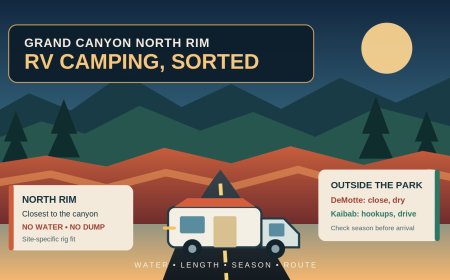
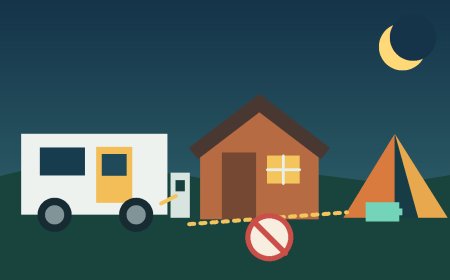
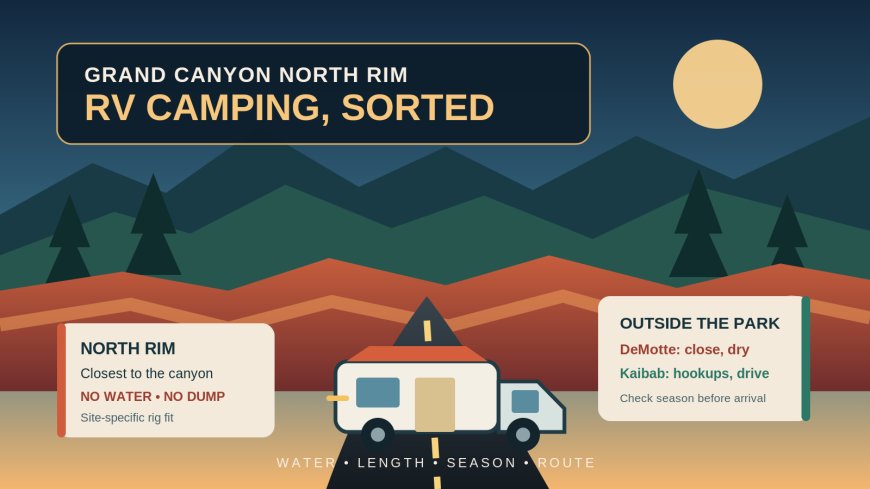
The best Grand Canyon North Rim RV campground depends on one uncomfortable question: how much inconvenience can your rig absorb? North Rim Campground puts you inside the park, but its 2026 setup has no potable water, no hookups, no dump station, portable toilets, and tight sites. DeMotte is the closest public-land alternative outside the entrance, with drinking water but no hookups. Kaibab Camper Village near Jacob Lake trades a much longer daily drive for full hookups.
There is also a calendar trap. On September 18, the park campground was still open for its June 1 through October 15 season. DeMotte's published 2026 season had ended September 17.[1][3] A late-September camper therefore cannot treat the closest two campgrounds as interchangeable backups.
Status check, September 18, 2026: NPS last updated its North Rim status page on September 15. North Rim Campground and Highway 67 were open, but the North Kaibab Trail had been closed since an August 29 flash flood.[1][8] Conditions can change quickly after storms or with fire-recovery work. Recheck the North Rim status page, park operations update, AZ 511, and the exact campground booking page before leaving pavement or committing a long rig.
The short answer
- Choose North Rim Campground for the shortest drive to the rim and a park-based stay. It is the clear location winner, but only for a rig that fits a specific site and can arrive with enough freshwater and wastewater capacity.
- Choose DeMotte during its operating season if you want a simple Forest Service campground close to the park boundary. It has limited potable water, but filling an RV tank is prohibited, and it has no hookups.[3][4]
- Choose Kaibab Camper Village if full hookups matter more than the commute. Its operator lists 41 RV sites, including full-hookup and water-and-electric choices, about 35 miles from the park entrance.[7]
- Keep Jacob Lake Campground in mind as another dry-camping option near the AZ 67/US 89A junction, not as a hookup substitute. Its federal listing says it is seasonal, has no hookups, and is 44 miles north of the North Rim destination area.[5]
Side-by-side RV comparison
| Decision factor | North Rim Campground | DeMotte Campground | Kaibab Camper Village | Jacob Lake Campground |
|---|---|---|---|---|
| Setting | Inside Grand Canyon National Park | Kaibab National Forest, 7 miles north of park boundary | Private campground near Jacob Lake | Kaibab National Forest at Jacob Lake |
| 2026 timing | June 1-Oct. 15; open on Sept. 18 | May 15-Sept. 17; season ended before Sept. 18 | Confirm live availability with operator | Seasonal; confirm current status before travel |
| Hookups | None | None | Full-hookup and water/electric sites advertised | None |
| Freshwater | No potable water; packaged water sold at General Store | Limited drinking water; no RV-tank filling | Confirm selected site's utility package | Limited drinking water; no RV-tank filling |
| Wastewater | Dump station closed; no gray/black discharge | No hookups; no ground discharge | Full-hookup sites advertised | No hookups; no ground discharge |
| RV fit | Site-specific combined-length limit; tight trees, turns, and clearance | Tents, trailers, and small motorhomes | 41 RV sites advertised; confirm dimensions | Tents, trailers, and small motorhomes |
| Daily drive tradeoff | At the rim | Short drive to entrance, then about 12 miles farther to developed area | About 35 miles to entrance, then farther to rim destinations | About 31 miles to entrance, then farther to rim destinations |
The mileages do not measure the same endpoint on every source. That matters. The park's 2026 pocket map places DeMotte 4 miles north of the entrance station and Jacob Lake 31 miles north of it, while the DeMotte booking page uses 7 miles to the park's North Rim entrance and the private campground advertises 35 miles to the entrance.[4][6][7] Use the reservation's map pin and your actual day-use destination, not a marketing shorthand, when estimating fuel and arrival time.
North Rim Campground: closest, driest, and least forgiving
North Rim Campground reopened June 1 after the 2025 Dragon Bravo Fire and is scheduled through October 15. Reservations are available, and NPS says a limited number of walk-up sites remain.[1] For 2026, Aramark operates the campground, so fees and policies may differ from NPS-operated campgrounds.[1]
The utility picture is blunt. There are no RV hookups or potable-water taps. The dump station, showers, and laundry are closed, and the campground uses temporary restrooms.[1][6] Recreation.gov also bans releasing either gray- or black-tank contents; every liquid must leave with you.[2]
That makes freshwater and wastewater capacity the real stay limit. A couple may be comfortable for several nights in one RV and run short on the first evening in another. Count drinking, cooking, handwashing, dishes, toilet flushing, and pet water. Then leave reserve capacity for a delayed departure. Buying packaged water at the General Store can rescue drinking supply, but it does not create an easy way to refill a large onboard tank or empty full waste tanks.
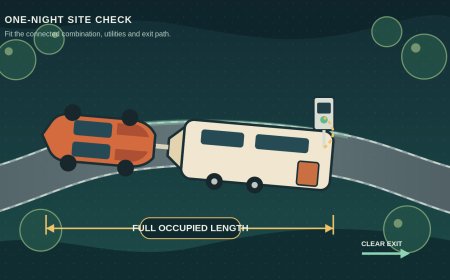
Site fit needs the same caution. Recreation.gov defines each site's maximum as the combined length of the RV or trailer and tow vehicle.[2] It also warns about narrow passages, tight curves, uneven sites, tree clearance, and limited room for slide-outs or awnings.[2] A 25-foot trailer is not a 25-foot campsite request when the truck must fit too.
Generators are limited to 7-9 a.m. and 6-8 p.m. Mountain Standard Time, and they are prohibited in the tent-only area.[2] Those two short windows make a high-demand battery plan risky. If the furnace blower, residential refrigerator, medical equipment, or inverter loads depend on daily charging, calculate the expected amp-hour use before booking.
DeMotte: the close outside-the-park fallback, when it is open
DeMotte is the obvious geographic backup. The Forest Service campground has 38 single-family sites for tents, trailers, and small motorhomes, with no utility hookups.[4] Recreation.gov says drinking water is available, but its notice prohibits filling RV water tanks because the supply is limited.[4]
For this article's September 18 planning date, DeMotte had just fallen off the board. NPS listed its 2026 season as May 15 through September 17.[3] Recreation.gov also warns that opening and closing dates are weather dependent.[4] Do not drive there after the published season expecting an unattended site merely because AZ 67 and the park remain open.
During the operating season, DeMotte works best for a self-contained smaller RV whose crew values proximity more than utilities. It can also be a sensible first search when an in-park site is too tight or sold out. It is not a water-fill strategy, and it does not solve the need for shore power or sewer.
Kaibab Camper Village: hookups with a commute
Kaibab Camper Village is the utility choice in this comparison. The current operator advertises 41 RV sites, with full-hookup, water-and-electric, and dry options, plus showers and laundry for registered guests.[7] Confirm the exact amperage, sewer connection, site dimensions, cancellation terms, and 2026 availability in the live reservation. "Full hookup" does not tell you whether a particular pedestal and parking pad match your RV.
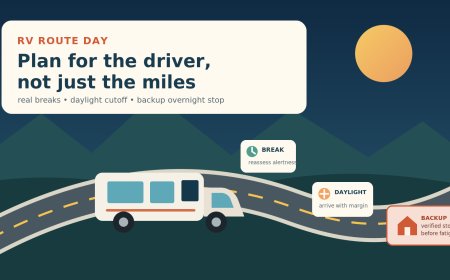
The cost is road time. The operator places the campground about 35 miles from the park entrance.[7] The North Rim developed area lies farther south. The 2026 park map shows 12 miles between the entrance and the North Kaibab Trailhead area.[6] A sightseeing day can therefore begin with roughly 45-plus miles of driving before the first overlook, then repeat the same distance after dark.
That commute is a fair trade for some travelers. It can make sense for a large battery load, a small freshwater tank, a multiweek trip that needs laundry, or a rig that cannot tolerate the park campground's clearances. It is a poor fit for anyone who wants to return to the RV for lunch or a midday rest.
Jacob Lake: a dry base near the highway junction
Jacob Lake Campground sits near the US 89A and AZ 67 junction. Its Recreation.gov listing describes a seasonal campground with limited potable water, no hookups, and first-come sites that must be claimed in person.[5] It also prohibits filling RV tanks from the limited water supply.[5]
The campground is farther from the rim than DeMotte and does not add hookups, so its strongest advantage is route position. It keeps you near fuel, food, and the decision point for trips toward Kanab, Fredonia, Page, or the North Rim. Because its season and availability are not identical to the park's, check the Forest Service status and Recreation.gov calendar rather than treating it as an automatic late-season overflow lot.
The route can eliminate an otherwise good campsite
The paved approach is one-way in practical terms: Highway 67 carries all road traffic to and from the North Rim, and drivers cannot cross the canyon by road to South Rim.[2] NPS puts the drive between the two rim villages at about 215 miles and five hours, despite an average straight-line separation of only 10 miles.[3] This is a North Rim plan, not a quick add-on to a South Rim reservation.
The campground fit and sightseeing fit are separate tests. Vehicles longer than 22 feet in total length are prohibited on Cape Royal Road and at the North Kaibab Trailhead.[6] Oversize parking near the former lodge area may let some campers leave an RV parked and explore in a shorter vehicle, but it does not make every road legal for the full combination.
The 2026 fire-recovery landscape adds another layer. NPS says the North Rim, Highway 67, Cape Royal Road, and Point Imperial Road were open in its September 14 operations update. The North Kaibab Trail was closed after the August 29 flood, and the September 15 status page listed several other trail closures.[1][8] A campground reservation is not evidence that a planned trail, pullout, or secondary route is open.
A booking sequence for an RV
- Check the live park status first. Confirm Highway 67, the campground, and the roads or trails you actually plan to use.[1][8]
- Measure the complete combination. Use motorhome plus toad, or trailer plus tow vehicle. Compare that number with the exact site's combined-length limit.[2]
- Run the water and tank math. North Rim Campground has no potable water and no dump station. DeMotte and Jacob Lake do not permit RV-tank filling from their limited water supplies.[2][4][5]
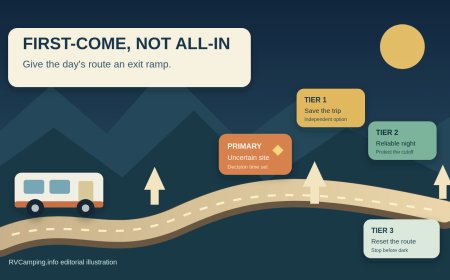
- Choose location or utilities. North Rim Campground minimizes driving. DeMotte is the closest public-land alternative in season. Kaibab Camper Village supplies the hookup option at the price of a long round trip.[3][7]
- Check the date, not the usual season. In 2026, DeMotte ended September 17 while North Rim Campground continued through October 15.[1][3]
- Plan sightseeing with a shorter vehicle if needed. The 22-foot restriction applies to Cape Royal Road and the North Kaibab Trailhead, even if the RV fits its campsite.[6]
- Save the confirmations offline. Keep the reservation, site dimensions, current closures, and AZ 511 route status available without cell service.
For a small self-contained RV, the in-park campground earns its inconvenience by returning hours to the trip. DeMotte is the better simple campground when it is operating and the park is full. A utility-dependent rig should start with Kaibab Camper Village, then decide whether the daily commute is acceptable. The wrong move is to book by distance alone and discover at the gate that the water, wastewater, length, or calendar constraint was the one that mattered.
Source credit: RVCamping.info compared current National Park Service, Recreation.gov, U.S. Forest Service-linked campground, and campground-operator records retrieved September 18, 2026. The constraint-first decision sequence, tank-capacity analysis, and endpoint-aware mileage comparison are original editorial work.
Sources
- Status of the North Rim (National Park Service; last updated September 15, 2026; accessed September 18, 2026)
- North Rim Campground (AZ) (Recreation.gov; accessed September 18, 2026)
- Camping in Grand Canyon National Park (National Park Service; last updated August 31, 2026; accessed September 18, 2026)
- DeMotte, Kaibab National Forest (Recreation.gov; accessed September 18, 2026)
- Jacob Lake Recreation Area (Recreation.gov; accessed September 18, 2026)
- 2026 North Rim Pocket Map (National Park Service PDF; updated July 2, 2026; accessed September 18, 2026)
- Kaibab Camper Village by WYLDE (campground operator; accessed September 18, 2026)
- Grand Canyon National Park Operations Update (National Park Service; last updated September 14, 2026; accessed September 18, 2026)
What's Your Reaction?