



First-come RV camping without gambling the day's route
Build a first-come RV campground route around fit checks, decision times and three backup tiers so one uncertain site does not consume the day's safe driving margin.


First-come RV camping without gambling the day's route
By Romana | September 18, 2026
A first-come, first-served campground is a candidate, not a destination. Until your RV is in a legal, suitable site and you have completed the campground's registration steps, you do not have a campsite.
That distinction should change the route. Build the day around a decision time, an exit ramp and three backup tiers. A good plan may still put the prettiest first-come campground first. It just prevents one uncertain site from consuming the daylight, fuel and driver attention needed to reach somewhere else.
Planning note: This guide was researched September 18, 2026. It does not report live campsite availability. Check the managing agency, the exact campground page, alerts, road status and posted rules before departure and again when you still have service.
The short answer
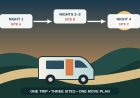
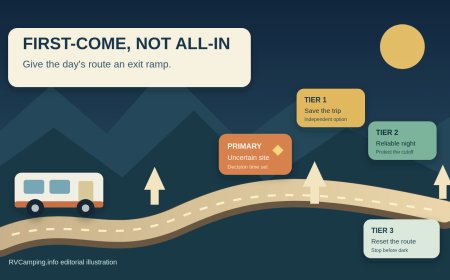
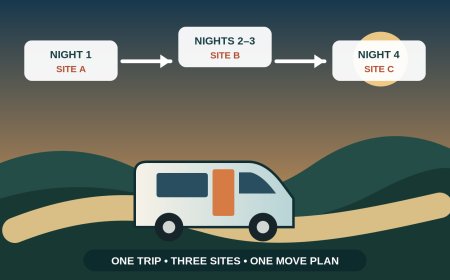
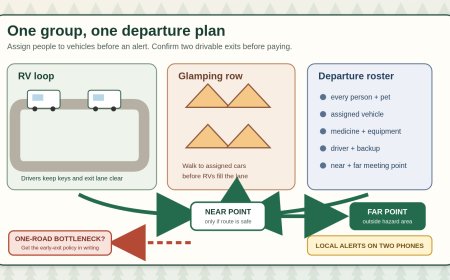
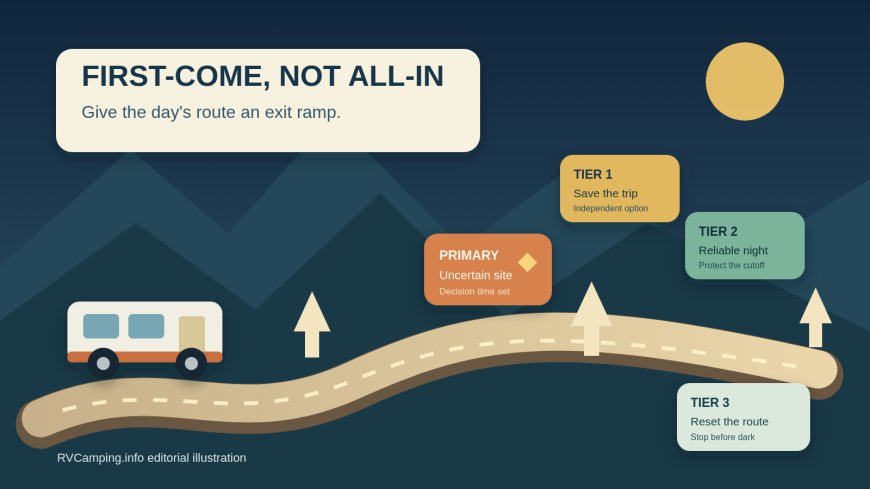
Do not make an all-day drive to a first-come campground unless at least one acceptable backup remains reachable before dark. Rank backups before departure:
- Tier 1 is another campground in the same area that fits the RV and preserves most of the trip.
- Tier 2 is the reliable overnight: a reservable campground, an RV park you have confirmed, or a larger legal campground on a good road.
- Tier 3 is the route reset: a legal overnight farther back on the corridor or a different destination that prevents tired, after-dark improvisation.
Set a time when you will stop chasing Tier 1 and move to Tier 2. Set a second, earlier-than-dark time for Tier 3. If every backup depends on the same narrow road, tiny set of sites, fire closure or holiday crowd, you have three names but only one plan.
Why the campground page is not a vacancy board
"First-come" describes how a site is assigned. It does not say that a suitable site is empty now, that someone will leave today or that your RV will fit the space that opens.
Official examples show how different the odds can be. Joshua Tree describes heavy competition for first-come sites during holidays, many weekends and spring, and says they are typically full by Friday afternoon during the periods described on its page.[1] Glacier says most of its first-come campgrounds fill early in busy summer months.[2] New River Gorge says its primitive campgrounds can fill quickly in busy months and explicitly recommends a backup plan.[3]
A Recreation.gov listing for Lid Creek Campground in Flathead National Forest gives the online limitation in unusually plain language: first-come sites may already be occupied because their status cannot be updated on the website.[6] A gray booking calendar, an "FF" label or the absence of reservable inventory is not proof of a vacancy.
Treat information in three bands:
- Confirmed rules: open season, road restrictions, RV length, hookups, payment method, stay limit and check-in procedure.
- Useful signals: a ranger or host report, a same-day campground notice, a recent fill-time pattern, or a caller ahead of you who has actually arrived.
- Unknowns: the site that may open, the rig it can fit and the number of people currently driving toward it.
Plan from the confirmed rules. Use signals to choose between viable options. Never convert an unknown into a promise because the route works better that way.
Start with fit, not scenery
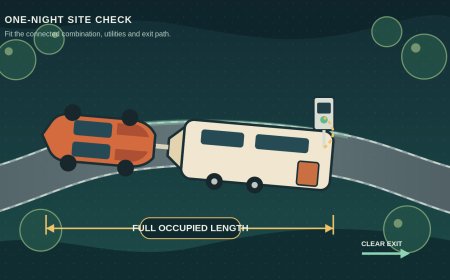
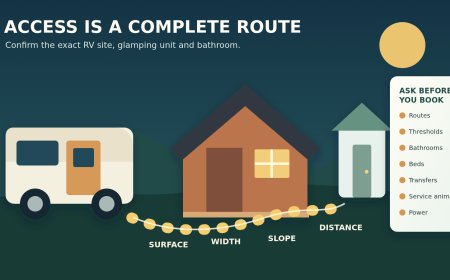
A vacant site is useless if the combination cannot enter the campground, turn through the loop or sit fully on the parking spur. Include the tow vehicle or toad when a published limit calls for combined length. Check height, width, axle or weight restrictions, grades, surface, turnaround space and any warning about trailers.
Joshua Tree, for example, publishes a 25-foot combined limit at Hidden Valley and White Tank; Belle can accommodate rigs up to 35 feet, though the park says most sites there fit 25 to 30 feet.[1] Glacier's page excludes RVs and trailers from some remote first-come campgrounds because of narrow, winding or rough access roads.[2] An archived April 6, 2026 copy of the Forest Service page for Camp Dick requires wheeled equipment to sit entirely within its assigned spur.[4]
Apply four hard screens to every candidate:
| Screen | Question that must have a yes |
|---|---|
| Access | Can this exact RV reach the loop and leave without relying on an unsafe turnaround? |
| Site | Can the whole setup fit as required, with slides and awning kept inside the site's usable space? |
| Systems | Can you camp there without missing hookups, potable water, dump access or permitted generator hours? |
| Rules | Is the campground open to this use, and can you complete the current payment or registration method? |
A campground that fails one hard screen is not a lower-ranked backup. Remove it.
Give the day four times
Arrival advice often stops at "get there early." That is too vague for an RV travel day. Put four times on the route sheet.
Target arrival is when you intend to reach the first campground. It should be based on the place's documented demand pattern and your driving limits, not a universal rule about arriving at checkout. Glacier lists noon checkout at its first-come campgrounds, but that local rule does not guarantee that a site will turn over at noon or fit the next RV.[2]
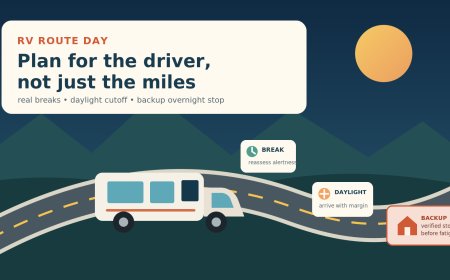
Decision time is when you stop waiting, circling or checking nearby loops. It protects the drive to Tier 2. Ten hopeful minutes can become an hour when a long RV has to crawl through several loops and queue at kiosks.
Tier 2 cutoff is the latest departure that still gets you to the reliable overnight with time to check in and set up. Add fuel, traffic, a wrong turn and slower travel on campground roads. Do not spend this margin at the first campground.
Daylight floor is the time after which you will not begin an unfamiliar forest road, tight campground loop or leveling job. It should move earlier when rain, smoke, snow, wildlife activity, fatigue or poor road surfaces raise the workload.
Write the times down before leaving. A cutoff invented at the full campground will usually favor "one more try."
Build backups in tiers
Tier 1: save the trip
Tier 1 keeps the main destination intact. It might be another public campground near the same trail system, a lower-amenity loop, or a facility outside the park boundary.
Choose two candidates only if they are meaningfully independent. Two small campgrounds on the same dead-end road may fill from the same demand and share the same closure. A stronger pair differs in at least one useful way: more sites, a different access road, a different operator, reservations, fewer amenities or less proximity to the headline attraction.
Tier 1 still has to pass the RV screens. Do not use a tent-oriented primitive campground as an RV backup just because it is nearby. New River Gorge's park sites, for example, have no drinking water, hookups or electricity and have limited restroom facilities.[3]
Tier 2: guarantee a workable night
Tier 2 trades some location quality for much more certainty. Favor a place with a reservation you can actually make, a staffed campground that has confirmed the rig and arrival window, or a high-capacity option with uncomplicated access.
This is the tier to protect with money when the rest of the trip depends on sleeping in the area. Read cancellation and late-arrival terms before booking. If you reserve Tier 2, do not assume you can ignore its arrival rule while chasing Tier 1. Call the operator when required, and cancel promptly if you will not use it.
Mixed reservation and first-come campgrounds can work well because they separate certainty from spontaneity. The archived Camp Dick page listed both types of sites and warned that weekend demand usually filled the campground before Friday morning.[4] The lesson is not that its old fill pattern predicts tonight. It is that "some first-come sites" does not make a busy mixed campground a safe end-of-day bet.
Tier 3: stop the loss
Tier 3 is not meant to rescue the original itinerary. It keeps a disappointment from turning into unsafe driving or an illegal overnight. Pick a legal campground or other overnight option on the route you can reach on major roads, even if it means retreating or abandoning the destination.
BLM says campsite selection at its developed campgrounds is typically first-come, though some accept Recreation.gov reservations. It also tells travelers to check the specific campground or local field office and confirm seasonal operating dates.[5] "BLM land nearby" is therefore not a complete Tier 3. Verify whether the exact place allows camping, whether a road and site suit the RV, and what local fire, stay, fee and access rules apply.[5]
If Tier 3 is also first-come, it needs its own fallback or a much earlier trigger. Uncertain plus uncertain does not become reliable because the second dot is farther away.
Use an uncertainty budget
Count the parts of the day that can fail:
- no suitable site at the primary campground;
- a slow or restricted access road;
- fuel, food or dump stops;
- weather, construction or a closure;
- a second first-come campground with the same demand pattern;
- limited phone service near the decision point.
Spend uncertainty on the campground if that is the experience you care about. Buy certainty elsewhere. Fuel before the final approach. Download the agency pages and map. Fill freshwater if the candidates do not have it. Keep Tier 2 on a paved route. Save the phone number and late-arrival instructions offline.
A practical limit is one major occupancy gamble per day. If the primary site is uncertain, the overnight backup should not also depend on an unverified forest road, a marginal length fit and a kiosk payment app you have not installed.
The arrival loop should be short
At the campground, use a fixed sequence:
- Read the entrance board and current notices before entering a loop that may be hard to exit.
- Confirm which sites are truly unoccupied under the posted system. A vehicle-free pad may still have an occupancy tag or belongings.
- Check the parking spur and route before committing the RV.
- Follow the local claim-and-pay procedure immediately.
- If no suitable site is open, leave at the decision time.
Do not block a loop, park in vegetation, hold a second site for another party or assume a site will become yours because people appear to be packing. First-come systems differ. Joshua Tree instructs visitors to locate an empty site, occupy it and then promptly complete registration and payment.[1] Under BLM's general guidance, the camper must occupy the site, pay and display the fee stub before the rental is complete; posted local rules still control.[5]
Calling can help, but ask a precise question: "Has anyone on site confirmed an unoccupied space today that can take a 34-foot motorhome?" A useful answer is still a snapshot, not a hold. Record who manages the facility, the time of the call and what was actually confirmed.
A one-page route card
Before departure, put this in the cab:
| Item | Primary | Tier 1 | Tier 2 | Tier 3 |
|---|---|---|---|---|
| Operator and phone | ||||
| Exact entrance coordinates | ||||
| RV access and maximum fit | ||||
| Hookups, water, dump, generator | ||||
| Payment and claim procedure | ||||
| Status checked at | ||||
| Drive time from prior choice | ||||
| Latest departure |
Add the weather and road-alert pages, not just the campground listing. A seasonal opening date does not overrule a gate, fire order, washout or temporary closure.
The plan is finished when every tier is legal, reachable and compatible with the RV, and when the driver knows exactly when to move on. The first campground can remain a gamble. The night's sleep should not be one.
Source note: RVCamping.info reviewed official National Park Service, Forest Service, Bureau of Land Management and Recreation.gov material retrieved September 18, 2026. The Camp Dick evidence is identified as an April 6, 2026 archived snapshot because the live Forest Service page blocked automated retrieval. The tier system, four-time route method, hard screens and uncertainty budget are original editorial planning frameworks.
Sources
- Campgrounds - Joshua Tree National Park
- First-Come, First-Served Campgrounds - Glacier National Park
- Camping - New River Gorge National Park and Preserve
- Camp Dick Campground - Arapaho and Roosevelt National Forests (archived April 6, 2026)
- Camping on Public Lands - Bureau of Land Management
- Lid Creek Campground - Flathead National Forest
What's Your Reaction?