







Big Bend RV camping: choose between full hookups, Rio Grande Village and Chisos Basin
Choose among Big Bend’s full-hookup Rio Grande Village RV Campground, dry Rio Grande Village Campground and size-limited Chisos Basin with a power-first test.

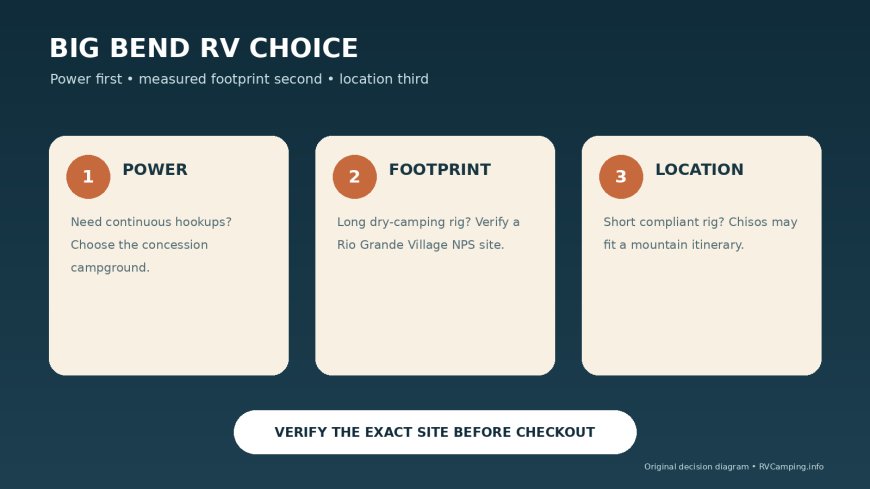
Big Bend RV camping: choose between full hookups, Rio Grande Village and Chisos Basin
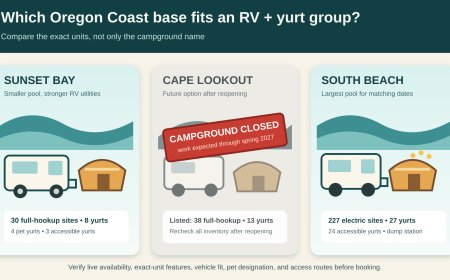
Big Bend presents three different operating plans under two place names. Rio Grande Village RV Campground is the concession-operated, full-hookup choice. Rio Grande Village Campground is the neighboring National Park Service dry campground with a dump-and-fill station. Chisos Basin Campground is the mountain option, but its approach and sites impose the tightest RV limits.[1][4][6]
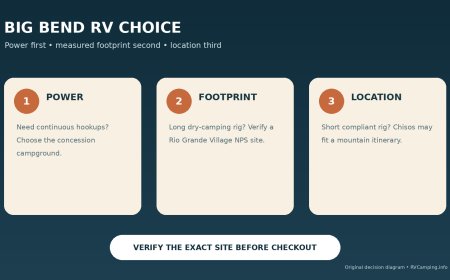
Short answer: Start with power, then size, then trip focus. Choose the concession RV campground when continuous shore power is non-negotiable and the RV is within its published 38-foot maximum. Choose the NPS Rio Grande Village campground when the rig can dry camp and needs access to selected sites that can fit a 40-foot motorhome. Consider Chisos Basin only when a motorhome is no longer than 24 feet or a travel trailer no longer than 20 feet, and mountain-trail access is worth accepting small, often unlevel sites.[1][4][6]
This is not a scenery ranking. It is a three-gate booking test that prevents a traveler from solving the wrong problem first.
The three-gate decision
| Gate | If the answer is yes | If the answer is no |
|---|---|---|
| Must the RV remain connected to electric, water and sewer at the site? | Check Rio Grande Village RV Campground first. | Continue to the footprint gate. |
| Is the motorhome over 24 feet, or the trailer over 20 feet? | Remove Chisos Basin; compare the two Rio Grande Village choices. | Chisos remains possible, subject to the exact site. |
| Is the trip centered on Chisos mountain trailheads rather than the east-side river area? | A compliant short rig may justify Chisos. | Rio Grande Village is usually the simpler base. |
The order matters. A full-hookup requirement eliminates both NPS campgrounds before scenery enters the discussion. A rig beyond the Chisos limits eliminates the Basin before availability enters the discussion. Only then should location break the tie.
Choice 1: Rio Grande Village RV Campground for shore power
NPS identifies the concession campground as a 25-site full-hookup area operated by Aramark and publishes a maximum length of 38 feet.[1] It sits adjacent to the Rio Grande Village Store and uses the concessioner's reservation channel rather than the Recreation.gov inventory for the NPS campground.[1][2]
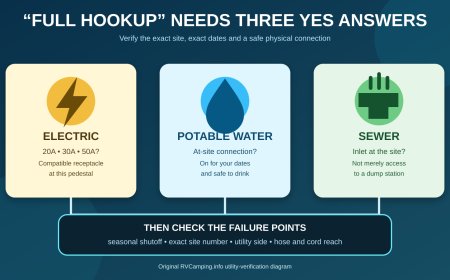
This is the correct branch when air-conditioning, medical equipment or another essential load cannot be supported by the RV's dry-camping system. “Full hookups” also changes the tank routine: the campsite provides the connection rather than requiring a trip through a shared service point.
Do not convert the 38-foot campground maximum into proof that any available site fits. Give the reservation agent the measured bumper-to-bumper RV length and disclose anything that affects placement, including a tow vehicle. Confirm the site assignment and electrical service before treating the booking as solved. The official NPS overview establishes the maximum and hookup category; it does not provide a site-by-site fit table.[1]
The concession option is not automatically the best choice for every large rig. The neighboring dry campground advertises selected pull-through spaces for a 40-foot motorhome, two feet beyond the concession campground's published maximum.[4] Power need and physical fit must be checked separately.
Choice 2: Rio Grande Village Campground for dry-camping flexibility
Recreation.gov describes 100 campsites ranging from small tent spaces to large pull-throughs that can fit a 40-foot motorhome. The same page warns that low branches remain and that not every site works for a tall or long RV or trailer.[4] That makes 40 feet a ceiling demonstrated by selected inventory, not a campground-wide promise.
Individual sites are dry: none supplies an electricity pedestal, a water connection or a sewer connection. A dump-and-fill station is at the campground entrance, and water spigots and flush toilets serve the campground.[4] That service pattern works for an RV that can carry its electrical load between generator opportunities but still benefits from servicing tanks on arrival or departure.
The NPS page says reservations are required and links this campground to Recreation.gov.[3] Read the exact listing before checkout. Match the equipment type, allowable length, driveway form and any clearance notes to the actual RV. A generic “RV allowed” label does not erase the low-branch warning.
Rio Grande Village Campground is the practical default when:
- the RV can dry camp without a pedestal;
- a selected site fits the measured equipment;
- shared fill and dump facilities are enough;
- the trip emphasizes the park's east side;
- the traveler wants Recreation.gov inventory rather than the concession booking channel.
It is the wrong fallback when “no hookups” would make the stay unsafe or unworkable. A nearby full-hookup campground does not put electricity at an NPS campsite.
Choice 3: Chisos Basin only after the road-and-site test
NPS says trailers over 20 feet and RVs over 24 feet are not recommended because the Basin road is narrow and winding and the campsites are small and unlevel.[5] Recreation.gov states the road and campground restriction as 24 feet for motorhomes and 20 feet for travel trailers, describing steep grades and sharp hairpin turns.[6]
Use the stricter Recreation.gov wording as the booking boundary. Do not round a 24-foot motorhome figure up from a model name, and do not treat a nominal trailer length as the full measurement without checking how the manufacturer and reservation listing define it.
Even a compliant rig has a second test. Recreation.gov says sites are small, rocky and often not level, with very few truly suitable for RVs. It warns that a replacement site is unlikely when the campground is full and recommends carrying leveling equipment.[6] Passing the road limit does not prove the reserved pad will work.
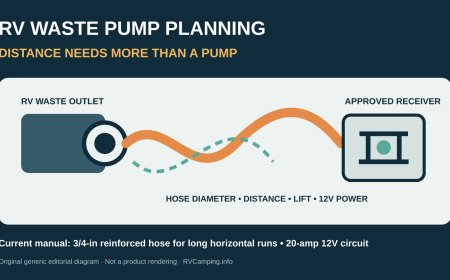
Chisos campsites are not connected to utilities. It does have a dump-and-fill station, but Recreation.gov notes that the inlet sits across the road from the side where most RV waste outlets are located, so a longer-than-usual hose may be needed.[6] That detail should be planned before arrival, not discovered while blocking the service area.
Choose Chisos when all of these are true:
- The measured equipment is within the applicable 24-foot motorhome or 20-foot trailer limit.[6]
- The exact site accepts that equipment and its grade is manageable.
- The driver is comfortable with the published road geometry.
- The RV can operate without hookups.
- Mountain access is valuable enough to outweigh a tighter arrival and leveling process.
If any one fails, return to Rio Grande Village rather than trying to make the Basin fit.
Avoid the Rio Grande Village name trap
“Rio Grande Village” is not one interchangeable reservation product. The concession RV campground is the full-hookup, 25-site, 38-foot-maximum option. The NPS campground is a 100-site dry campground whose selected spaces can fit a 40-foot motorhome and whose shared dump-and-fill station does not create campsite hookups.[1][4]
Before paying, write down five fields:
- exact campground name;
- booking channel;
- exact site or assigned site class;
- measured RV or trailer length and tow-vehicle plan;
- hookup status and tank-service plan.
If the confirmation says Recreation.gov and “no hookups,” it is not the concession full-hookup reservation. If it came through the concession channel, do not assume the NPS campground's 40-foot example applies.
Final booking checklist
Open the official pages again shortly before travel because conditions and inventory can change. Then make the decision in this order:
- Power: continuous hookups, or a dry-camping electrical budget?
- Footprint: measured length, height, tow vehicle and exact-site fit?
- Road: does the Chisos approach remain within both the official limit and the driver's comfort?
- Tanks: campsite connections, or a shared fill-and-dump stop?
- Location: east-side river destinations, or Chisos trail access?
Full hookups point to Rio Grande Village RV Campground. A larger dry-camping rig usually points to a carefully selected Rio Grande Village NPS site. Chisos Basin is the specialist choice for short equipment and a mountain-centered itinerary—not overflow for a rig that misses either published limit.
Editorial note: This research-based comparison uses official NPS and Recreation.gov pages archived October 21, 2026. It does not claim a firsthand drive, campsite inspection or current vacancy check.
Sources
What's Your Reaction?