





Big Meadows vs. Loft Mountain vs. Mathews Arm: Which Shenandoah campground fits your RV?
Compare three Shenandoah RV campgrounds by exact-site rig fit, Skyline Drive access, reservations, showers, dry-camping services, generator zones, and 2026 seasonal caveats.


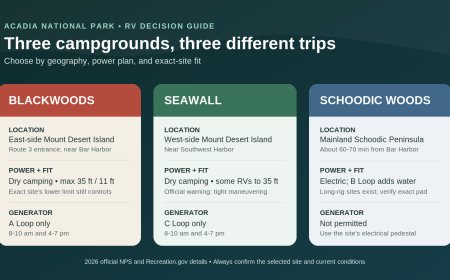
Quick answer: Big Meadows is the best all-around base for a first Shenandoah trip, especially if you want central-mile access, a nearby visitor center, and showers. Loft Mountain is the stronger south-district choice and has pay showers nearby. Mathews Arm is the practical north-district base, but it has no showers and sits north of Marys Rock Tunnel. None of the three has RV hookups. Your rig dimensions, chosen park entrance, and the exact site's equipment listing should settle the decision.
Shenandoah stretches 105 miles along Skyline Drive. These campgrounds sit at mile 22.2, 51.2, and about 79.5, so moving from one to another is not a quick campground loop. The park places Marys Rock Tunnel at Skyline Drive mile 32.2 and publishes 12 feet 8 inches as its maximum clearance.[9] That makes campground choice partly a routing decision: Mathews Arm is north of the tunnel, while Big Meadows and Loft Mountain are south of it.
The comparison at a glance
| Decision point | Big Meadows | Loft Mountain | Mathews Arm |
|---|---|---|---|
| Best fit | First visits, central-district hikes, nearby services | South-district trips and campers who want showers nearby | North-district trips and the shortest campground run from Thornton Gap |
| Skyline Drive mile | 51.2 | About 79.5-80 | 22.2 |
| 2026 schedule | Opened March 25; closing date listed as TBD | Opened April 29; closing date listed as TBD | Opened April 29; closing date listed as TBD |
| Reservations | Reservation only | Reservable and first-come, first-served sites | Reservable and first-come, first-served sites |
| Hookups | None | None | None |
| Shared services | Potable water, dump station, flush toilets, showers | Potable water, dump station, flush toilets; pay showers near campstore | Potable water, dump station, flush toilets; no showers |
| Generator baseline | 8-10 a.m. and 4-7 p.m., except generator-free sites | 8-10 a.m. and 4-7 p.m., except generator-free sites | 8-10 a.m. and 4-7 p.m., except generator-free sites |
| RV-fit takeaway | Several long pull-through listings exist, but limits remain site-specific | Current listings range widely; verify grade as well as length | Current listings also vary; do not infer fit from the campground total |
| Main access caveat | Do not use Tanners Ridge Road; enter through a signed park entrance | Longest Skyline Drive approach from the north | North of Marys Rock Tunnel; no shower at this campground |
The 2026 NPS table lists Big Meadows as open from March 25 and Loft Mountain and Mathews Arm from April 29. All three closing dates remain “TBD” in that table.[2] Treat a fall reservation as inventory for a scheduled season, not proof that every park road or service will remain unchanged. Check park alerts before departure.
Big Meadows: the central, service-near choice
Big Meadows is at mile 51.2, near Byrd Visitor Center, Big Meadows Lodge, and the wayside. Recreation.gov describes the visitor center as about a one-mile walk and the lodge as roughly a five-minute walk from the campground.[3] For a first trip split between north- and south-district stops, this location cuts down on repeated end-to-end drives.
It is still dry camping. The campground has no electric or water hookups at individual sites. A dump/fill station with potable water is available, and the facility listing includes flush toilets and showers.[3][6] Plan battery use, tank capacity, and food storage as you would for any nonelectric national-park site.
Big Meadows is the only campground in this comparison that is reservation-only. NPS tells campers to choose carefully because some reservable sites are tent-only while others accept larger vehicles, and rangers cannot move a reservation into a different site unless the camper changes it through Recreation.gov and suitable inventory exists.[1] That makes the equipment field part of the reservation, not a loose suggestion.
Some current Big Meadows listings show substantial paved pull-through space. Site I223, for example, lists RVs to 50 feet, trailers to 40 feet, an 85-foot driveway, and a moderate grade.[11] Those figures apply to I223, not to every loop. A long motorhome that fits one pull-through may fail the equipment limit or parking geometry of another site.
Arrival routing deserves equal attention. Recreation.gov says not to use Tanners Ridge Road because it does not provide campground access. It directs drivers to one of the four official Skyline Drive entrances instead.[3] From Thornton Gap, Big Meadows is about 19 miles south; from Swift Run Gap it is about 15 miles north.[3] A rig taller than the published tunnel clearance should use Swift Run Gap or a southern entrance and stay south of Marys Rock Tunnel.[9]
Loft Mountain: the south-district choice
Loft Mountain sits near mile 80 on Big Flat Mountain. Recreation.gov places it about 15 miles south of the Swift Run Gap entrance and about 25 miles north of Rockfish Gap.[4] That makes it the natural base for Big Run, Doyles River, Jones Run, and the park's southern miles. It also avoids Marys Rock Tunnel when approached from either Swift Run Gap or Rockfish Gap.
The utility setup is dry: no RV hookups, with potable water and a dump station available. Recreation.gov lists flush toilets and says pay showers are nearby at the campstore.[4] "Nearby" matters here. Do not book expecting a private water connection or an electrical pedestal at the pad.
Loft Mountain has both reservable and first-come, first-served inventory.[1] Its current Recreation.gov notice says walk-up sites must be claimed in person, cannot be held, and that online inventory does not show current occupancy because campground internet is unreliable. The same notice says weekend demand commonly exhausts that pool and Saturday openings are rare.[4] A first-come plan is therefore a calculated backup, not a reservation substitute.
Rig limits differ by site. Current examples include A060, a pull-through listing with a 45-foot RV or trailer limit, and D112, which lists a 30-foot RV or trailer limit and a moderate driveway grade.[12][13] Neither number is a campground-wide maximum. The useful lesson is the spread: filter for the full camping unit, then read the exact driveway entry, grade, and equipment fields before paying.
Mathews Arm: the north-district choice
Mathews Arm is at mile 22.2, roughly nine miles north of the Thornton Gap entrance.[5] For arrivals from the Washington, D.C., side via US 211, it requires far less Skyline Drive mileage than Loft Mountain. It is also the only one of these three north of Marys Rock Tunnel, which can simplify a trip for a tall rig that will remain in the north district.
The campground has no RV hookups. Recreation.gov lists drinking water, flush toilets, and one dump station with potable water, but no showers at the campground or closest wayside.[5] If a shower is part of the plan, solve that before booking rather than assuming every developed Shenandoah campground has the same service mix.
Like Loft Mountain, Mathews Arm combines reservable and first-come, first-served sites.[1] NPS says first-come sites must be claimed in person. The park's reservation guidance also notes that fall campgrounds can fill on Thursday or early Friday, which makes a weekend walk-up gamble particularly weak.[1]
A few current site records show why the exact listing controls. A011 lists a trailer limit of 44 feet, while A020 lists 33 feet.[14][15] These examples do not establish a campground maximum, and a trailer number does not answer where the tow vehicle will park. NPS campground rules require all equipment and vehicles to stay on the established paved or graveled area.[8][10]
Generator policy: same clock, different site zones
The baseline generator schedule is the same at all three campgrounds: a two-hour morning period starting at 8 and a three-hour afternoon period ending at 7, with a 60-decibel limit. Generator use is prohibited in sites marked generator-free.[6][7][8] Read the campground map and the individual site record before booking if generator access is essential.
The cold-weather exception does not apply on September 11. At Loft Mountain and Mathews Arm, generator hours extend to 9 p.m. from October 15 through closing for heat.[7][8] Big Meadows uses that same October 15-through-closing extension and also extends the evening window from opening through April 14.[6] An extended hour is permission to run within the stated policy, not a guarantee that fuel, weather, or late-season services will cooperate.
Quiet hours run from 10 p.m. to 6 a.m. on the campground maps.[6][7][8]
Reservations and seasonal caveats
NPS says many Shenandoah campsites can be reserved up to six months ahead. Big Meadows is reservation-only, while Loft Mountain and Mathews Arm retain some first-come sites.[1] Recreation.gov remains the place to check the exact booking window, equipment rules, and live reservable inventory.
The official 2026 operating table had not posted closing dates for these campgrounds by September 11.[2] Do not copy a prior year's closing date into a fall itinerary. Nighttime cold, fog, leaf-season traffic, temporary fire restrictions, and road work can change the practical trip even when the campground remains open. Confirm the live operating table and park alerts close to departure.
Boondocking at overlooks, trailheads, and parking areas is not a fallback when a campground is full or closed. NPS requires RV overnight stays in a park campground; when the campgrounds close, vehicle campers must stay outside the park.[1]
A rig-first booking sequence
- Choose the district and entrance. Use Mathews Arm for the north, Big Meadows for the center, or Loft Mountain for the south. A rig near 12 feet 8 inches tall should not have an itinerary that depends on clearing Marys Rock Tunnel.[9]
- Match the complete setup to one site. Enter the actual RV or trailer length. Then account for the tow vehicle or toad, driveway grade, pull-through versus back-in access, and the requirement to keep every wheel on the designated parking surface.[10]
- Set the power plan before choosing a loop. All three are dry campgrounds. If generator use is necessary, reject generator-free sites and confirm the current map hours.[6][7][8]
- Treat first-come inventory honestly. Only Loft Mountain and Mathews Arm offer it, it must be claimed on site, and weekends can fill early.[1][4]
- Check the live park status. The 2026 closing dates are still listed as TBD, so verify conditions rather than relying on an old calendar.[2]
Bottom line
Big Meadows is the easiest recommendation for a first-time visitor who wants central geography and the broadest nearby service cluster. Loft Mountain suits a south-district itinerary and keeps pay showers within the campground area. Mathews Arm saves Skyline Drive mileage for north-district arrivals, but campers give up on-site or nearby shower access.
There is no utility winner: all three lack hookups and use the same standard generator windows. The better campsite is the one that matches your entrance, stays on the correct side of the tunnel for your height, and has an individual Recreation.gov listing that fits the whole rig.
Sources
- Campground Reservations - Shenandoah National Park
- Operating Dates & Hours - Shenandoah National Park
- Big Meadows Campground - Shenandoah (VA) - Recreation.gov
- Loft Mountain Campground - Recreation.gov
- Mathews Arm Campground - Recreation.gov
- Big Meadows Campground Map and Rules - NPS
- Loft Mountain Campground Map and Rules - NPS
- Mathews Arm Campground Map and Rules - NPS
- Driving Skyline Drive - Shenandoah National Park
- Campground Regulations - Shenandoah National Park
- Big Meadows Site I223 - Recreation.gov
- Loft Mountain Site A060 - Recreation.gov
- Loft Mountain Site D112 - Recreation.gov
- Mathews Arm Site A011 - Recreation.gov
- Mathews Arm Site A020 - Recreation.gov
What's Your Reaction?