





Watchman vs. South Campground at Zion: the RV choice in 2026
Watchman or South at Zion? Compare RV power, generator rules, booking windows, rig-fit caveats, shuttle access and the 2026 South reopening.

By Romana | September 8, 2026
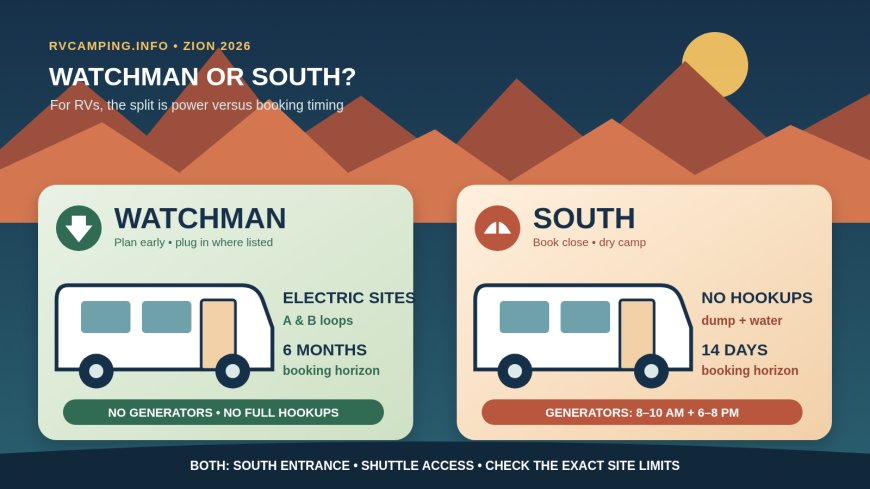
Quick answer: Choose Watchman if your RV trip depends on shore power, a year-round stay, or the ability to reserve months ahead.[2][3] Choose South if you can dry camp, want a legal generator window, and can work with a short reservation release.[1][4] Both put you near Zion's South Entrance, the visitor center, the park shuttle, and Springdale.[1][3] The right choice is less about scenery than power and timing.
Watchman vs. South at a glance
| Decision point | Watchman Campground | South Campground |
|---|---|---|
| Best fit | RVers who need electricity or want to plan early | Dry campers who can book close to arrival |
| Operating pattern | Open year-round | Seasonal, generally spring through fall |
| Reservation window | Up to six months for standard sites | Up to 14 days before arrival; a stay may extend up to two days beyond that window |
| RV hookups | Electric sites in A and B loops; no full-hookup sites | No hookups |
| Generator use | Not allowed | Allowed only 8–10 a.m. and 6–8 p.m. |
| Dump/fill | Dump station with potable water at entrance | Dump station and drinking water |
| RV-size catch | C and D non-electric loops do not allow vehicles 19 feet or longer, including combined length | Site parking sizes vary; check the exact site's limit |
| Reservation link | Watchman on Recreation.gov | South on Recreation.gov |
Zion requires reservations for its park campgrounds.[2] The park says Watchman is open all year with a six-month reservation horizon, while South closes seasonally and releases sites up to 14 days ahead.[2] Recreation.gov currently describes South's normal season as early March through the end of October. The NPS gives mid-March as the usual start and October 31 as the usual final day.[4][8] Those descriptions are close, but they are not identical. Trust the date picker for the night you need rather than building a trip around a generic season label.[4]
Watchman wins when electricity is the deciding factor
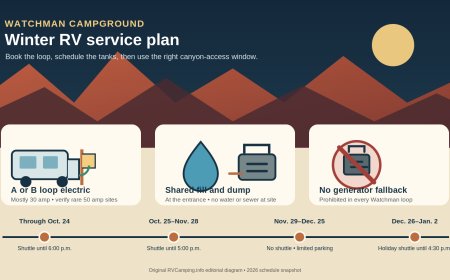
Watchman's A and B loops have standard electric sites suitable for tents or RVs.[3] Recreation.gov says those sites provide 30-amp service, with only a handful offering 50 amps; none has a full hookup.[3] The entrance area has a dump station and potable water.[3]
That makes Watchman the easier choice in hot weather if you need dependable air-conditioning power.[3] It also works better for travelers whose batteries, medical equipment, or work setup make generator-free dry camping a poor bet.[3] Do not read "electric" as water and sewer at the pedestal.[3] Fill and dump separately.[3]
Check the individual site card before paying.[3] Watchman's C and D loops are non-electric, and Recreation.gov says they do not permit a vehicle 19 feet or longer, counting combined length.[3] The tent-only E and F loops are not RV substitutes.[3] An available dot on the calendar is useful only if the listed equipment and driveway limits fit your complete setup.[3]
There is one hard tradeoff: generators are prohibited throughout Watchman.[3] An RV with no suitable electric reservation cannot fall back on a morning generator run.[3] If you depend on a generator, South is the campground to watch.[3][4]
South wins for flexible dry campers
South has no hookups.[4] It does have flush toilets, drinking water, picnic tables, fire rings, and a dump station, according to its Recreation.gov listing.[4] The fire rings do not override a park fire restriction; on September 8, open fires remain prohibited.[7]
Generators are allowed at South only from 8 to 10 a.m. and 6 to 8 p.m.[1][4] Those two windows can cover battery charging, but they are narrow.[4] Build your energy budget before arrival: refrigerator mode, furnace fan, device charging, inverter draw, and hot-weather cooling all count. Solar can help, though site shade and weather are not promises.
The short booking window changes how you plan.[4] South reservations become available up to 14 days before arrival and may run as much as two days beyond the open booking window.[4] Watchman is the safer anchor for fixed flights, school breaks, and caravan schedules.[2][4] South is a useful second chance for travelers who can wait until two weeks out or shift their arrival by a day.[4]
The NPS lists a campground-wide maximum RV and trailer length of 40 feet, then warns that campsites and parking areas come in different sizes and directs campers to Recreation.gov for each site's limit.[8] Treat 40 feet as an outer campground ceiling, not a promise that every South site fits a 40-foot rig.[8] Check the listed driveway and equipment limits for the specific site, including tow vehicle and trailer where the listing asks for combined length.[8]
Location is nearly a tie
Both campgrounds sit by Zion's South Entrance, close enough to reach the Zion Canyon Visitor Center, shuttle system, and Springdale on foot.[1][3] Moving from one campground to the other does not meaningfully change the basic car-free strategy: park the RV, walk to the visitor center, and use the park shuttle for Zion Canyon.[1][3][6]
During shuttle season, private vehicles cannot use Zion Canyon Scenic Drive, even before the first shuttle or after the last one.[6] The shuttle is free and needs no ticket or reservation.[6] Its dates and hours change during the year, so consult the current schedule for both your outbound ride and the last trip out of the canyon.[6]
For September 8, the posted 2026 Zion Canyon Line schedule runs 7 a.m. to 7 p.m. from the visitor center, with the last bus leaving Temple of Sinawava at 8:15 p.m. That schedule applies through September 12. On September 13, the listed evening times move one hour earlier.[6] Do not make the last bus your plan; NPS warns that missing a full final shuttle can leave you with a nine-mile walk back to the visitor center.[6]
The route into camp matters more than the campground choice
Since June 7, 2026, vehicles over any NPS dimension or weight cap have been barred from the road segment that runs east from Canyon Junction to the East Entrance. The rules apply to that whole part of the Zion-Mt. Carmel Highway, not only the tunnel.[5]
A single vehicle is over the limit if it exceeds 35 feet 9 inches long, 7 feet 10 inches wide, 11 feet 4 inches high, or 50,000 pounds. For a combined vehicle, the total-length limit is 50 feet, the trailer may not exceed 26 feet from hitch to rear axle, and the same width, height, and weight limits apply. Mirrors, tires, roof air conditioners, bike racks, satellite dishes, and other attachments count in the measurements.[5]
Oversize campers with a valid Watchman or South reservation are among the vehicles allowed to enter from the South Entrance to reach camp, space and instructions permitting, but that exception does not authorize travel east of Canyon Junction.[5] If your measurements cross any limit, route through Springdale and plan to leave the same way.[5] Measure the actual travel configuration rather than relying on a model brochure.[5]
Heat, fire, and river cautions apply to both
The two South Entrance campgrounds have few trees, and NPS says summer daytime temperatures in this desert area often exceed 95°F.[2] On September 7, the park's conditions page went further, saying summer daytime temperatures regularly exceed 100°F and that mid-to-late-summer monsoons raise flash-flood risk.[7]
Stage 2 fire restrictions were still posted on September 8. They prohibit open fires, including campfires, charcoal fires, and propane fire rings, in both campgrounds; petroleum- or liquid-propane-fueled cook stoves are allowed.[7] Restrictions can change quickly. Check the live alert banner before bringing firewood or charcoal, and check again after arrival.
The park also warns of toxic cyanobacteria in the Virgin River and streams. Do not submerge your head or try to make river water drinkable by filtering it.[7] That caution matters at a campground beside the river, especially when the water looks inviting on a hot afternoon.
A practical booking strategy
- Measure first. Record total length, widest point including mirrors, loaded height including rooftop gear, and weight. Towed combinations need the trailer's hitch-to-rear-axle measurement too.[5]
- Try Watchman at six months. Target A or B if electricity is required. Verify amperage and all site-level equipment limits before checkout.[2][3]
- Set a South reminder for 14 days out. Use South only if no-hookup camping works for your rig and the exact site fits. A generator plan must stay inside the two permitted windows.[1][4][8]
- Read the live notices. Confirm campground availability, fire rules, shuttle hours, trail closures, and road restrictions on the dates you travel. The stale South-closure line proves that a single summary page is not enough.[6][7]
- Save the reservation offline. Reception can fail at the worst time. Keep the confirmation, site number, rig dimensions, and route into the South Entrance available without a connection.
Which one should you book?
For most RV travelers, Watchman is the first search. Electricity, the longer booking horizon, and year-round operation remove several planning problems at once. South is not a lesser campground; it is a different tool. It suits rigs prepared for dry camping and travelers who can turn a 14-day release into an advantage.[2][3][4]
Choose South over Watchman when generator access matters more than shore power, or when Watchman sold out months ago and your dates remain flexible. Choose Watchman over South when air-conditioning, electrical reliability, or a fixed itinerary matters. In either campground, the individual site listing has the last word on fit.[3][4][8]
Source credit: RVCamping.info compared current National Park Service and Recreation.gov campground, alert, shuttle, and vehicle-rule pages retrieved September 8, 2026. The recommendation framework and RV planning analysis are original.
Sources
What's Your Reaction?