


Yellowstone's Mammoth Campground after the seasonal sites close: a winter RV arrival plan
A Gardiner decision gate for reaching first-come Mammoth Campground after seasonal sites close, with RV-length, tank, parking and fallback checks.

By Romana | October 22, 2026
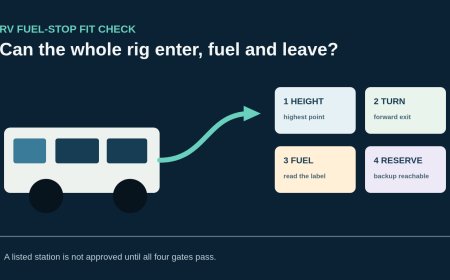
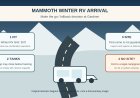
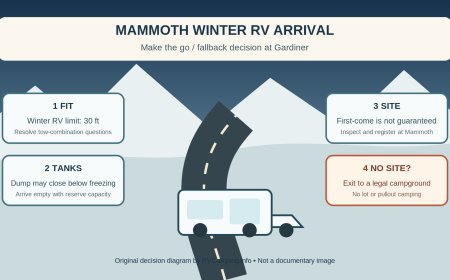
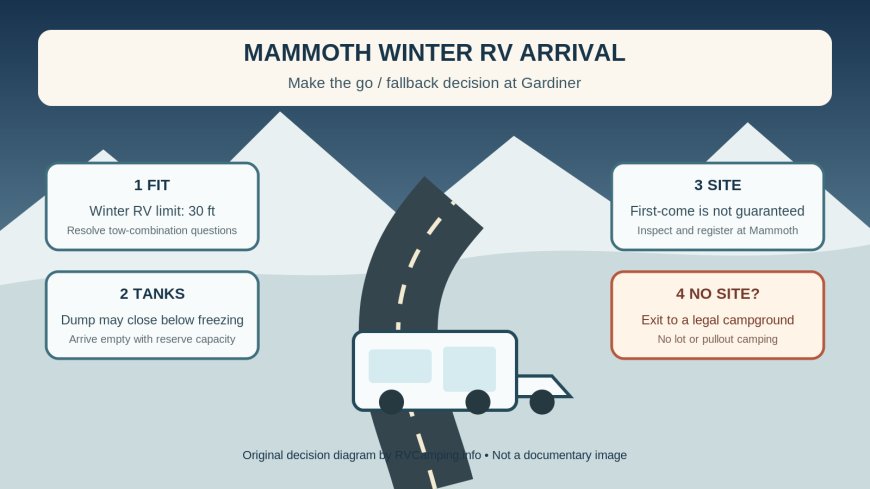
After Yellowstone's seasonal campgrounds close, Mammoth is the in-park RV option that remains. That does not make it a casual late-night arrival. The winter plan has four gates: your RV must fit the reduced limit, a campsite must still be open when you reach the loop, your waste tanks must survive a potentially unavailable dump station, and you need a legal retreat north of the entrance.
The best decision point is Gardiner, before the last five miles to Mammoth. Stop there while the turn-around options are better and there is still room to change the plan. A hopeful drive into the park is not a substitute for a campsite.
First-come means the decision happens on arrival
Yellowstone lists Mammoth as its only year-round campground and says it moves to first-come use for winter. The two current official pages do not show identical boundary dates: the NPS campground overview says October 15 through April 1, while Recreation.gov currently posts October 16 through April 16 and says winter payment is through Scan & Pay in its app.[1][2] On October 22, the practical result is the same: there is no reserved site waiting for you.
Download and sign in to the Recreation.gov app before losing a dependable connection. A phone with the app is part of the payment plan, but it does not create inventory. Treat every open site as unconfirmed until you are physically at the campground and have completed the posted registration steps.
This changes the arrival clock. Reach Gardiner with daylight left and enough fuel to leave. If weather, traffic or a late departure would put you at Mammoth after dark, use the outside backup rather than forcing a blind campground loop in a long vehicle.
The winter length limit is the first hard stop
The NPS campground table gives Mammoth a 30-foot winter limit, and Recreation.gov states a 30-foot RV limit from November through April.[1][2] The wording is not detailed enough to settle every motorhome, trailer and tow-vehicle configuration. Measure the RV itself, then ask the campground how it applies the limit to your exact combination before driving in. Do not assume a summer site photograph or a larger warm-season limit still applies.
Use this gate before departure:
- At 30 feet or less, record the actual measured length and continue to the service check.
- Over 30 feet, do not make Mammoth the overnight plan once the winter limit applies.
- For a trailer near the line, call the campground and ask whether the tow vehicle may be parked within the site without violating the winter restriction or blocking the road.
A compact rig still needs a controlled arrival. Snow can hide pad edges, and a site that is long enough on paper may be a poor choice if backing or leveling requires leaving the established surface.
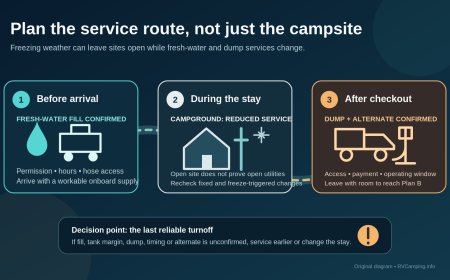
Arrive as if the dump station will be closed
Mammoth is dry camping. Recreation.gov lists potable-water spigots and year-round flush toilets, while the NPS says Fishing Bridge is Yellowstone's only campground with water, sewer and electrical hookups.[1][2] The NPS adds a warning that dump stations may close when temperatures fall below freezing.[1] That warning matters more than a dump icon on a campground table.
Empty the black and gray tanks at a confirmed, operating facility before the final approach. Carry enough unused tank capacity for the entire Mammoth stay plus the drive to the next verified dump. Keep winterized plumbing winterized unless you know the rig, heat system and water plan can handle the forecast.
At Gardiner, make one last service decision: if the tanks are already too full to absorb the stay, turn north. Do not enter on the theory that the dump station will probably work. A frozen or closed station is an operating condition, not a problem that can be solved in a pullout.
There is no overflow campsite in a parking area
Yellowstone explicitly prohibits car camping and overnight vehicle parking in pullouts, parking areas, picnic grounds and anywhere else outside a designated campground.[1] If Mammoth has no suitable site, the visitor-center lot and roadside pullouts are not Plan B.
Leave the park through the North Entrance while the route is clear. For 2026, the NPS projects regular-vehicle access from Mammoth toward Norris through October 31, but the year-round regular-vehicle corridor is the North Entrance through Mammoth and on toward the Northeast Entrance; weather can still close roads temporarily.[3] For a late-October RV arrival, Gardiner is the reliable decision side of that road network. Check live road status on travel day instead of relying only on the projected calendar.
The outside fallback is legal, primitive and still conditional
Eagle Creek Campground in Custer Gallatin National Forest is about two miles northeast of Gardiner. Its current official facility record describes 20 gravel, unpaved sites, a 48-foot maximum, no hookups, and no nearby water or sewer dump.[4] The Forest Service lists the campground for year-round use, but that is not a promise that every site or the approach will suit an RV after snow.[5]
Use Eagle Creek as a call-ahead fallback, not an overflow extension of Mammoth. Before committing, contact the Gardiner Ranger District for current road, snow and site conditions. Confirm that your rig can use Jardine Road and that a legal campsite is available. Arrive with the same empty-tank and self-contained water plan you prepared for Mammoth.
If Eagle Creek is unsuitable or full, continue north toward a confirmed commercial or public campground rather than improvising in Gardiner. A map pin is not proof that a campground is operating that night; call for an actual open date and a site for the measured rig.
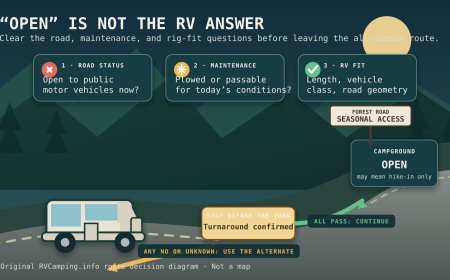
A one-minute decision at Gardiner
Park legally, then run the route in order:
- Is the North Entrance road open for the RV right now? If not, stop and use the outside plan.
- Is the RV within the winter length rule, with any tow-vehicle question answered? If not, skip Mammoth.
- Are the waste tanks empty enough for the stay and the next dump? If not, find service before entering.
- Is there enough daylight, fuel and weather margin to inspect a first-come site and leave again? If not, take the fallback.
- At Mammoth, is a suitable designated site actually available? If not, exit. Do not sleep in a lot or pullout.
This route protects the part of a winter Yellowstone trip that a reservation cannot protect. Mammoth may be open, but the usable campsite, service set and road are all arrival-day facts.
Sources
- Camping — Yellowstone National Park — National Park Service campground status, winter length note, freeze warning for dump stations, and prohibition on overnight parking outside designated campgrounds; retrieved October 22, 2026.
- Mammoth Campground (Yellowstone) — Recreation.gov/NPS facility record for first-come winter operation, Scan & Pay, 30-foot winter RV limit, and current facilities; retrieved October 22, 2026.
- Park Roads — Yellowstone National Park — National Park Service year-round corridor and projected 2026 regular-vehicle dates; retrieved October 22, 2026.
- Eagle Creek Campground — Custer Gallatin National Forest — Official facility record for location, site count, surface, RV maximum and lack of hookups, water and nearby sewer dump; retrieved October 22, 2026.
- Eagle Creek Campground — Forest Service — Custer Gallatin National Forest exact page for year-round status and the call-ahead context for a primitive winter fallback; indexed October 22, 2026. Direct capture was blocked with HTTP 403, which is recorded in the source manifest.
What's Your Reaction?