








When shore power quits: run the RV refrigerator clock before opening the door
A four-hour closed-door decision for an RV refrigerator outage, including measured cooler transfer and clear discard branches.

When shore power quits: run the RV refrigerator clock before opening the door
By Romana | October 22, 2026 | Cooking
The campground pedestal goes dark. Before anyone opens the refrigerator to inspect breakfast, write down the time. A closed refrigerator gets a limited grace period during a power loss; every look inside trades some of that stored cold air for warmer RV air.
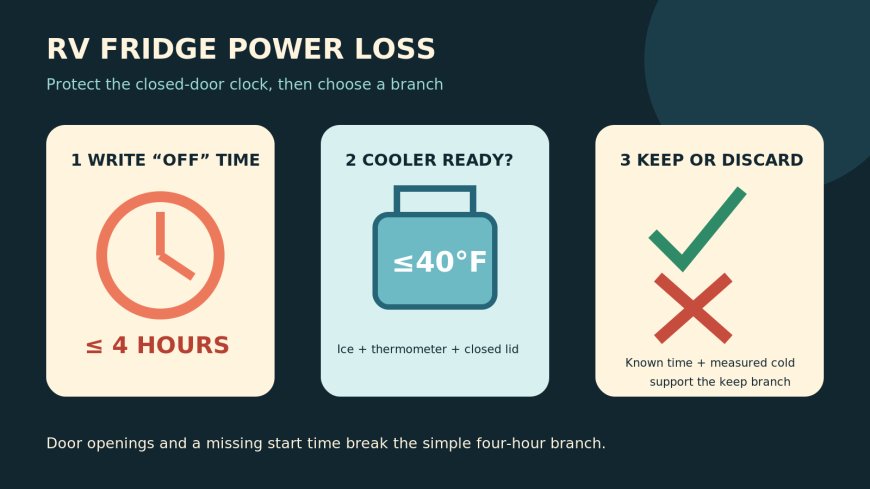
CDC and USDA give the same working limit: with the door kept shut, refrigerated food can remain safe for up to four hours without power.[1][2] That is a closed-door clock, not a promise about a refrigerator that has been opened repeatedly or was warm before the outage.

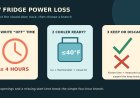
Write the outage time first, then choose the refrigerator, cooler or discard branch. Original RVCamping.info diagram.
One outage needs two facts
Put two readings at the top of a note: the time cooling stopped and the temperature shown by the refrigerator's appliance thermometer. If the display itself needs electricity, use the separate thermometer inside the cabinet. Do not open the door just to check food package by package while the outage is still young.
The four-hour rule assumes the refrigerator started at 40°F or below and stayed closed. A known warm start, a door left ajar or several rounds of browsing break that clean assumption. In those cases, a food thermometer can help with a current reading, but it cannot recreate an unknown history. Smell and taste cannot do that job either; both agencies say not to taste questionable food as a safety test.[1][2]
This clock applies to the refrigerator compartment. A freezer has separate guidance and a much longer closed-door window, so do not use the refrigerator's four hours to condemn frozen food automatically.[1] Keep both doors shut and assess each compartment under its own rule.
Decide before the fourth hour arrives
A cooler is useful only if it becomes controlled cold storage. CDC says that at four hours, refrigerated perishables can be moved to a cooler with ice or another cold source, held at 40°F or lower.[1] USDA likewise calls for enough ice or frozen gel packs to keep the cooler at that temperature, with more ice added as it melts.[2]
For an RV outage, prepare that transfer early rather than beginning a long sorting project at the deadline:
- Put ice or frozen packs in a clean insulated cooler and place a thermometer where it can be read quickly.
- Make a short transfer list while the refrigerator remains closed: meat, poultry, fish, eggs, milk, soft cheese, cut produce, cooked dishes and leftovers belong near the front of the decision.
- Open the refrigerator once, move the listed food in one pass, and close both containers.
- Keep the cooler at 40°F or below. Replenish ice as it melts and drain water only if the cooler's design or the food packaging makes that necessary.
A half-filled cooler with one small, thawing pack is not a temperature guarantee. The thermometer, not the sight of ice nearby, settles whether the new storage is holding the required temperature.
The decision branches
Use the following branches in order.
Power returns before four hours
If the refrigerator stayed closed and the outage remained inside the federal four-hour window, keep the door shut and let the unit recover. Check the appliance thermometer. CDC directs users with a refrigerator thermometer to see whether the cabinet is still at 40°F or below.[1]
If the refrigerator was opened often, began above 40°F or has no dependable time record, the simple branch no longer fits. Move food to verified cold storage while its safety can still be established, or discard the questionable perishables.
The outage reaches four hours and a cold cooler is ready
Transfer refrigerated perishables to the iced cooler and hold it at 40°F or below.[1][2] Label the cooler with the transfer time. The move does not create a fresh, unmeasured grace period; from that point forward, the temperature reading is the control.
Keep raw packages sealed and below ready-to-eat food so leaks cannot reach sandwiches, fruit or drinks. That arrangement is an RV packing precaution, not an exemption from the 40°F limit.
Four hours pass with no cold source
Discard refrigerated perishables. USDA's list includes raw or cooked meat, poultry and fish; eggs; milk and many other dairy products; soft cheeses; cut produce; cooked vegetables; soups, stews, casseroles, pizza and mixed salads.[2] CDC names meat, fish, eggs, milk, cut fruits and vegetables, and leftovers among the foods to throw away after four hours without power or another cold source.[1]
Do not keep a questionable casserole because the center still feels cool, and do not sample milk before deciding. The rule is deliberately based on time, temperature and food type rather than a taste test.
The history is missing
Maybe the pedestal breaker tripped while everyone was hiking, or the refrigerator switched off during a fuel stop and nobody knows when. Without a trustworthy start time or temperature history, there is no factual way to place the food inside the safe branch. Discard refrigerated perishables rather than assigning the outage a convenient start time.
What the 40°F reading can and cannot tell you
A reading at or below 40°F gives useful evidence about current cold control. It is especially helpful when the cooler transfer is underway or the refrigerator has just regained power.[1][2] It does not prove that food never spent too long warmer than 40°F before the reading was taken.
That is why the note matters. Record:
- OFF: when active cooling stopped;
- CLOSED: whether the door stayed shut;
- MOVE: when perishables entered the iced cooler;
- TEMP: the cooler or refrigerator reading after the move.
The labels are an original RVCamping.info handoff device, not a separate government rule. They keep one camper from resetting the story when another takes over the kitchen.
Reset the RV before the next outage
Keep an appliance thermometer in the refrigerator, freeze several gel packs when power is dependable, and store a clean cooler where it can be reached without unloading the entire bay. Those small preparations turn a vague “How long has it been?” into a timed choice.
The decision is narrow: protect the closed-door window, move perishables into measured cold storage by the four-hour point, and discard them when neither time nor temperature supports keeping them.[1][2]
Evidence note: CDC and USDA FSIS supply the four-hour, 40°F, cooler-transfer and discard guidance. The OFF/CLOSED/MOVE/TEMP note is an original RV handoff tool.
Sources
- CDC: Keep Food Safe After a Disaster or Emergency — refrigerator, cooler-transfer, temperature and discard guidance (official page reviewed October 22, 2026).
- USDA FSIS: Keep Your Food Safe During Emergencies: Power Outages, Floods & Fires — closed-door timing, cooler ice and food-specific discard guidance (official page reviewed October 22, 2026).
What's Your Reaction?