












Camco 55191 review: useful 30-amp reach, not extra power
Research-based Camco 55191 review covering TT-30 fit, 30-amp limits, voltage, safe routing, inspection and storage.

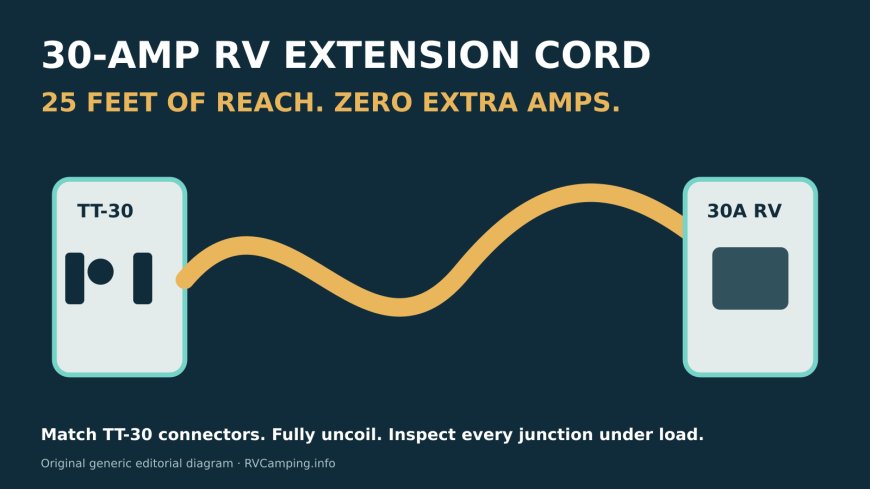
The Camco Power Grip 55191 makes sense for a 30-amp RV owner who occasionally finds the pedestal beyond the coach cord and wants a purpose-built 25-foot TT-30 extension. Skip it if your RV has a 50-amp inlet, you need a permanent home hookup, the run crosses vehicle traffic, or you expect another 25 feet of cable to increase the amperage available at the pedestal.
The exact product reviewed is the Camco Power Grip 25-foot 30-amp RV extension cord, model 55191, Amazon ASIN B000BUU5YU. Camco's dealer catalog and the current Amazon listing identify 10-gauge copper conductors, NEMA TT-30P and TT-30R ends, a 125-volt/3,750-watt rating, an outdoor PVC jacket and grip handles.[1][2]
This is a research-based review. RVCamping.info did not buy, connect or load-test this cord. The assessment draws on manufacturer and retailer specifications, RV electrical documentation and government extension-cord safety guidance.
As an Amazon Associate, RVCamping.info earns from qualifying purchases. If you buy through an Amazon link in this article, we may earn a commission at no additional cost to you.
Check the Amazon listing for Camco 55191, ASIN B000BUU5YU. Confirm the listing still names model 55191, a 25-foot length and TT-30 connectors before ordering. Search results also expose other Amazon pages using the same model number, so the ASIN is part of the identity check.
Verdict in one minute
Buy the 55191 when your 30-amp RV cord is sound but sometimes falls short. The molded handles should make a heavy connection easier to separate without yanking the cable, and 10-gauge conductors are appropriate to the product's published 30-amp rating.[1][2]
Its central tradeoff is simple: 25 feet of useful reach adds another plug-and-socket junction, more cable to inspect and store, and some electrical resistance. It does not turn a weak pedestal into a strong one. Airstream describes 30-amp RV service as one 120-volt hot leg with a 3,600-watt maximum at nominal voltage; an extension cord cannot raise that ceiling.[6]
The cord is also not an electrical-management system. It does not test pedestal polarity, disconnect on low voltage, absorb a major surge or make a worn receptacle safe. Owners who need those functions still need properly selected protective equipment and a sound source.
The compatibility boundary: TT-30 only
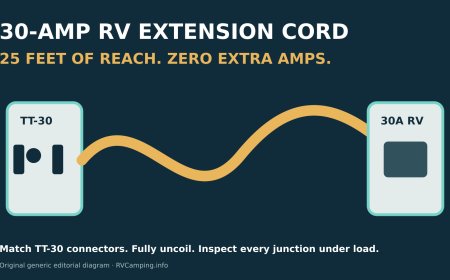
Model 55191 has a TT-30 male plug and TT-30 female connector. Eaton describes TT-30 as a 30-amp, 125-volt, two-pole, three-wire grounding configuration intended for travel trailers and RVs.[7] That makes the cord a direct match for a conventional 30-amp RV shore cord and a correctly wired TT-30 pedestal.
Do not confuse the three-prong TT-30 shape with an older 30-amp dryer receptacle. TT-30 is a 120-volt RV connection. A wrong-voltage homemade outlet can damage coach equipment and create a shock or fire hazard. Have a qualified electrician install and test any home receptacle intended for the RV.
A 50-amp coach can use 30-amp service only through a correctly rated 30-to-50-amp RV adapter. The whole coach remains constrained by the 30-amp source, and load management becomes necessary. Airstream says a 50-amp RV connected to 30-amp service cannot operate at full power or assume both air conditioners can run together.[6]
The reverse case also needs care. Do not improvise adapters or alter blades to make the cord fit. The Consumer Product Safety Commission says never cut or change plug blades and recommends cords listed by a recognized testing laboratory.[4]
What the ratings mean at a campsite
Camco publishes 30 amps at 125 volts, or 3,750 watts, for the cord.[1][2] That is a product rating at 125 volts. Most RV load planning uses nominal 120-volt service, where 30 amps equals 3,600 watts.[6] The two figures are not conflicting claims about extra capacity.
Your useful power may be lower than the arithmetic ceiling. Every conductor and connection has resistance. Voltage can already be low at a busy campground, and the extension adds length plus one more junction. The correct response is to reduce load and investigate the source or connection, not to assume a thick cord cures low voltage.
Air conditioners, electric water heaters, microwaves, hair dryers and portable heaters can consume much of a 30-amp budget. Add appliance nameplate amps or watts instead of relying on the number of open receptacles. The pedestal breaker protects the supply circuit; it is not a planning tool to trip repeatedly until a load combination happens to hold.
The CPSC warns that an extension cord that becomes hot may be overloaded or damaged. Its guidance calls for checking the cord's rating, inspecting the full length and replacing damaged cords.[4] Warm sun on a black jacket is different from concentrated heat at a plug. A hot connector, discoloration, soft plastic or a burnt odor means shut down and inspect the system.
The 25-foot question
Measure before buying. Follow the normal path from the pedestal to the RV inlet without stretching the coach cord tight. Include the height of the pedestal, bends around slide rooms and enough slack to keep tension off both connectors.
Twenty-five feet is useful when the pedestal sits on the wrong side or near the front of a long campsite. It is excessive when the standard cord already reaches comfortably. South Carolina's extension-cord guidance recommends the shortest practical length to reduce current loss and heat buildup.[5]
Avoid chaining two extension cords. The same guidance says not to daisy-chain extension cords and calls for fully uncoiling them during use.[5] For an RV, each added junction is also another outdoor point that can loosen, admit contamination or be driven over.
Storage matters more than the product photos suggest. The current retailer specification lists about 8.5 pounds.[1] Set aside a dry compartment where the cord can lie in broad loops rather than tight kinks. A 25-foot 10-gauge cord is useful gear, but it is not pocket-sized.
A safe hookup and inspection routine
- Park and stabilize the RV before laying out the cable. Keep the route out of roads, neighboring sites, standing water, sharp edges and places where a slide room or leveling jack could crush it.
- Turn the pedestal breaker off. Inspect the pedestal face for damage, moisture, scorching or a loose receptacle. Do not use a visibly unsafe outlet.
- Inspect the extension cord end to end. Reject cracked insulation, flattened sections, exposed copper, bent blades, corrosion, loose molded heads, discoloration or burnt odor. The CPSC advises replacing damaged cords rather than taping the insulation.[4]
- Fully uncoil the extension. Coiled cable can retain heat, which is why general safety guidance calls for unwinding it before use.[5]
- Connect the extension firmly to the RV shore cord or detachable cordset. Keep the junction off the ground and protected from direct water without sealing it inside a heat-trapping improvised wrap.
- Plug the TT-30P end into a verified TT-30R source. Use a properly selected RV electrical-management device if your protection plan calls for one.
- Turn the pedestal breaker on, then add large loads one at a time. Check coach voltage under load rather than only with everything off.
- Recheck both ends and the cord junction after the air conditioner or another sustained load has run. Shut down if a connection becomes hot, loose, noisy, discolored or smells burnt.
- At departure, turn large RV loads off and switch the pedestal breaker off. Pull on the molded grip, not the cable. Dry and inspect the cord before storage.
CPSC guidance also says outdoor cords must be marked for outdoor use and should not run through doorways, under carpets or under furniture.[4] The Camco cord is sold for outdoor RV use, but that does not make it submersible or resistant to crushing by a tire.[1][2]
What the Power Grip handles help with
The molded handles address a real problem: heavy RV plugs can be difficult to separate, especially for users with limited grip strength. Pulling on a handle rather than the cable reduces strain at the conductor-to-terminal connection. Camco also uses angled heads to reduce leverage on the connection.[1][2]
The handles cannot compensate for a worn pedestal. If the male blades do not seat firmly, find another approved connection and notify the campground. Repeated arcing damages contact surfaces, and a loose high-current junction can overheat even when total coach load stays below 30 amps.
The archived Home Depot product page confirms that model 55191 has been sold for years as a 25-foot, 30-amp, 10-gauge grounded STW cord with handles.[3] That long listing history establishes product continuity, not a guarantee that every current unit or campsite connection is fault-free.
What this cord does not solve
It does not add amperage. A 30-amp pedestal remains a 30-amp source, and a 50-amp coach on an adapter still needs a 30-amp load plan.[6]
It does not fix low voltage. Additional cable can only add resistance. If voltage falls when a large load starts, reduce load and check the pedestal, plugs, junction and campground supply.
It does not replace surge or low-voltage protection. There are no monitoring electronics in the published model description.[1][2]
It does not make a permanent hookup. General extension-cord guidance treats extension cords as temporary wiring and recommends a properly located circuit when power is needed routinely.[5]
It does not make unsafe routing acceptable. Do not put the cord under a tire, through a doorway, across an unprotected walkway or into standing water.[4][5]
Who should buy it
The Camco 55191 is a sensible purchase for:
- a 30-amp RV with a standard cord that occasionally needs another 25 feet;
- owners who have measured the route and can keep the full cable protected and uncoiled;
- campers who want grip handles rather than pulling on a heavy cable;
- a backup kit where the exact TT-30 plug, connector and 30-amp load boundary are understood.
Choose something else when:
- the RV has a 50-amp connection and you want to preserve full 50-amp capacity;
- a shorter cord will reach;
- the only route crosses traffic or water;
- the intended hookup is permanent;
- you need voltage monitoring, automatic disconnect or surge protection rather than reach;
- the product label, cord jacket or molded ends do not match the listing when it arrives.
Final assessment
The Camco 55191 solves one problem well: it gives a 30-amp RV another 25 feet of TT-30 reach with appropriately identified connectors and a published 10-gauge copper construction.[1][2] The handles are useful, and the long-running model is easy to identify by both model number and ASIN.
Buy it only after measuring. Then treat the extra junction as part of the electrical system: inspect it, keep it dry and protected, fully uncoil the cable, monitor voltage under load and stop at the first sign of heat or damage. If the real problem is inadequate amperage, low campground voltage or an unsafe pedestal, an extension cord is the wrong fix.
Sources
- Camco Dealer: Power Grip 30-Amp RV Extension Cord 55191
- Amazon listing: Camco 55191, ASIN B000BUU5YU
- Home Depot Camco 55191 product page, archived November 23, 2016
- U.S. Consumer Product Safety Commission: Household Extension Cords Can Cause Fires
- South Carolina Administration: extension-cord safety guidance
- Airstream Support: differences between 30-amp and 50-amp systems
- Eaton: NEMA TT-30 travel-trailer power-device specification
What's Your Reaction?