







The campground is open. Build the RV water and dump route anyway
Plan a confirmed fresh-water fill before arrival and a confirmed dump after checkout when a winter campground stays open with reduced utility service.

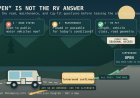
The campground is open. Build the RV water and dump route anyway
An open campsite can sit between two closed utility points. That is the planning problem for a freezing-weather RV stay: arrive after the campground dump has closed, discover that the remaining potable tap is not an approved tank-fill point, then leave with no confirmed place to empty the holding tanks.
Two current park notices show different versions of the problem. Ed Z'berg Sugar Pine Point State Park has winter camping in its first loop, but California State Parks says the showers and dump station closed October 16. A centrally located restroom still has potable water.[1] At Whiskeytown National Recreation Area, Brandy Creek RV is open year-round for self-contained RVs, while the National Park Service warns that water and the dump station can be switched off during winter cold to prevent freezing.[2]
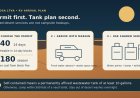
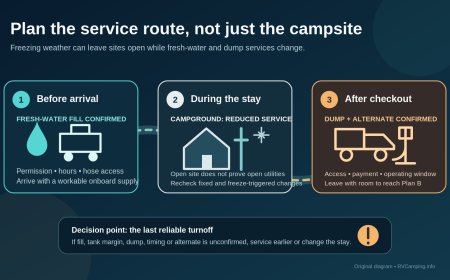
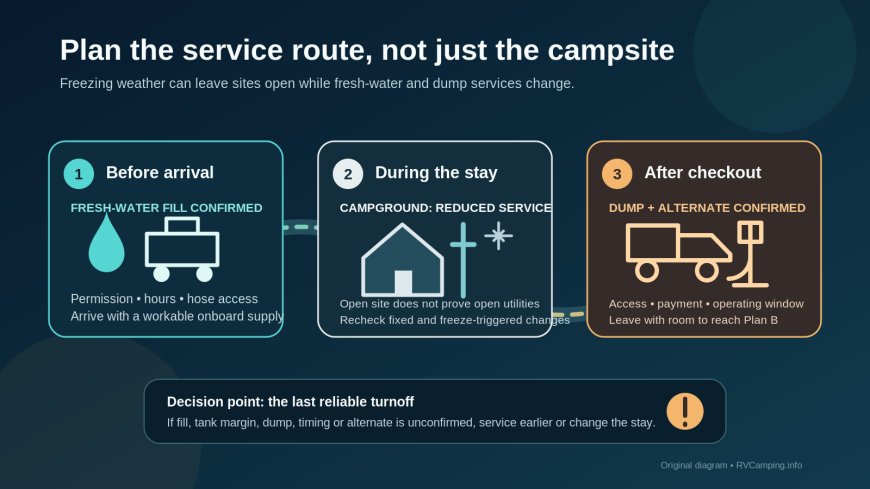
The first is a dated seasonal change. The second is conditional. Neither is solved by winterizing an appliance or buying a heated hose. The trip needs a service route: a confirmed fill before arrival, enough onboard capacity for the stay, and a confirmed dump after departure.

Put the campground between two service stops
Treat the reservation as the middle of the route, not as the place that must supply every utility.
| Route point | What must be confirmed | Failure response |
|---|---|---|
| Last reliable fill | Potable source, RV tank filling permitted, access hours, hose reach and payment | Fill earlier or carry an approved separate drinking-water supply |
| Campground stay | Which water outlets remain on, whether bulk filling is allowed, restroom status and how a freeze shutdown is announced | Arrive able to camp without campground water |
| First reliable dump | Station operating after checkout, accepted users, fee, payment, rinse-water status and rig approach | Use the preselected alternate before tanks lose working margin |
This is different from confirming that a campground has a dump station in summer. The route has to work on the arrival and departure dates. A same-property station that is closed contributes nothing to the winter plan.
Sugar Pine Point makes the distinction unusually clear. Winter sites remain available, yet the dump station is already closed for the season. The page identifies potable water at a central restroom, but it does not say that RVers may attach a hose there or fill a tank.[1] Record it as drinking water at a named building until park staff confirms a bulk-fill use. For guidance on evaluating an exact outlet, see Can you fill an RV tank from that campground spigot?
Brandy Creek requires a different entry on the trip sheet. Its water and dump service are weather-dependent rather than tied to one published closure date.[2] A confirmation made a week ahead is useful, but it is not the last check. Reconfirm on the travel day and arrive prepared for the off state.
Choose the arrival state before choosing the stop
Write down the condition in which the RV must reach the campground:
- fresh tank at the planned level, within the RV's actual carrying limits;
- separate drinking water aboard if the campground supply is unavailable or not approved for tank filling;
- gray and black tanks emptied far enough in advance to cover the stay plus the drive to the next confirmed station;
- clean fill equipment stored apart from sewer equipment;
- the next dump address, access window and alternate saved offline.
Do not make "full fresh, empty waste" an automatic rule. Water adds load, and the safe amount depends on the RV's ratings, the rest of the cargo and the trip. The useful target is enough verified capacity to reach the next service point without exceeding any vehicle limit or relying on a closed facility.
For the waste side, leave margin rather than planning to reach a monitor reading at the limit. Tank gauges can be imprecise, usage changes with the number of occupants, and a weather closure can extend the interval. If your measured capacity cannot cover the campground stay and the drive to the dump, shorten the stay or add an operating station to the route.
Match service timing to check-in and checkout
Utility stops must fit the travel clock. Sugar Pine Point currently lists 2 p.m. check-in and noon checkout for winter camping.[1] That creates two separate timing questions:
- Can the last potable fill be reached before the campground arrival window, without forcing the RV to wait somewhere it is not allowed to park?
- Will the departure dump accept the rig after noon, with enough time left for the next drive?
A station that closes at noon cannot serve as a post-checkout stop. A fill point behind a locked municipal gate is not an arrival backup. A commercial RV park may limit dumping to registered guests even when a map listing calls it public. Confirm operating hours and user eligibility with the operator of the exact facility.
Build the route backward from the earliest hard deadline. If the dump closes at 3 p.m., subtract the campground departure time, travel time, a queue allowance and the dump task itself. If that leaves no practical margin, use a station before the stay or select a later-operating departure option.
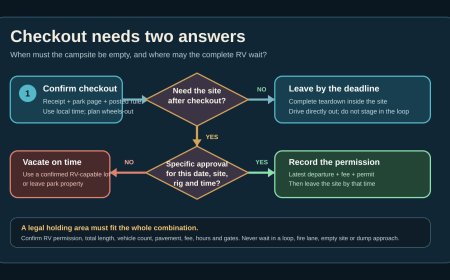
The campground loop, dump lane and roadside shoulder are not staging areas. If a service stop opens later than checkout, find legal RV parking that accepts the complete motorhome or truck-and-trailer combination. Our RV checkout and staging guide covers that separate parking decision.
Ask for four statuses, not one "open"
An office answer such as "the campground is open" is too broad. Ask for four separate statuses for the exact dates:
- Are the winter campsites accepting arrivals?
- Is an approved RV fresh-water fill operating, and where is it?
- Is the RV dump operating, including any water needed for normal station use?
- Which toilets or restrooms remain available if water systems are reduced?
Then ask what can change the answer. At Brandy Creek, freezing conditions can interrupt water and dump availability.[2] The practical follow-up is: "Where will that shutdown be posted, and when should I check again?"
For a fixed seasonal closure such as Sugar Pine Point's dump station, ask when reopening is expected but plan from the current closed status.[1] Do not turn an estimated spring date into a promise. For a conditional service, record both the present state and the trigger that could change it.
A concise message is enough:
We have an RV stay on [dates]. Please confirm whether an RV tank-fill point and the dump station will operate on our arrival and departure days. If potable water remains at a restroom or winter hydrant, is RV tank filling allowed from that exact outlet? If a freeze closes either service, where is the notice posted, and which nearby fill or dump does the park currently recommend?
Save the reply with the reservation and note when it was received. Recheck during office hours before passing the last reliable service point.
Keep water labels attached to locations
"Water available" is not a route instruction. Give every water note a place and a permitted use:
- potable water for bottles at the central restroom;
- approved RV tank fill at a named station;
- non-potable rinse water at the dump lane;
- individual site hookup, operating only in a stated loop;
- no water service.
Sugar Pine Point's current notice is a good reason to be precise: potable restroom water remains while showers and the dump are closed.[1] Those facts do not establish that the restroom outlet can supply an RV tank. They also do not establish that water is available where the dump equipment sits.
Keep the dump status equally specific. "Dump closed" can mean the entire lane is barricaded, the sewer inlet is unavailable, or the station lacks the water needed for normal operation. The operational answer must come from the park or station operator. Never use a campsite sewer fitting, restroom fixture, storm drain or other connection as a substitute unless it is expressly designated for that disposal.
Decide before the last reliable turnoff
The go/no-go decision belongs at the last place where the RV can still fill, dump, buy water or change campgrounds without a difficult reversal. Put that point on the route card.
Continue to the reduced-service campground only if:
- the onboard fresh-water and drinking-water plan covers the stay;
- the holding tanks have measured room for the stay and onward travel;
- one departure dump and one alternate are confirmed;
- both stops fit access hours, payment rules and the rig's route;
- a same-day shutdown will not strand the plan.
Otherwise, service the RV before proceeding, shorten the stay or use a campground with operating utilities. This is a logistics decision, not a test of whether the RV can physically tolerate cold. Plumbing freeze protection is a separate rig-specific task; see Shoulder-season RV freeze plan: protect the whole water path.
The service-route card
Keep this with the reservation:
- Arrival date and local time: ___
- Last confirmed potable RV fill: operator, address, hours, permission, payment, checked at ___
- Campground water: exact outlet, allowed use, current status, update channel ___
- Campground dump: open / closed / conditional; trigger and last check ___
- Fresh-water departure trigger: remaining amount or operating problem that requires a route change ___
- Wastewater departure trigger: measured tank margin and earliest exit time ___
- First confirmed dump after checkout: operator, address, hours, access, payment ___
- Independent alternate: operator, address and confirmation time ___
- Legal waiting place if timing leaves a gap: ___
At Sugar Pine Point, the card currently reads "winter loop open; dump closed; potable water at central restroom; bulk RV fill not established by the page."[1] At Brandy Creek, it reads "RV camping open; water and dump conditional in winter; verify again before arrival."[2]
That level of detail prevents an open campsite from being mistaken for an open utility system. Arrive with a workable water state, leave with a real dump destination, and let the campground provide only the services it has actually confirmed.
Editorial note: Campground utilities can change with weather, maintenance and operating decisions. The named pages were checked October 22, 2026. Confirm the exact dates and facilities with the park before travel. This article does not claim firsthand inspection.
Sources
- Ed Z'berg Sugar Pine Point State Park — California State Parks — Current winter-camping notice, potable restroom water, seasonal shower and dump closure, and check-in/checkout times. Page updated October 19, 2026; archived October 22, 2026.
- Camping at Whiskeytown — National Park Service — Brandy Creek RV's year-round status, self-contained-RV requirement and conditional winter water/dump shutdown. Archived October 22, 2026.
What's Your Reaction?