







Checkout is a deadline, not a parking plan: where to put the RV after you leave the site
Confirm the campground checkout time, get specific permission for any late departure, and identify an RV-capable holding area before vacating the site.

Checkout is a deadline, not a parking plan: where to put the RV after you leave the site
By Romana | Rules checked October 21, 2026
A noon checkout and a 3 p.m. tour create a three-hour problem. The campsite belongs to the next camper, but a motorhome cannot slip into an ordinary car space and a trailer combination may not fit the visitor-center lot. Waiting on the campground loop is not a neutral solution: it can obstruct one-way traffic, slow site cleaning and leave the next arrival trying to back around your rig.
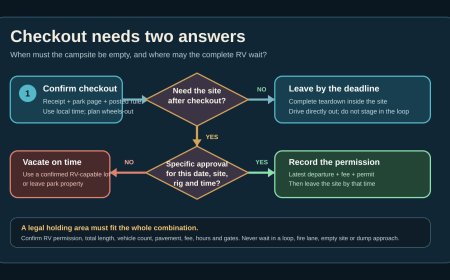
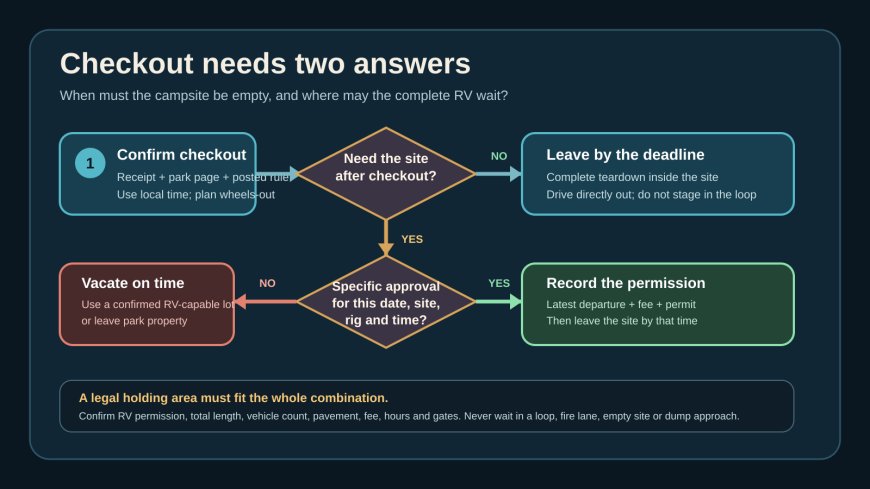
Solve this before departure day with three separate answers: the exact checkout time, whether the park has authorized a later departure, and the named place where the complete RV combination may wait. A paid reservation answers only the first part.
The short rule
The National Park Service tells campers to be packed and out by the campground's checkout time and to confirm the procedure for the actual campground.[1] Treat that time as the moment the entire site must be vacant—not the time to begin retracting slides, disconnecting sewer or deciding where to go.
Use this order:
- Save the checkout time from the confirmation and the current park page.
- If you need the site longer, ask before checkout and record the answer.
- If the site cannot be extended, identify a legal holding area that accepts the RV's total length, height and vehicle count.
- Leave the loop completely; do not create an unofficial staging lane.
The examples below show why there is no universal late-departure policy. Fort Pickens, El Capitán and Joshua Tree handle time and parking differently.[2][3][4]
Washington State Parks adds another system-wide example.[5]
Confirm which clock controls
Write the time in local park time, including the date. Then compare four places:
- reservation confirmation or camping receipt;
- park or campground page;
- posted rules at the entrance or site;
- instructions from staff.
If they conflict, ask staff which current instruction controls and note the employee or office, date and answer. Do not quietly choose the latest time.
Fort Pickens Campground at Gulf Islands National Seashore, for example, publishes an 11 a.m. checkout.[2] El Capitán State Beach publishes noon.[4] Washington State Parks generally lists 1 p.m. for campsites, while its roofed accommodations generally check out at 11 a.m.[5] These are examples from named systems, not a national sequence that travelers can apply elsewhere.
Build backward from the controlling time. A realistic departure card includes:
| Milestone | Planned time |
|---|---|
| Breakfast and interior packing finished | ___ |
| Slides, awning and exterior gear stowed | ___ |
| Utilities disconnected and caps installed | ___ |
| Tow connection or towed vehicle verified | ___ |
| Final site scan | ___ |
| Wheels cross the site boundary | ___ |
| Arrival at approved holding area | ___ |
The last two entries matter. A road-ready RV still needs somewhere legal to be.
Late departure requires an affirmative answer
Do not translate an empty neighboring site, a quiet weekday or an unstaffed booth into permission. The next reservation, cleaning schedule and traffic pattern may not be visible to you.
El Capitán's official camping page directs campers who want more time to check current inventory through ReserveCalifornia or ask entrance-station personnel.[4] Fort Pickens states that late checkouts are subject to another night's fee.[2] Neither example supports an informal grace period. One points travelers to availability and staff; the other attaches a potential full-night charge.
Ask a question that can be answered precisely:
We are in site [number] with a [total-length] motorhome or tow combination. Checkout is [time] on [date]. May the RV remain on this site until [requested time]? If yes, what fee or reservation change applies, and should we display or collect anything? If no, which lot may legally hold this complete combination after checkout, and until what time?
A useful approval includes the date, departure time, exact site or parking area, fee, and any permit or windshield tag. “It should be fine” is not enough if the speaker has not identified the rig, date or location. When approval is verbal, repeat the terms back and write down when and where the conversation occurred.
If nobody with authority says yes, depart by the published checkout time.
Staging is a parking permission, not a wide shoulder
The holding area must pass all of these checks:
- RVs or trailers are allowed, not merely passenger cars;
- the complete combination fits inside marked limits;
- the surface and approach handle the rig's weight and turning path;
- no part of the rig enters a travel lane, fire route, loading zone or neighboring space;
- detached tow vehicles and trailers comply with the area's vehicle-count rule;
- the parking permit or day-use fee covers the planned hours;
- gates remain open through departure;
- parking does not become prohibited overnight use.
Fort Pickens provides a clean example of named overflow parking: its campground map says additional vehicles must use the overflow area and may not use unoccupied campsites. The same map marks campground roads as one way.[2] That is not blanket permission to put the RV itself in overflow; it is a prompt to ask whether the exact motorhome or trailer combination is accepted there.
Joshua Tree demonstrates the opposite condition. It provides no in-park overflow lot for extra vehicles; visitors must park elsewhere and carpool back. It also warns that an RV extending into a road can be hit or cause a crash.[3] At a park with that rule, “we will find a corner after checkout” is not a plan. The legal holding point may need to be outside the park.
El Capitán requires vehicles to stay in assigned campsites, sends additional vehicles to extra-vehicle parking, and requires tires and equipment to remain on pavement.[4] Again, an extra-vehicle lot is not automatically a large-RV waiting lot. Ask whether the complete rig is permitted and whether a fee applies.
Washington State Parks offers an instructive arrival example: early guests are told not to wait outside someone else's campsite and may use a day-use area when they have the required pass.[5] The direction is about early arrival, not late departure, but the traffic principle carries: use a designated visitor area under its own rules instead of idling in the camping loop.
Rank the holding options
Use this preference order only after confirming that the specific place accepts the rig:
- Staff-designated RV or overflow area.* Best when size, hours and fee are confirmed.
- Park day-use lot with explicit RV permission.* Verify day-use pass, closing time and trailer rules.
- Dump station queue used only for the dump task.* Never turn a service lane into parking; leave when the task is done.
- Off-property commercial or public parking that affirmatively allows the combination.* Confirm with the operator rather than relying on map imagery.
- The next campground or destination.* Often the least complicated answer when local parking is uncertain.
Do not use an unoccupied campsite, road shoulder, campground entrance, turnaround, fire lane, dump-station approach, accessible aisle, campsite apron or striped loading area unless staff has designated it for that exact purpose. A place where the RV physically fits is not necessarily a place where it may wait.
Separate the trailer problem from the motorhome problem
A motorhome and a towable ask different parking questions.
A motorhome towing a car may need to remain connected because there is no safe coupling area at the destination. Ask for the accepted total length and whether two vehicles are counted even while connected.
A travel trailer may fit only if detached, but detaching creates two parked vehicles and requires a legal place to chock and secure the trailer. Do not unhitch in a day-use lot unless the operator allows it. Do not leave a trailer unattended merely because the tow vehicle fits elsewhere.
For either setup, save the route into and out of the lot. Satellite imagery cannot establish current striping, one-way controls, vertical clearance, surface strength or permission.
Build a no-blocking departure sequence
On checkout morning:
- Finish packing while fully inside the reserved site.
- Complete the rig's manual-based travel checks before entering the loop.
- Perform the empty-pad scan without occupying the road longer than necessary.
- Pull directly to the approved holding area or out of the park.
- If the named area is full or inaccessible, continue to the predetermined backup; do not circle or wait at the loop entrance.
The spotter should walk only where campground rules and traffic make it safe. Never stand behind a backing RV in an active lane. If the driver cannot see the spotter, stop.
A useful backup card has two destinations:
- Plan A:* [approved lot], entrance [description], allowed until [time], permit [type].
- Plan B:* [off-property location], route [road], permission confirmed with [operator/date].
Add the park office and after-hours number, but do not assume a call made after the deadline retroactively authorizes the overstay.
The one-message checkout confirmation
Send this before the cancellation or modification deadline when possible:
Please confirm the checkout time for RV site [number] on [date]. If late departure is available, what is the latest authorized time and charge? If it is not available, may our [rig type and total length] use a specific day-use or overflow area after checkout? Please identify the lot, permit or fee, hours, whether the RV and tow vehicle may remain connected, and any route or gate restriction.
Save the response with the reservation. If the answer names no legal lot, plan to leave the property.
Checkout is not complete when the jacks come up. It is complete when the campsite is empty on time and the RV is either moving toward the next stop or parked in a place that has actually accepted it. That distinction keeps a travel delay from becoming somebody else's blocked loop.
Editorial note: Rules, fees, access and parking availability can change. The named examples were checked October 21, 2026 and illustrate different local policies; they are not universal. Confirm the exact campground, site, rig and date. This article does not claim firsthand inspection or provide legal advice.
Sources
- Checking Out — National Park Service — General direction to vacate by the campground's checkout time and confirm local procedures. Archived October 21, 2026.
- Fort Pickens Campground map and information — Gulf Islands National Seashore, National Park Service — Official 11 a.m. checkout, late-checkout fee warning, overflow-parking rule and one-way-road map. Archived October 21, 2026.
- Campgrounds — Joshua Tree National Park — Official no-overflow-parking answer, vehicle limits and warning against an RV extending into the roadway. Archived October 21, 2026.
- El Capitán State Beach Camping — California State Parks — Official noon checkout, instruction for extending a stay and assigned/extra-vehicle parking rules. Archived October 21, 2026.
- Camping — Washington State Parks — General campsite and roofed-unit checkout times plus designated day-use guidance for early arrivals. Archived October 21, 2026.
What's Your Reaction?