





Can Guests Adjust the Heat? Verify the Exact Glamping Unit Before a Cold-Weather Stay
A unit-specific booking check for mixed RV and glamping groups to verify guest thermostats, timed or host-only heat, personal-heater rules, backup heat, alarms and evacuation before cold weather.

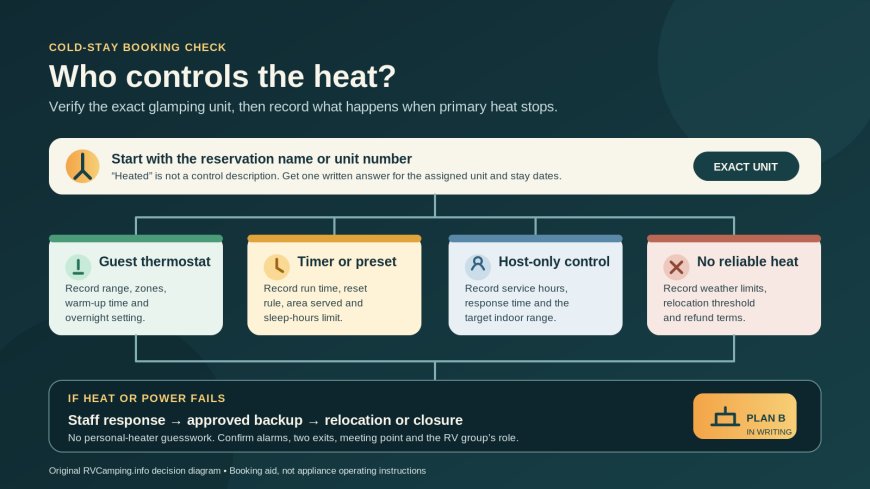

Can guests adjust the heat? Verify the exact glamping unit before a cold-weather stay
By Romana | Information checked October 19, 2026
A listing that says "heated" still leaves the cold-weather question unanswered. One cabin may have a wall thermostat a guest can set. The neighboring yurt may have a heater that runs for 30 minutes at a time. A safari tent may rely on staff to deliver an appliance. Another unit may have heat that stops with the electric service.
This matters when RV travelers share a campground with relatives or friends in glamping units. The RV crew knows which furnace, battery and propane supply serves each rig. The glamping side deserves the same clarity, but the answer must come from the property for the named unit and stay dates. Verify the control, the overnight operating rule and the fallback before the cancellation deadline.
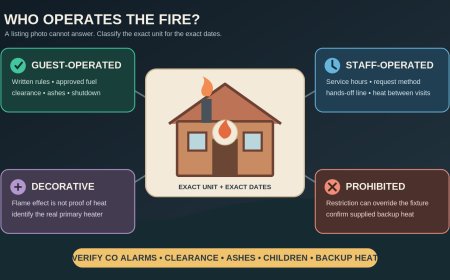
Scope note: This guide is about temperature control and continuity of heat in a specific unit. It does not repeat the broader CO/fire venue-selection checklist published October 16 or the wood-stove lighting, fuel and ash questions covered October 18.
Replace "heated" with a control description
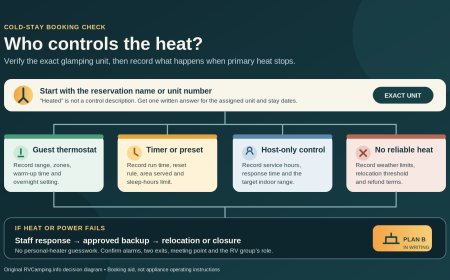
Ask the host to classify each reserved cabin, tent, yurt, wagon or tiny house by what the guest can actually do:
| Control arrangement | What it means | What to get in writing |
|---|---|---|
| Guest-set thermostat | The guest chooses a set point within the installed system's range | Control location, allowed range, zones, normal warm-up time and whom to call if the displayed setting produces no heat |
| Guest timer or limited control | The guest can start heat or select a preset, but the appliance stops, resets or covers only part of the unit | Run time, restart rules, overnight restriction, area served and the approved way to stay warm after shutoff |
| Host-only control | Staff starts, changes, delivers or resets the heat | Service hours, after-hours response time, target room temperature and whether staff must enter the unit |
| Fixed or automatic heat | Guests cannot select a temperature; a building system or occupancy control decides when heat runs | Expected indoor range, sensor location, setback schedule and fault-reporting process |
| No dependable active heat | The unit is seasonal, unheated, or the offered equipment is not approved for sleep hours | Bedding supplied, temperature or weather limits, closure or relocation threshold and refund terms |
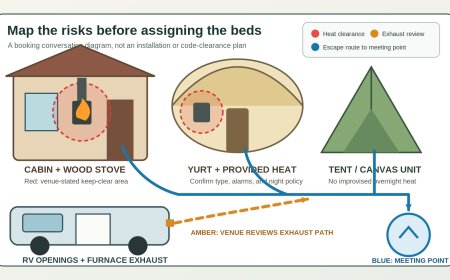
Do not infer one row from the appliance's appearance. A digital display may be locked. A wall unit may heat only one room. A portable electric heater may be property-supplied but subject to a bedtime shutdown rule. "Central heat" can still have a host-controlled set point.
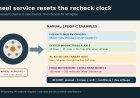
Official operator instructions show how sharply the control can vary inside one lodging category. AutoCamp publishes several thermostat methods: one system requires selecting "heat and gas," another uses a dial, and a two-zone control separates the bedroom from the kitchen and bathroom.[1] Huttopia says some canvas accommodations have wood stoves while others use a small heater on a 30-minute timer; its cabins and tiny houses have heating, and it tells guests to check the accommodation.[2] Neither example establishes what a different property supplies. Both show why the booked unit, not the word "glamping," is the useful level of detail.
Ask about the exact unit, not the unit type
A mixed group may reserve two accommodations sold under the same label but receive different floor plans or equipment generations. Put the unit name or number in the message. If assignment happens at check-in, ask the property to confirm that every possible assignment has the same control and backup arrangement. If not, request an assigned unit or written minimum standard.
Send this before the free-cancellation deadline:
For reservation [number] on [dates], please confirm the primary heat in exact unit [name/number]. Can guests change the temperature themselves? If yes, please identify the control, allowed range, rooms or zones served, and whether it may operate while guests sleep. If control is staff-only, timed, fixed or automatic, please state the normal indoor range and after-hours response. Please also confirm the supplied backup if heat or power fails, the rule for personal heaters, smoke and CO alarm coverage, the evacuation meeting point, and the relocation, refund or closure policy if safe heat cannot be restored.
A useful reply names hardware and policy. "There is a heater" does not say who controls it. "Call us if needed" does not say whether anyone answers at 2 a.m. Ask for the answer in the reservation thread so every household sees the same terms.
At check-in, compare the assigned unit with the confirmation. Photograph the control and its displayed status for the group's own reference, without removing covers or changing installer settings. If the unit differs, settle the heat plan while staff is available.
Test the control before bedtime
Do a normal guest-level test soon after arrival. Follow the posted instructions, make one modest adjustment and allow the property-stated warm-up time. Check the sleeping area rather than standing beside the heater. A warm vent in the main room does not prove that a closed bedroom will hold temperature.
Record four observations:
- The control accepted the change rather than showing a lock, error or expired timer.
- Heat reached every sleeping zone the property said it serves.
- The appliance cycled normally without smoke, unusual odor, visible damage or repeated breaker trips.
- The room stayed usable without moving bedding, curtains, luggage or a travel crib near the appliance.
Stop and contact staff if the unit does not behave as described. Guests should not open a heater, reset a breaker repeatedly, alter ventilation, bypass a timer, tape over a sensor or use an installer menu. A control problem belongs to the property.
A portable heater needs extra room around it. The U.S. Fire Administration says bedding, clothing and curtains should remain at least three feet away, portable heaters should plug directly into an outlet rather than an extension cord or power strip, and heaters should be turned off when occupants go to bed or leave the room.[3] The installed appliance instructions and property rule may be more restrictive. A small tent or cabin may lack a compliant place once bags, pet bedding and children's sleep gear are inside.
Treat personal heaters as prohibited until confirmed
Do not pack an electric space heater, propane heater, heated appliance or extension cord as an unannounced fix. Ask for the personal-heater policy in writing. The property may ban outside equipment because of circuit capacity, fire risk, insurance terms or the unit's ventilation design.
If personal equipment is allowed, the answer still needs boundaries:
- exact appliance type and electrical rating the property permits;
- approved outlet and location;
- whether an extension cord or power strip is forbidden;
- clearance from fabric walls, beds, curtains and luggage;
- tip-over and overheat protection requirements;
- hours of use and whether operation during sleep is barred.
Permission to charge a phone does not imply permission to add a high-draw heater. Likewise, an outlet in an RV site's pedestal is not permission to route a cord into a detached glamping tent. If the approved heat is inadequate, ask for staff service or relocation instead of experimenting.
Separate backup heat from power-outage policy
"Backup heat" can mean a second installed system, a staff-issued appliance, heated bedding, relocation to another accommodation, or closure with a refund. Find out which one the property means and what event activates it.
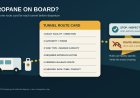
Build a short failure ladder for each unit:
- Primary heat fault: Who answers, how quickly, and can staff safely restore the installed system?
- Local electrical fault: Does the property move the group, issue approved equipment, or close the unit?
- Property-wide outage: Which heat, alarms, door locks, well pumps, lighting, communications and accessibility equipment lose power?
- Extended cold: At what indoor temperature or outage duration does the host relocate guests, end the stay or direct them to a staffed warming location?
Ready.gov advises going to a powered community location when heat or cold becomes extreme. It also says generators belong outdoors and away from windows, and a gas stove or oven should not be used for space heating because of CO and fire risks.[4] At a campground, guests should follow staff and emergency instructions rather than choosing a generator location or converting cooking equipment into a heater.
For a mixed RV/glamping group, do not quietly assign the RVs as the backup. That can exceed sleeping capacity, overload electrical service, drain house batteries or propane, and leave belted travel seats unavailable if the group must evacuate. If the property proposes the group's RV as the fallback, confirm occupancy, overnight parking, hookups, fuel, alarm coverage and the ability to leave promptly. A property-managed heated space or relocation is usually a cleaner plan.
Verify alarms without treating them as heat controls
Smoke and CO alarms are warning equipment, not proof that a heater is safe or suitable. Ask the property to confirm which alarms serve the exact sleeping space, when staff last tested them and what guests must do when either sounds. If the heat source burns fuel, if a generator may operate elsewhere on the property, or if an attached space contains combustion equipment, the CO answer deserves particular attention.
At arrival, locate the alarms and exits without pressing buttons unless the property instructs guests to do so. Never cover, move, disable or silence an alarm to keep a heater running. If an alarm sounds, everyone leaves for fresh air and follows the property's emergency instructions. Do not remain inside to change the thermostat or investigate the appliance.
Power loss creates another question: do the alarms have battery backup, and will any monitored alert or staff notification still work? Ask the host. A glowing thermostat screen says nothing about alarm backup, and a personal travel alarm does not replace the property's duty to provide and maintain the required protection.
Give every sleeping unit an exit plan
The heat plan and the evacuation plan should fit on the same unit card. U.S. Fire Administration guidance calls for two ways out of every room, unblocked doors and windows, an outdoor meeting place and a practiced plan.[5] A glamping property may have different structures and site constraints, so ask staff to identify the exits and meeting point that apply there.
Before sleep:
- keep the route from every bed to the door free of shoes, bags and heater cords;
- check that the alternate exit identified by the property can be opened from inside;
- assign an adult to assist each child or guest who may need help;
- put shoes, coats and essential mobility aids where they can be reached without crossing the heater's clearance area;
- share the exact property address, unit identifier and after-hours number;
- agree that everyone stays at the meeting point and nobody re-enters for gear.
Detached units may not hear one another's alarms. Decide how the RV and glamping households will account for everyone without approaching a dangerous structure. One adult can carry the roster at the meeting point; that person is not expected to search a smoky unit.
Use a one-card cold-stay record
Create one card per glamping unit, then share the cards with the RV households:
| Field | Confirmed answer |
|---|---|
| Exact unit and dates | Name/number and stay dates |
| Primary heat | Installed or property-supplied appliance |
| Guest control | Thermostat, timer, preset, host-only, automatic or none |
| Range and coverage | Allowed setting and rooms/zones served |
| Overnight rule | May run during sleep, must shut off, or staff instructions |
| Personal heaters | Prohibited or exact written permission and limits |
| Primary failure response | Contact, response time and staff action |
| Outage fallback | Backup system, relocation, warming site, closure or refund |
| Alarm coverage | Smoke and CO locations, battery backup and response |
| Escape | Primary exit, alternate exit and outdoor meeting point |
| Mixed-group boundary | Whether RVs are excluded from or formally included in fallback |
The decision is simple once the blanks are filled. Book when the exact unit has a heat control the group can live with, an overnight rule that does not depend on improvisation, and a credible response if the appliance or power fails. Change units or properties when the host cannot say who controls the heat, what happens after hours or where guests go when the room will not stay safely warm.
Sources
- Thermostat Operation Instructions — AutoCamp — Official examples of guest-adjustable dials, modes and zones across different suite controls. Accessed October 19, 2026.
- Is My Accommodation Heated and Does It Have AC? — Huttopia North America — Official example distinguishing canvas-unit wood stoves, 30-minute heaters, and heated cabins or tiny houses. Accessed October 19, 2026.
- Heating Fire Safety — U.S. Fire Administration — Portable-heater clearance, direct-outlet and bedtime shutdown guidance. Accessed October 19, 2026.
- Power Outages — Ready.gov — Outage planning, extreme-temperature relocation, generator placement and cooking-appliance warnings. Accessed October 19, 2026.
- Home Fire Escape Plans — U.S. Fire Administration — Exit, meeting-place and fire-drill guidance. Accessed October 19, 2026.
What's Your Reaction?