








La Posa LTVA by RV: choose the permit, then plan water and waste
Choose La Posa's short or long LTVA permit, then build an arrival plan around shared water, dump facilities, self-containment rules, and the winter season.

La Posa LTVA by RV: choose the permit, then plan water and waste
La Posa is easy to mistake for a very large, inexpensive campground. That is the wrong planning model. The Bureau of Land Management's 11,400-acre Long-Term Visitor Area south of Quartzsite is open-desert camping supported by shared toilets, water points, dump facilities, and trash service. It does not provide the individual utility connections or serviced campsite routine many RV travelers associate with a campground.[1][3]
A successful stay starts with two decisions before the RV reaches US 95: buy the permit that fits the actual number of days, and arrive able to manage fresh water and both waste tanks without treating the common facilities as hookups.
Choose by days, not by the word "long-term"
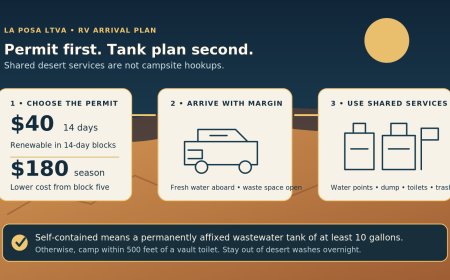
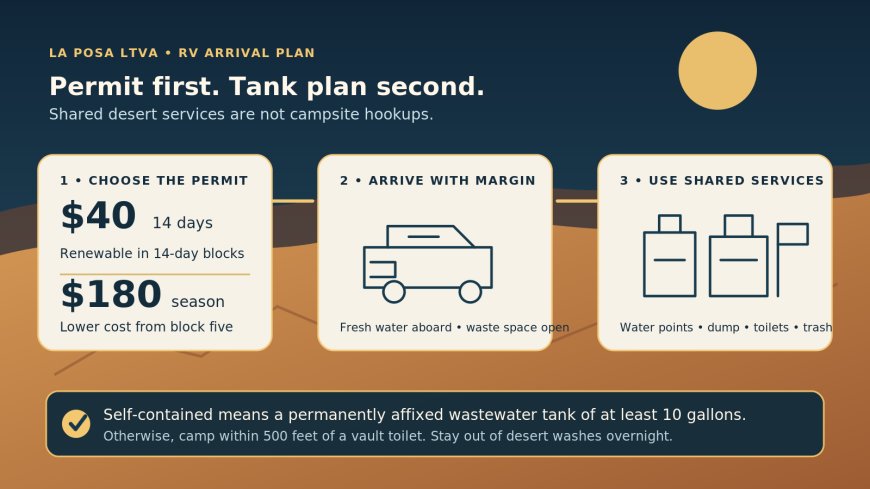
For the winter LTVA season, BLM's current La Posa page lists a $40 short-visit permit for 14 consecutive days and a $180 long-term permit for the full September 15-April 15 season or any portion of it. The short permit can be renewed as often as needed for another $40. Its 14-day clock begins when the receipt is exchanged for the official permit and decal.[1] A BLM update dated February 18, 2026 repeats the same $180 and $40 prices and the same seven-month and 14-day terms.[4]
That produces a useful purchase line:
| Winter use you expect | Short-visit permits | Short-permit cost | Better price on permit fees alone |
|---|---|---|---|
| Up to 14 consecutive days | 1 | $40 | Short visit |
| 15-28 days | 2 | $80 | Short visits |
| 29-42 days | 3 | $120 | Short visits |
| 43-56 days | 4 | $160 | Short visits |
| 57-70 days | 5 | $200 | Long term at $180 |
The long-term permit becomes cheaper when a trip reaches the fifth 14-day block. It can still make sense earlier if dates are unsettled and avoiding repeated renewals is worth $20 or more. A traveler certain of leaving within 56 days pays less with short permits.
There is a fee trap in old search results. A September 2024 BLM draft business plan proposed a much larger fee increase and a 30-day short permit.[5] The current La Posa page and BLM's February 2026 program update still state $180 for the long permit and $40 for 14 days.[1][4] This article therefore uses those current official figures, checked October 22, 2026, rather than treating a proposal as an adopted price. Recheck the La Posa page shortly before departure because permits and fees can change.
The LTVA permit is a separate special-use charge. BLM's camping brochure says America the Beautiful and older federal recreation-pass discounts do not apply to LTVA permit fees.[3]
Arrive with one clean cycle in reserve
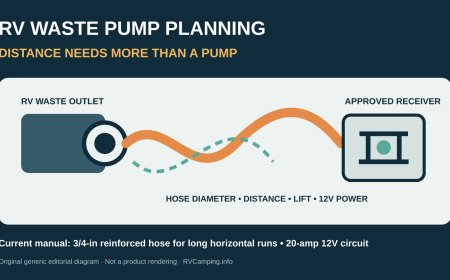
La Posa's official facility list is better than the phrase "open desert" may suggest: 10 accessible vault toilets, eight water faucets, a dry dump station, a dump station with water, and trash service.[1] All of those are shared facilities. None is a water, sewer, or electrical connection at the RV.
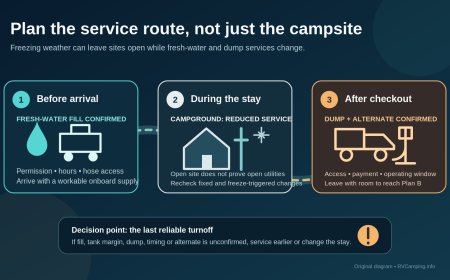
Plan the first campsite as though a line, closure, or maintenance problem could delay a service run. A practical arrival looks like this:
- Fill the freshwater tank or carry enough potable water for the first night and the next morning.
- Empty black and gray tanks before the final approach when convenient, rather than arriving nearly full.
- Keep drinking water separate from hoses and fittings used around dump equipment.
- Park with enough tank capacity to wait for a quieter service window instead of moving the RV immediately after setup.
The most useful number is not a generic gallons-per-day estimate. It is the number of days your own crew takes to move each tank from the arrival level to its normal action point. Record the freshwater, gray, and black readings at the same time each day during the first few days. The tank that reaches its limit first sets the service interval.
Do not wait for that limiting tank to be completely full. Desert stays are easier when the service run happens with a buffer for a closed lane, a busy January day, or an extra night in camp. If gray water usually reaches the chosen action point on day six, for example, schedule the run on day four or five. That timing is editorial advice, not a BLM rule.
BLM's sanitation rules are firmer. Sewage, gray water, and garbage cannot go on the ground, and holding-tank sewage does not belong in a vault toilet. Use of LTVA trash and dump facilities requires an LTVA permit.[2]
Check whether the RV qualifies for the spot
Most of La Posa is for self-contained camping units. BLM defines one as having a permanently affixed wastewater holding tank with at least 10 gallons of capacity. A portable toilet, a portable waste tank, or a permanently installed tank smaller than 10 gallons does not meet that definition.[2]
La Posa has a narrow exception: a non-self-contained unit may camp within 500 feet of a vault toilet.[2] This matters for a basic van, pickup camper, or small trailer. A portable tote may still be useful for moving waste, but it does not turn the camping unit into a self-contained unit under the rule.
Choose the legal zone before settling in:
- If the RV meets the permanent 10-gallon wastewater-tank test, it can use the wider camping area, subject to posted restrictions.
- If it does not, target the allowed area within 500 feet of a vault toilet and confirm the distance and current signs with the host.
- If the setup is uncertain, bring the tank specifications and ask at the contact station before establishing camp.
This is one reason La Posa should not be approached like an ordinary campground. A campground reservation usually settles the question of where the rig belongs. At an LTVA, the RV's wastewater system can determine which part of the open area is legal.
Make the arrival route part of campsite selection
BLM directs travelers from Interstate 10 at Quartzsite south on US 95. The four La Posa sections are North, South, West, and Tyson Wash, with entrances beginning about two miles south of town.[1] The supplementary rules require use of legal access roads from US 95. Cutting through a ditch, berm, fence, or improvised opening is prohibited.[2]
Arrive with daylight if possible. The appealing flat line ahead may be a desert wash, and overnight camping in washes is prohibited at La Posa.[2] Daylight also makes it easier to preserve the required 15 feet between dwelling units, see established travel routes, and judge whether the surface and turn radius suit the RV.[2]
The official facility count covers La Posa as a whole. It does not promise that every water point, toilet, or dump lane is equally close to every section.[1] Before dropping jacks or unpacking outdoor gear, locate the route back to water and waste facilities. A beautiful distant spot loses some of its appeal if every service run requires breaking camp or threading a large RV through a poor approach.
Rules that shape a stay longer than a weekend
A few LTVA rules affect the rhythm of everyday RV life:
- Quiet hours run from 10 p.m. to 6 a.m., unless posted otherwise. Generator noise can still be judged unreasonable outside those hours.[2]
- The LTVA speed limit is 15 mph unless another speed is posted, and motorized travel stays on existing roads, trails, and washes.[2]
- Pets must remain leashed, and campers are responsible for disposing of pet waste properly.[2]
- A camping unit or campsite cannot be left unoccupied for more than five days without advance approval from an authorized BLM officer.[2]
- Wheels must stay on wheeled vehicles so the camping unit remains mobile. Purpose-built trailer and pickup-camper jacks are allowed.[2]
- Wood cannot be collected within the LTVA, and native mesquite, ironwood, or palo verde firewood cannot be possessed there. Campfires remain subject to current posted restrictions.[2]
Posted rules take precedence when they differ from the general supplementary brochure.[2] Photograph the entrance board on arrival and read it again after a major weather or fire-condition change.
The season ends even if the desert does not
The long-term permit framework runs from September 15 through April 15.[1][2][4] La Posa does not simply continue under the same rules on April 16. The current BLM page lists a separate off-season structure through September 14: $10 per vehicle for day use, $15 per vehicle for overnight use, or $75 for an annual vehicle permit, with a maximum stay of 14 days in a 28-day period.[1]
The supplementary rules add that, after the 14th off-season day, the camper must move beyond a 25-mile radius of that LTVA.[2] Summer heat also changes water needs and risk, but the fee and stay-limit change alone is enough to require a new plan. A winter decal should not be treated as permission to remain in place through summer.
A La Posa arrival card
Keep this short version with the route notes:
- Confirm the current fee on the official La Posa page.
- Use short permits through 56 expected days; compare the $180 long permit before a fifth 14-day block.
- Carry enough potable water and waste capacity to absorb a delayed service run.
- Confirm that the RV has a permanent wastewater tank of at least 10 gallons, or camp within 500 feet of a vault toilet.
- Enter from a legal US 95 access road and stay out of washes overnight.
- Locate the shared water and dump route before finishing setup.
- Read the posted board for local changes.
La Posa works well when the RV remains its own small utility system. The permit buys access to a managed seasonal area and shared support facilities. It does not turn the desert into a full-hookup campsite.
Sources
- La Posa Long Term Visitor Area - Bureau of Land Management - Current La Posa facilities, directions, winter and off-season fees, and stay limits. Accessed October 22, 2026.
- Long-Term Visitor Area Supplementary Rules - Bureau of Land Management (PDF) - Permit display, sanitation, self-containment, access, spacing, quiet hours, and La Posa-specific rules. Accessed October 22, 2026.
- Long-Term Camping on Public Lands - Bureau of Land Management (PDF) - LTVA program scope, minimum facilities, self-containment, and federal pass policy. Accessed October 22, 2026.
- Yuma Field Office updates broaden volunteer opportunities - Bureau of Land Management - February 18, 2026 confirmation of the La Posa season and current $180/$40 permit structure. Accessed October 22, 2026.
- Draft Yuma Field Office Long-Term Visitor Areas Business Plan - Bureau of Land Management (PDF) - 2024 proposal retained only to distinguish proposed fees from the current official prices. Accessed October 22, 2026.
What's Your Reaction?