














Renogy 100W N-type solar suitcase review: portable charging, limited daily energy
Research-based Renogy 100W N-type solar suitcase review covering RV battery fit, realistic output, setup, generation changes and safety.

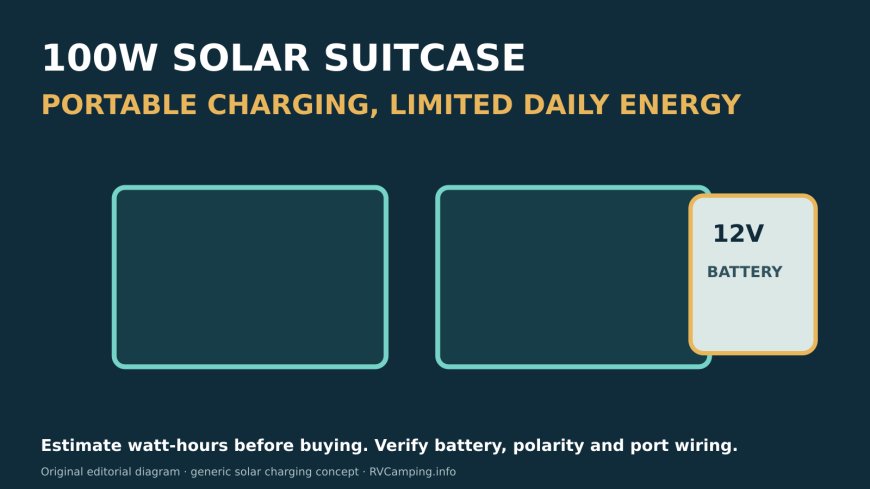
The current Renogy 100W N-type Solar Suitcase with Voyager is a practical fit for RVers who want to move a panel into the sun while the rig stays in shade, have a 12-volt house battery they can reach safely, and can live within a modest daily energy budget. Skip it if you need to run air conditioning, recover a large depleted battery bank quickly, leave panels unattended in theft-prone campsites, or expect the included alligator clips to plug into every RV "solar ready" port.
The exact kit reviewed is manufacturer SKU RNG-KIT-STCS100DC-VOY20-G1 (the Amazon model field shortens this to RNG-KIT-STCS100DC-VOY20) and Amazon ASIN B0GRVY1Y39.[5][6] The central tradeoff is portability versus output: at 17.42 pounds it is much easier to move than Renogy's earlier 100W suitcase, but 100 watts is still a nameplate maximum under standard test conditions, not a promise of 500 watt-hours every day.[5]
This is a research-based review. RVCamping.info did not purchase, connect or physically test this solar kit. Current manufacturer documentation, the live marketplace identity, warranty terms and owner reports for the preceding 100W Voyager generation were reviewed separately. Those older reports help explain the suitcase format, but they are not test results for the current N-type panel.
As an Amazon Associate, RVCamping.info earns from qualifying purchases. If you buy through an Amazon link in this article, we may earn a commission at no additional cost to you.
Check the current Amazon listing for ASIN B0GRVY1Y39. Before ordering, confirm the listing still names the 100W N-type kit with the 20A Voyager controller and model RNG-KIT-STCS100DC-VOY20. Renogy has sold several visually similar 100W suitcase generations under near-identical names.[1][5][6]
Verdict in one minute
Buy this kit for battery maintenance and light off-grid use: lighting, water-pump cycles, device charging, fans and other moderate 12-volt loads, provided your actual energy audit fits. Its adjustable panel can sit in sun that a roof-mounted array misses, and the controller supports 12-volt gel, flooded, sealed/AGM and lithium iron phosphate battery settings.[5]
Do not treat it as a small generator. The panel cannot directly power ordinary 120-volt RV outlets, and the controller does not create AC power.[5] A 100W nameplate also cannot keep up with loads that average more than the panel harvests. An inverter adds another conversion step and its own losses.
The strongest reason to choose this kit is the current generation's weight. Renogy lists 17.42 pounds and a folded size of 27.17 by 15.59 by 3.15 inches.[5]
The preceding RNG-KIT-STCS100D-VOY20 manual listed 21.2 pounds and a different folded shape, while older retailer copy and owner reports sometimes described still heavier versions.[1] If a listing shows 21 to 27 pounds, 20.4V maximum-power voltage or a 24.3V open-circuit voltage, it is probably describing an earlier panel generation rather than the N-type kit reviewed here.[1][5]
What 100 watts can realistically do
The current panel is rated at 100W under standard test conditions. Renogy lists 18.65V at maximum power, 5.602A maximum-power current, 21.47V open-circuit voltage and 6.029A short-circuit current.[5] Those laboratory ratings establish the panel's electrical boundary. They do not predict a campsite's clouds, tree shadows, panel temperature, wiring loss, battery acceptance or controller loss.
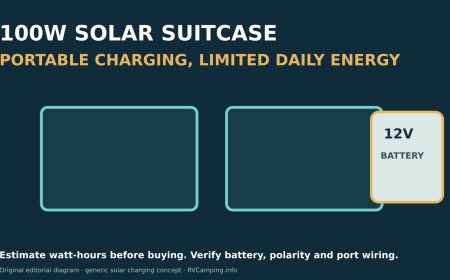
Amazon advertises up to 500Wh per day with five hours of sunlight.[6] That is the simple nameplate calculation: 100W multiplied by five peak-sun hours. Before losses, four peak-sun hours equals 400Wh and five equals 500Wh. At a nominal 12.8V, those totals correspond to about 31Ah and 39Ah. Real battery recovery will be lower because the panel does not hold its nameplate rating all day and charging is not lossless.
Use an energy budget rather than a list of appliances. Record each load's watts and daily hours, then add the watt-hours. If the coach uses 600Wh per day and the panel harvests 400Wh, the battery still loses about 200Wh daily. Solar slows the decline; it does not balance the system.
A current near 6A around solar noon is plausible for a well-aimed 100W panel charging a low 12-volt battery, but it is not an all-day rate. In an archived Home Depot review of the previous generation, one travel-trailer owner reported seeing 6.1A near solar noon and liked being able to place the suitcase beyond the rig's shade.[2] That is one owner report from an older panel, without an independently verified meter setup. It supports the use case, not a performance guarantee for the new model.
The RV compatibility checks that matter
Battery chemistry and charging voltage
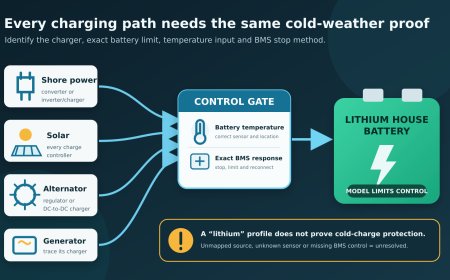
The Voyager controller includes presets for gel, sealed/AGM, flooded lead-acid and lithium iron phosphate batteries.[5] Select the setting that matches the battery maker's instructions. "Lithium" is not enough information by itself. Confirm the battery is LiFePO4, its battery-management system allows solar charging at the current temperature, and its recommended charge voltage fits the controller's adjustable lithium setting.
The current manual requires the user to set nominal voltage manually for lithium batteries. It gives a default lithium boost voltage of 14.2V and an adjustable range from 12V to 16V.[5] Do not copy another camper's voltage. A wrong setting can damage a battery or prevent a proper charge.
Cold-weather charging deserves special attention. Many LiFePO4 batteries block charging below a specified temperature even though they can still discharge. The suitcase controller's lithium preset does not prove that an unheated battery is safe to charge. Follow the battery's low-temperature limit and verify whether its BMS provides a charging cutoff.
Direct battery access versus an RV solar port
The included setup uses a fused cable with alligator clips at the battery.[5] That is simple when the battery terminals are accessible, clean and correctly identified. It is less convenient when batteries sit in a locked compartment, under an interior seat or behind a cover that should remain closed.
A factory "solar ready" port is not automatically compatible. Some ports lead to a separate charge controller, some expect a panel without a controller, and connector polarity is not universal. Feeding the Voyager's regulated output into another controller may not work as intended. Bypassing the Voyager without a documented wiring plan changes the reviewed system.
Check the RV maker's wiring diagram and the port's polarity, fuse, conductor size, connector type and maximum input. If the route is unclear, use the supplied battery connection as documented or have an RV electrical technician make a properly fused connection. Never assume an adapter corrects polarity merely because the plugs fit.
Cable reach and voltage drop
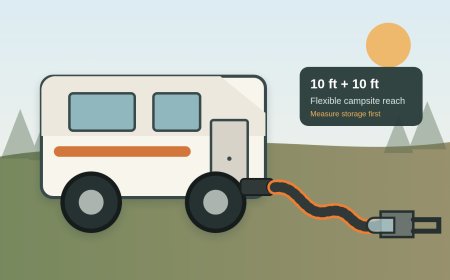
The kit includes a 10-foot, 14-AWG solar-connector-to-alligator-clip cable with a 15A fuse.[5] Ten feet may not reach from a sunny patch to a battery on the shaded side of a large trailer. The current manual says longer cable increases line loss and calls for conductors sized for the circuit.[5]
Long extensions can preserve shade flexibility, but cable size matters more as distance grows. Keep the controller where the manual places it unless Renogy approves a different arrangement, use connectors rated for outdoor DC service, and protect every cable from tires, steps, pets and sharp compartment edges. A loose cable across a shared campsite is also a trip hazard.
Storage and deployed footprint
The N-type 100W suitcase folds to 27.17 by 15.59 by 3.15 inches and weighs 17.42 pounds.[5] Measure the compartment door as well as the compartment. Leave room for the soft case and avoid stacking gear where it can press against the tempered glass.
Deployed, the panel is about 27.17 by 31.3 inches.[5] It needs a stable patch of unshaded ground plus space for the kickstands and cable route.[5] Wind can turn a freestanding panel into a liability. The manual does not give a wind rating, so bring it in when conditions become gusty rather than inventing one from the frame's weight.
Safe setup at camp
Follow the connection order in the current manual. The controller needs the battery connection first so it can identify and regulate the system correctly.[5]
- Park and stabilize the RV. Turn off unnecessary 12-volt loads so the initial charging behavior is easier to inspect.
- Remove the folded panel from its case and inspect the glass, frame, hinges, kickstands, cables, connectors and fuse holder. Do not use cracked, burnt, corroded or pinched parts.
- Place the panel on firm, noncombustible ground. Aim it toward open sun without blocking a road, neighboring site or emergency path.
- Keep the panel covered or face down while making connections. Confirm the selected battery preset and polarity.
- Connect the black clip to battery negative, then the red clip to battery positive, following the manual's battery-first sequence.[5]
- Connect the panel side through the specified fuse and uncover the panel. Confirm that the controller displays battery voltage and charging current without an error code.
- Recheck the clips after a few minutes. They should be secure, clean and protected from accidental contact. Stop if a connection becomes hot, arcs repeatedly or smells burnt.
- Re-aim the panel as the sun moves when the extra harvest is worth the campsite chore.
- To disconnect, cover the panel, separate the panel from the controller, then disconnect the battery side as directed in the manual.[5]
The manual warns against connecting the solar panel directly to a battery, working with jewelry around the circuit, using a visibly damaged panel, placing it on combustible material, immersing it, or making solar connections before the controller has a battery reference.[5] Waterproof ratings reduce weather risk; they do not make submerged connectors or an exposed battery compartment safe.
PWM is adequate here, but it explains a limitation
The included Voyager is a 20A pulse-width-modulation controller.[5] PWM is simple and matched to the kit, but it does not convert excess panel voltage into additional charging current the way a well-designed maximum-power-point-tracking controller can. In practical terms, the panel's 100W nameplate and 5.602A maximum-power current do not mean the battery will receive a steady 100W at every state of charge.[5]
That tradeoff is reasonable for a compact kit meant to be unfolded and clipped to a battery. Buyers building a larger permanent array may prefer an MPPT controller, fixed roof wiring and a battery monitor. Those are different system decisions, not upgrades the suitcase can settle on its own.
The 20A label also causes confusion. It is the controller's current rating, not the current a single 100W panel promises.[5] Renogy permits a specific expansion path, but the current manual should control the design. Do not mix random panels based only on a matching "12V" label or assume the controller's 20A rating makes every combination safe.[5]
What the older owner evidence does and does not show
The available independent reports mostly concern the earlier, heavier 100W Voyager suitcase. Owners in the archived Home Depot page liked the portable format, readable controller and protective case. One used it to supplement roof solar when the trailer was parked in shade; another reported recharging enough after two rainy days to finish a four-day trip.[2]
Those stories identify two genuine advantages of a movable panel: you can seek sun, and you can add charging without drilling the roof. They also expose the work. The panel must be carried out, aimed, wired, monitored and packed away. The older review that praised the construction also called the unit heavy.[2] The current N-type version cuts the published weight, but it still occupies a hand and demands a storage plan.[5]
Do not transfer old reviews to the new cells as if nothing changed. The current SKU has different voltage, dimensions, weight and weather-rating details from the 2024 RNG-KIT-STCS100D-VOY20 manual.[1][5] Long-term hinge, case and controller reliability for the N-type generation is not yet established by the older review set.
Generation and warranty checks
Renogy's names are close enough to invite ordering mistakes:
RNG-KIT-STCS100D-VOY20is the preceding 100W monocrystalline Voyager kit documented in September 2024.[1]RNG-KIT-STCS100DC-VOY20-G1is the current N-type high-efficiency kit documented in November 2025.[5]- The current Amazon listing uses ASIN
B0GRVY1Y39and shortens the model field toRNG-KIT-STCS100DC-VOY20.[6]
The older Amazon ASIN B079JVBVL3 has carried legacy 100W suitcase copy and should not be used as proof that a buyer will receive the N-type G1 hardware.[3] Compare the label, electrical specifications and weight when the box arrives.[1][5] If they do not match the ordered generation, resolve that before connecting it.
Renogy's warranty document lists different coverage periods for different suitcase SKUs and separates controller coverage from panel coverage.[4] Marketplace copy may summarize a longer panel warranty without explaining every component. Save the dated listing, invoice, serial label and warranty version that applies on the purchase date. Do not assume the controller, cables and panel all share one term.
Who should buy it
The current 100W N-type suitcase makes sense for:
- RVers with a reachable 12-volt house battery and a verified charging profile;
- campers whose roof sits in shade while open ground nearby receives sun;
- modest daily loads that fit a measured 300-to-500Wh planning envelope before real-world losses;
- people willing to deploy, aim, secure and pack the panel each day;
- small rigs where the 17.42-pound current generation fits a measured storage opening.
It is a poor fit for:
- air-conditioner, electric-water-heater or space-heater energy demands;
- large battery banks that need fast recovery after deep discharge;
- RV solar ports whose polarity and controller arrangement have not been verified;
- campsites where theft, wind, shade or pedestrian traffic prevents safe ground deployment;
- buyers who want app history, automatic roof charging or a permanent hands-off installation.
Final assessment
The Renogy RNG-KIT-STCS100DC-VOY20-G1 is best viewed as a movable 100W battery charger. Its 17.42-pound weight, built-in stands and included Voyager controller make it easier to deploy than the older suitcase generation.[5] Its limit is the same number printed on the product: 100W under test conditions, with weather, shade, temperature, cable loss and battery acceptance reducing the energy that reaches the bank.
Buy it after three checks. First, verify the exact N-type model and ASIN B0GRVY1Y39. Second, confirm that your battery chemistry, voltage and access match the controller and clip connection. Third, total your daily watt-hours. If a conservative solar estimate covers those loads, the suitcase is a useful off-grid tool. If the numbers only work when the panel delivers its best-case 500Wh every day, the system needs more array, less load or another charging source.
Sources
- Renogy preceding-generation 100W/200W Solar Suitcase with Voyager user manual
- Home Depot listing and owner reviews, archived June 13, 2025
- Amazon legacy listing for the earlier Renogy 100W suitcase
- Renogy limited warranty
- Renogy N-type 100W/200W Solar Suitcase with Voyager manual
- Amazon listing: Renogy N-type 100W suitcase, ASIN B0GRVY1Y39
What's Your Reaction?