















Is That Glamping Wood Stove Yours to Use? Check the Exact Unit Before You Book
A unit-by-unit booking method for mixed RV and glamping groups to confirm who may operate a wood stove or fireplace, how alarms and ashes are handled, and what heat remains if fire use is barred.


Is that glamping wood stove yours to use? Check the exact unit before you book
By Romana | Information checked October 18, 2026
A wood stove in a glamping photo can mean four very different things. Guests may be expected to light and tend it. Staff may control it. It may be an electric or nonworking feature that only looks like a fireplace. Or a real appliance may be off-limits because of the season, a fire restriction, or the property's rules.
For a mixed RV and glamping group, the answer changes more than the mood of the trip. It decides who stays warm after the office closes, whether a child can safely move around the room, who handles ashes, and whether the RV households become the improvised warming shelter. Do not classify the stove from a hero photo, an amenity icon, or a review. Get the operating status for the exact unit and dates in the reservation record.
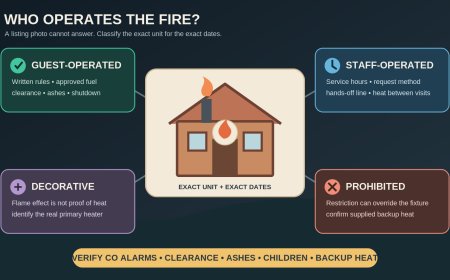
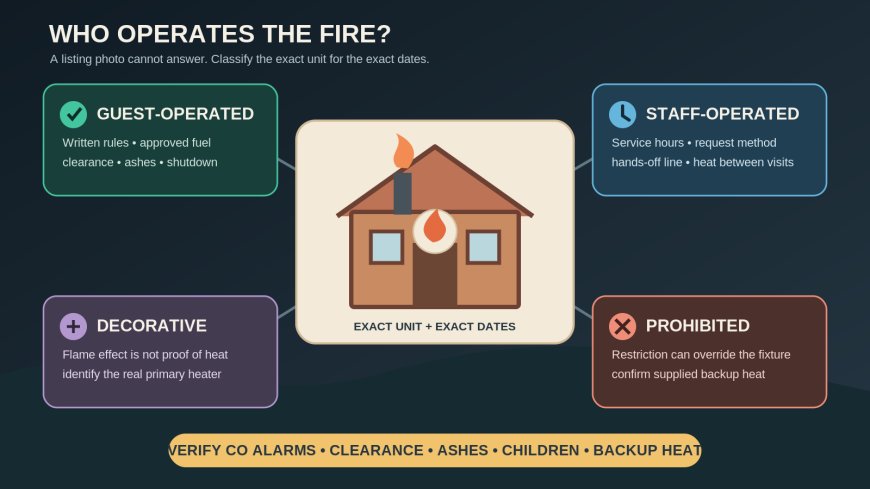
Put every unit in one of four boxes
Use one status per reserved cabin, yurt, tent, wagon, treehouse, or hut. "Fireplace available" is not a status.
| Status | What it means for the booking | What must be confirmed |
|---|---|---|
| Guest-operated | The guest may light, fuel, tend, and shut down the appliance under written rules | Approved fuel, lighting method, loading limits, damper or air-control instructions, required clearances, ash duty, overnight rule, and help number |
| Staff-operated | Only staff lights, adjusts, refuels, or authorizes the appliance | Service hours, how to request heat, whether staff returns overnight, what guests must not touch, and the heat plan between visits |
| Decorative or non-combustion | The feature is visual, sealed electric, disconnected, or otherwise not a usable wood fire | Whether it produces heat, how it is controlled, and the actual primary heat source |
| Prohibited for the stay | Nobody may use it during the booked dates, even if it is physically present | Reason, duration, enforcement, whether the restriction can change, and the supplied backup heat |
A property may have all four statuses at once. A shared lodge fireplace can be staff-run while one cabin has a guest-run stove, another has an electric flame effect, and every solid-fuel appliance becomes unavailable during a temporary ban. Record the answer by unit number or name, not by brand or accommodation type.
Published rules show why this distinction matters. Alaska State Parks' North Fork Cabin page names a wood stove as the heating method, tells the renter to bring supplies, and lists an ash scoop among the amenities. That is evidence of a hands-on, guest-operated cabin, although a renter still needs the current reservation instructions before use.[3] At Under Canvas, the company FAQ says most tent types have wood stoves, with wood, a firestarter, and matches provided; Kids Tents have no heating element, Yosemite uses heaters and heated blankets instead, and Columbia River Gorge uses gas fireplaces.[4] One brand name is not enough to identify one unit's heat.
A staff-operated example is just as specific. The Spearhead Huts Society guest manual says a custodian turns on its fireplace when the hut is very cold or has been unoccupied, while the hut heats without the fireplace when its occupancy system is on.[5] "There is a fireplace" would be a poor summary of that arrangement. The control boundary is the useful fact.
Send a four-line verification request
Ask before the free-cancellation deadline, while you can still change units. Keep the request narrow enough that a reservations agent can answer it without guessing:
For reservation [number], please confirm the status of the stove or fireplace in exact unit [name/number] for [dates]: guest-operated, staff-operated, decorative/non-combustion, or prohibited. If usable, please send the unit's current operating rules, approved fuel, required clearance, overnight shutdown rule, ash procedure, and child or pet restrictions. Please also confirm the smoke and CO alarms serving the sleeping area and identify the primary backup heat if the appliance is unavailable. Add the answer to the reservation notes or reply in writing.
If the reply says "available seasonally," ask who makes the decision and when the group will know. If it says "staff can help," ask whether help means a demonstration, the first lighting, every lighting, or exclusive staff control. If the agent cannot identify the exact unit, the classification is unresolved.
A current interior photo can settle layout questions, but it cannot prove that a flue was inspected, an alarm works, or use is permitted. Written rules and staff confirmation carry those answers.
Check the room, not just the appliance
A safe-looking stove can become unworkable once six people's gear arrives. The U.S. Fire Administration says a wood stove should be three feet from anything that can burn and that the fire should be out before occupants sleep or leave. Its fireplace guidance also calls for a screen and the same out-before-sleep rule.[1]
Use the property's stated clearance and the installed appliance instructions when they are more specific. Then apply that distance to the proposed room:
- Mark the stove or fireplace, every bed, both sides of any exit, curtains, wall hangings, and the luggage area.
- Count the rollaway, cot, pack-and-play, pet bed, drying rack, and winter coats that will appear after check-in.
- Keep the route from each bed to the door outside the keep-clear area.
- Ask whether a fixed hearth guard or screen is present; do not assume the group may bring or improvise one.
- Reject a bed assignment that depends on moving furniture into the protected zone.
Children need a plan that works when adults are tired. Assign the room with the appliance to adults who understand the rules, unless the property expressly designed and permits the unit for the group's child setup. Do not place a travel crib, floor mattress, toys, or a bag of marshmallows beside the hearth. A screen can reduce escaping sparks; it does not make hot metal, glass, tools, or embers safe to touch.
The RV side of the group should perform the same spacing check around each rig's furnace exhaust and generator location. Parked vehicles and portable generators must not send exhaust toward a yurt door, tent opening, cabin window, or RV intake. The cabin's CO alarm does not protect people in the neighboring RV, and the RV alarm does not cover the yurt.
Verify CO alarms by sleeping space
Wood combustion can produce carbon monoxide, and people cannot rely on smell or sight to detect it. The Consumer Product Safety Commission describes CO as odorless and colorless. It recommends CO alarms on every level and outside sleeping areas, with interconnected alarms preferred; it also says the fireplace damper should be opened before lighting and kept open until ashes are cool.[2]
For each exact glamping unit, ask:
- Is there a CO alarm serving the sleeping area, and where is it?
- Is there a separate smoke alarm or a listed combination alarm?
- When did staff last test the alarm, and how are low-battery or end-of-life signals handled?
- If the unit has multiple rooms or levels, what does the property's alarm arrangement cover?
- What should guests do, and whom should they call, if either alarm sounds?
A guest should not relocate, cover, silence, or test an alarm with smoke or flame. A personal travel alarm can be an extra layer if allowed, but it does not replace the property's installed and maintained protection.
Write one response for the whole mixed group: leave the unit immediately, move to fresh air, call emergency services, and account for everyone at the agreed meeting point. Do not go back inside to open a window, adjust the damper, rescue luggage, or search for the source. Headache, fatigue, shortness of breath, nausea, dizziness, confusion, vomiting, poor coordination, or loss of consciousness can be CO-poisoning symptoms; suspicious symptoms call for fresh air and emergency help even if nobody remembers hearing an alarm.[2]
Ashes belong to the operating policy
An ash scoop in a listing is not permission to empty a stove. Ask whether staff or guests handle ashes and where the approved container is located. If staff handles them, leave them alone. If the written guest procedure assigns the task, follow that procedure exactly and do not substitute a plastic bucket, paper bag, campsite trash can, or the RV fire ring.
USFA says fireplace ashes should go into a lidded metal container outdoors at least 10 feet from the home.[1] That is sound national safety guidance, not permission to choose a disposal spot at a rental. A property may use a different designated metal receptacle or reserve ash handling for staff. The renter's job is to use the provided system, not design one.
Ask these questions before accepting guest ash duty:
- Must the fire be fully out before checkout, and how much cooling time does the property require?
- Is a lidded metal ash container supplied and labeled for this unit?
- Who moves that container, and where is it kept on a noncombustible surface?
- Are guests forbidden to empty ash during the stay?
- What after-hours number handles a hot-ash problem?
Never send a child to carry wood, open the appliance, stir coals, or move ash. In a group, name one competent adult operator per guest-operated unit. Everyone else treats the stove as hands-off.
Build backup heat before the forecast drops
Backup heat is part of the reservation, not an item to negotiate at midnight. Under Canvas tells guests to prepare for cold evenings because fire restrictions can make a tent's wood stove unavailable.[4] The lesson is broader than that one operator: an appliance can be present, normally usable, and still unavailable on your dates.
For each glamping unit, record the fallback:
- an installed electric, gas, or central system that the property identifies as safe for overnight use;
- staff relocation to another heated unit;
- property-supplied bedding or heated bedding with clear use instructions;
- a refund, rebooking, or closure threshold when the unit cannot be kept within the property's operating range.
Do not make the group's RVs the unofficial fallback unless the RV reservations, occupancy limits, seat-belt plan, electrical capacity, and sleeping layout actually allow it. An RV furnace also needs its own fuel, battery power, exhaust clearance, and working alarms.
Guest-supplied combustion heaters, grills, lanterns, or cooking appliances never belong indoors unless the property and the appliance instructions expressly permit that exact use. A vague offer to "bring a heater" is not a backup plan. Ask what equipment the property supplies, where it may operate, whether it can run while people sleep, and what electrical circuit serves it.
Give the group one stove card
Put a short card in the shared itinerary for every sleeping unit:
| Field | Record this, not a guess |
|---|---|
| Exact unit | Name or number on the reservation |
| Classification | Guest-operated / staff-operated / decorative / prohibited |
| Primary heat | Appliance type that is actually supplied for the dates |
| Authorized operator | Named adult or "staff only" |
| Fuel and tools | What the property supplies and what guests may use |
| Clearance | Property or appliance requirement, plus the luggage-free zone |
| Children and pets | Sleeping assignment, barrier rule, and hands-off boundary |
| Alarms | Smoke and CO locations, last staff check, and response instruction |
| Ashes | Staff duty or exact written guest procedure |
| Overnight rule | Whether the fire must be out and what heat remains afterward |
| Backup | Supplied heat, relocation, or rebooking plan |
| Help | On-site number, after-hours number, unit address, and emergency meeting point |
Review the cards together at check-in because a restriction or unit assignment may have changed. If the exact unit differs from the confirmation, reverify before lighting anything. If the promised backup heat is missing, resolve it with staff while the office is open.
The useful booking answer is not "cozy fireplace." It is a named unit, one of four operating statuses, written rules, a protected room layout, working alarm coverage, a settled ash procedure, and heat that does not disappear when the fire does. That gives the RV and glamping sides of the group the same thing: a place to sleep that works without improvisation.
Sources
- Heating Fire Safety — U.S. Fire Administration — Wood-stove clearance, fireplace screen, shutdown, chimney, and ash guidance. Accessed October 18, 2026.
- Protect Your Family from Carbon Monoxide Poisoning — U.S. Consumer Product Safety Commission — CO alarm placement, fireplace damper, symptoms, and alarm response. Accessed October 18, 2026.
- North Fork Cabin — Alaska State Parks — Exact-cabin example listing a wood stove, bring-your-own supplies, and an ash scoop. Accessed October 18, 2026.
- Frequently Asked Questions — Under Canvas — Unit-type and location differences, stove supplies, staff assistance, Kids Tent exception, and fire-restriction backup warning. Accessed October 18, 2026.
- Guest Manual — Spearhead Huts Society — Staff-controlled fireplace example and separate baseline heating arrangement. Accessed October 18, 2026.
What's Your Reaction?