







The RV fuel-stop fit check: height, turning room, fuel and reserve
Screen an RV fuel stop for maximum travel height, full-combination turning room, the exact fuel at the usable pump, and enough reserve to reject a bad fit.

The RV fuel-stop fit check: height, turning room, fuel and reserve
By Romana | September 27, 2026 | RV Camping
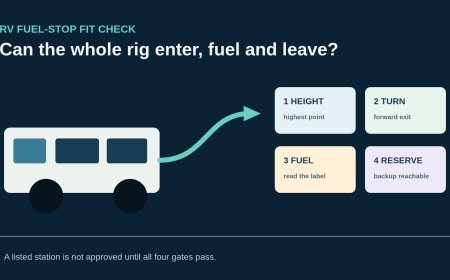
Quick answer: Approve a fuel stop only after four separate checks: the highest point on the travel-ready rig fits the actual approach and canopy; the whole combination can enter, reach the correct pump and leave without an improvised backup; that lane dispenses the exact fuel the vehicle manual permits; and rejecting the stop still leaves enough fuel to reach a second verified station. A brand name or “RV friendly” icon is a lead, not clearance.

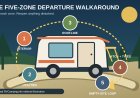
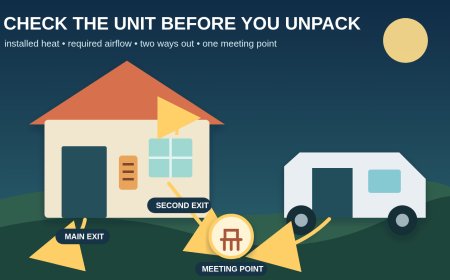
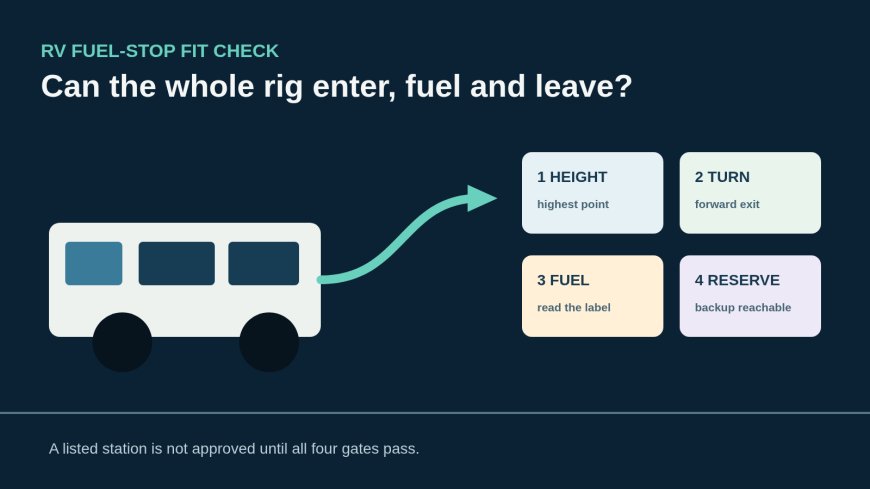
Trace the movement before committing: entrance, correct pump, forward exit and a reachable Plan B. Original diagram by RVCamping.info.
This is a site-fit decision, not another range formula
RVCamping.info published a loaded-range worksheet on September 13. This guide deliberately starts where that calculation stops. Its question is narrower: can this exact rig use this exact station, and can the driver decline it without turning the reserve into the plan?
A station can sell the right product and still be unusable. The driveway may force a turn across traffic. The gasoline island may sit under a lower canopy than the truck diesel lanes. A trailer may clear the first curb and clip the second as it tracks inside the tow vehicle's arc. A motorhome can reach a pump, then discover that parked cars have closed the only forward exit.
Treat the stop as a short route with four gates. If any gate is unknown, move the primary stop earlier, call the property, or choose another station.
Gate 1: use the rig's maximum travel height
Write one height on the trip card: ground to the highest fixed point while the RV is loaded for travel. That point may be an air conditioner, vent cover, antenna, satellite housing or another roof-mounted part. A chassis dimension, interior height or sales-page number is not enough after a coach body and accessories have been added.
Measure on level ground using a rigid reference across the highest point and a plumb measurement to the pavement. Include the normal travel setup and tire condition. Record the date, units and highest component. If the roof equipment, suspension or tires change, measure again.
Then inspect the entire path, not just the space above the nozzle. Check the street entrance, price-sign structure, canopy edge, canopy underside, signs suspended below it, side lanes and the exit. A posted number is a limit, not a target. Allow margin for pavement crown, driveway grade, suspension movement, snow or resurfacing, and leave if the sign is absent or unreadable.
The National Park Service's New River Gorge RV guidance is a useful warning about treating length and height as separate constraints: it identifies a road barred to RVs over 12 feet because of a low bridge, while sharp curves can trouble even some small RVs.[1] A short coach is not automatically a low coach, and a low trailer is not automatically easy to turn.
Do not send a passenger onto an active lane to “watch the roof” while the driver inches under an uncertain canopy. A spotter cannot create clearance. Stop before the structure and use a verified alternate.
Gate 2: draw the turn all the way through
Start with the combination's travel length, width and articulation points. For a towable, note the tow vehicle, hitch pivot, trailer axles and rear overhang. For a motorhome towing a car, plan for the combination as connected. Many four-down towing setups are not meant to be backed up while coupled; follow the manuals for the actual equipment.
Review recent satellite or street imagery before departure, but use it to form questions. Images may predate new bollards, construction fencing, restriping or a restaurant queue. The final check happens from the road, before turning in.
Trace six movements:
- Approach: Can the rig reach the correct driveway from its travel direction without an unsafe last-second lane change?
- Entrance swing: Is there room for the front to swing without the trailer crossing a curb, post or neighboring lane?
- Off-tracking: Where will the trailer tires or rear axle track inside the tow vehicle's path?
- Tail swing: What could the rear corner hit as the front turns away?
- Pump alignment: Is the filler side next to a pump that carries the required product, without stretching a hose across the RV?
- Exit: Can the combination pull forward to a legal road exit if a car, delivery truck or queue occupies the expected space?
NPS describes Thurmond Road as narrow and winding and tells RV drivers not to cross the bridge because the depot/town area provides neither suitable RV parking nor space for a large rig to reverse course.[1] A fuel island is smaller, but the planning lesson transfers: “I can enter” is incomplete until the exit is known.
Prefer a lane that preserves forward motion. Do not count on unhooking at a pump, backing across live lanes, moving another customer's vehicle, or borrowing a truck-only exit that the property does not permit. If the only workable maneuver depends on the lot being empty, it is a backup at best.
Gate 3: verify the product at the usable pump
“Diesel available” does not prove diesel is available in the lane your RV can reach. “Fuel lanes” does not prove a gasoline tow vehicle can use the truck island. Verify the product and access as one fact.
Start with the exact vehicle or chassis manual. The 2026 Ford motorhome chassis manual, for example, specifies regular unleaded gasoline with a minimum pump octane rating of 87, prohibits diesel and fuel with more than 15 percent ethanol for that gasoline chassis, and warns against starting the engine after an incorrect fill.[2] That is one chassis, not a rule for every RV. Diesel engines, gasoline tow vehicles, flex-fuel vehicles, generators and auxiliary tanks can have different requirements.
Copy the manual wording into the trip note: fuel family, minimum octane or cetane requirement if stated, allowed ethanol or biodiesel blend, and any cold-weather or regional limitation. Match that note to the label on the dispenser before lifting the nozzle. Federal rules require retailers to post automotive fuel ratings on dispenser faces; the rule covers gasoline octane and specified disclosures for alternative fuels and biodiesel blends.[3] The label is the last check, not the lane color or nozzle color.
For an alternative-fuel RV or tow vehicle, the Department of Energy's station locator can map stations offering biodiesel, ethanol, propane, renewable diesel and several other fuels.[4] It identifies product availability, not RV geometry, canopy clearance or today's pump status. Verify those separately with the station.
If the tow vehicle and onboard generator use different fuels, make two entries. Do not let the generator's requirement overwrite the engine's requirement in a shared note.
Gate 4: make the reserve survive a rejected stop
A reserve is useful only if it remains available when the primary stop fails the fit check. Before departure, identify:
- a primary station early enough that passing it is not a fuel emergency;
- one later station that has also passed the height, movement and product checks;
- the road distance from the primary to that backup, including the actual exit and re-entry path;
- a decision point before the primary's entrance where the driver can choose safely.
Use the range method already established for the rig, but add a rejection test: At the primary entrance, can the rig continue to the verified backup and arrive with the chosen reserve still intact? If the answer is no, the primary is too late. Pick an earlier stop or verify a closer backup.
Do not quietly count the bottom of the gauge as reserve. Ford's current motorhome chassis manual says the amount remaining when the gauge indicates empty varies and should not be used to increase driving range.[2] Your planning reserve should sit above that unknown remainder.
The percentage is a personal planning input, not a universal safety number. Increase it when stations are sparse, wind or grades can raise consumption, hours are uncertain, construction affects access, or the group cannot tolerate an extended roadside wait. The practical test is whether one closed pump, blocked turn or unreadable clearance sign can be rejected without pressure to “try it anyway.”
What “RV lanes” does and does not prove
Pilot describes its RV fueling lanes as spacious and designed for RV access.[5] That is useful discovery information, but the same page is a chain-level services page. It does not document the current canopy height, approach, fuel products or obstructions at every property.
For each candidate, open the operator's individual location record and call the listed property when any fit detail remains unclear. Give the measured height and total connected length, say which fuel is required, name the travel direction, and ask about the exact lane and forward exit. Better questions sound like this:
- “My travel height is 12 feet 8 inches. What is the posted minimum clearance on the entrance and RV island?”
- “The connected pickup and trailer are 54 feet long. Can I enter from westbound Route 6 and leave forward without disconnecting?”
- “Does the RV-accessible lane sell gasoline with at least 87 octane, or only diesel?”
- “Is construction, a delivery or overnight parking blocking that path today?”
Record who or what supplied the answer and when. A phone answer can still be wrong, so compare it with signs on arrival. If the physical site contradicts the note, trust the restrictive condition and leave.
The 60-second arrival check
Slow down before the driveway without obstructing traffic. The passenger can read signs and compare the saved approach; the driver keeps attention on the road.
- Confirm this is the planned entrance, not the car-only driveway.
- Read every clearance sign before passing its decision point.
- Locate the required product in a lane the rig can reach.
- Check the entrance swing, inner-wheel path and tail-swing area.
- Find a forward exit and note anything that could close it.
- If one item fails, continue to the verified backup. Do not improvise inside the island.
Once parked at the pump, apply the vehicle's refueling instructions. The Ford manual cited here says to switch the engine off, keep flames and smoking materials away, remain outside, attend the pump, and stop when the nozzle first shuts off.[2] Owners should follow the manuals for their exact vehicle and installed equipment.
A good fuel plan does not merely locate gasoline or diesel on a map. It gives the driver permission to reject a bad fit while there is still time and fuel to choose the next safe option.
Evidence note: NPS supports the distinction between height, curves and turnaround constraints. Ford supports the example fuel specification, refueling precautions and warning not to rely on empty reserve. Federal regulations support dispenser rating labels. DOE and Pilot support station discovery and listed RV services. The four-gate fit test, measurement method, call script, rejection test and arrival sequence are RVCamping.info editorial analysis.
Sources
- Visiting New River Gorge With an RV | National Park Service — Examples of separate height, curve, parking and turnaround limits.
- 2026 Ford Motorhome Owner's Manual | Ford Motor Company — Fuel specification, incorrect-fuel warning, refueling precautions and empty-reserve limitation for this chassis.
- 16 CFR Part 306, Automotive Fuel Ratings, Certification and Posting | U.S. Government Publishing Office — Retail dispenser fuel-rating and label requirements.
- About the Alternative Fueling Station Locator | U.S. Department of Energy — Product-based station and route-search scope for alternative fuels.
- RV Services | Pilot — Chain description of RV fueling lanes and related services; exact-site verification remains necessary.
What's Your Reaction?