
























On The Go OTG4-VM-DBLSOFT review: soften hard water, not unsafe water
Research-based On The Go OTG4-VM-DBLSOFT review covering capacity, regeneration, RV fit, filtration limits and sodium.

The On The Go OTG4-VM-DBLSOFT is a good fit for RVers who regularly camp on hard-water hookups, have room for a 22-inch-tall, 9.5-inch-diameter tank, and are willing to test hardness and regenerate the resin by hand.[1][2] Skip it if storage is tight, you rarely encounter hard water, you expect filtration or disinfection, or a 32-pound dry tank is already awkward to move.[1][11] The central tradeoff is simple: the 16,000-grain bed can go much longer between regenerations than the smaller 8,000-grain model, but it takes more bay space and weighs more before it holds any water.[1]
This is a research-based review. RVCamping.info did not purchase, install or physically test this water softener. Manufacturer specifications, current marketplace identity, public-health guidance and attributed owner reports were reviewed separately.
As an Amazon Associate, RVCamping.info earns from qualifying purchases. If you buy through an Amazon link in this article, we may earn a commission at no additional cost to you.
Check the current Amazon listing for ASIN B085Q2LBJV. Confirm that the listing still names the brass-fitting model OTG4-VM-DBLSOFT before ordering; the manufacturer also sells a similar Double Standard version without the VM identifier.[1][4]
Verdict in one minute
Buy it when calcium and magnesium scale is the problem you are trying to solve. The manufacturer rates this brass-fitting Double Standard model at 16,000 grains, 3 gallons per minute, 32 pounds, and 640 to 1,600 gallons between regenerations in the hardness range it emphasizes.[1] Those are planning figures, not a promise that every campground hookup will deliver the same run time.[1]
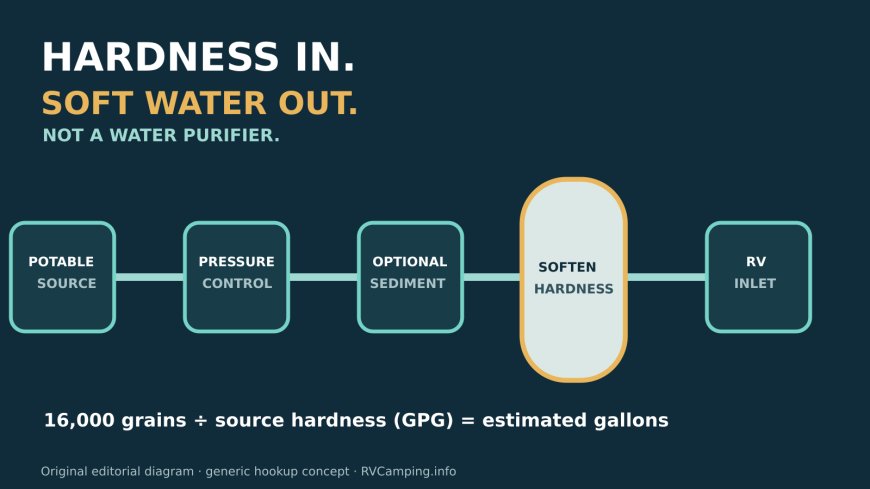
Do not buy it as an answer to questionable campground water. Water softening exchanges hardness minerals; it is not the same job as sediment filtration, carbon treatment, disinfection or contaminant-specific treatment.[11] Penn State Extension warns that softening is often misrepresented as purification, even though it mainly removes nuisance hardness minerals.[11] Start with a potable source. If the source is under a boil-water notice or has an unknown contaminant problem, a softener does not make it safe.[11]
The brass fittings are the identity boundary in this review. The exact model is On The Go Double Standard OTG4-VM-DBLSOFT, and the exact Amazon ASIN is B085Q2LBJV.[1][4] Do not substitute the plastic-fitting OTG4-DBLSOFT specifications or a different brand's 16,000-grain tank without checking its fittings, dimensions, instructions and certification claims.
What a 16,000-grain rating means on a trip
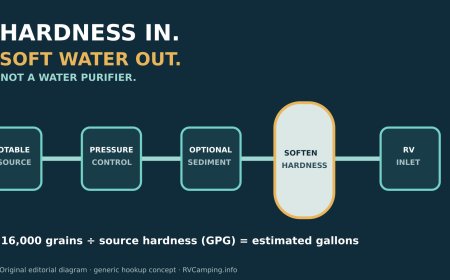
The useful number is not "up to 40 days." It is source hardness divided into the resin capacity. On The Go's instructions use this formula:
16,000 grains ÷ source hardness in grains per gallon = estimated gallons before regeneration
The manufacturer's current table gives 3,200 gallons at 5 GPG, 1,454 gallons at 11 GPG, 640 gallons at 25 GPG and 275 gallons at 58 GPG.[1] The product page's shorter 640-to-1,600-gallon range therefore describes selected hard-water conditions, not the full mathematical range.
For trip planning, the same tank can look very different:
- At 11 GPG, 1,454 gallons is about 72 days at 20 gallons per day, 36 days at 40 gallons, or 24 days at 60 gallons.
- At 25 GPG, the manufacturer's 640-gallon estimate works out to 32, 16 or 10 days at those same usage levels.
- At 58 GPG, 275 gallons is only about 13, 6 or 4 days.
Those day counts are RVCamping.info calculations from the manufacturer's capacity formula, rounded down for practical planning. A family that takes long showers can exhaust the same resin far sooner than a couple who uses the bathhouse. Iron, sediment, inconsistent source hardness and imperfect regeneration can also upset a neat spreadsheet.
Test the campground water at the source and test again at the softener outlet. The current instructions say the regenerated output should read 0 to 3 GPG and should not taste salty.[2][3] Do not wait for shower feel or white spotting alone to tell you the resin is exhausted.
Compatibility checks before buying
Bay height and handling
The tank is 22 inches high and 9.5 inches in diameter.[1] It weighs 32 pounds dry.[1] Measure the actual door opening, not just the empty space behind it. Leave room above the head for the carry handle, hose bends and removal of the top cap during regeneration.[1][2]
Owners discussing the unit on the Alliance RV forum repeatedly focused on whether the tall tank would fit upright and whether it should remain outside. One owner described draining much of the water before loading it to reduce handling weight.[6] That is useful experience, but it is anecdotal. Follow the manufacturer's draining instructions with the top cap and head installed rather than improvising around the resin bed.[2][3]
Flow expectations
On The Go publishes a 3 GPM flow rate for this model.[1] That can serve a conservative RV hookup, but it is not unlimited. A shower, faucet and toilet fill running together can expose a bottleneck. So can a clogged sediment filter, undersized hose, kink, restrictive regulator or campground spigot that was weak before the softener entered the line.[1][6]
If flow disappoints, diagnose one component at a time. Record pressure and flow at the pedestal, after the regulator, after any prefilter, and at the RV. Removing every protective device at once may make the shower feel better while hiding the actual restriction.
Hardness versus filtration
A cation-exchange softener targets calcium and magnesium. Penn State Extension explains that sodium on the resin trades places with those hardness minerals; regeneration restores the resin with a salt solution.[11] A sediment cartridge catches particles. Carbon is commonly used for taste, odor and certain chemical reductions. Those devices can share a hookup, but they do different work.
If sediment is part of the problem, a prefilter can protect the resin from debris. The independent owner thread includes reports of using sediment and carbon stages with the softener, although owners disagreed about filter order.[6] Treat those layouts as experience reports, not a universal plumbing standard. Follow the filter maker's direction, preserve adequate flow, and use only drinking-water-safe housings, cartridges and hoses.
RVCamping.info's Camco TastePURE 40043 review covers the separate boundary between taste/sediment improvement and water purification.
Sodium-sensitive drinking-water needs
Salt-regenerated ion exchange can add sodium to treated water. EPA says most people do not receive a large share of their sodium from drinking water, but people being treated for sodium-sensitive hypertension should discuss their water sodium and possible alternatives with a health professional. Its advisory also notes that domestic softeners can raise sodium substantially under some conditions.[9]
That is not a reason for every RVer to avoid a softener. It is a reason not to make a medical assumption. If someone in the rig follows a sodium-restricted plan, ask the relevant clinician whether cooking and drinking water should bypass the softener or come from a separate source.[9] Source hardness affects how much ion exchange occurs, so another camper's setup is not a safe proxy.[9][11]
Setup that protects the RV and the resin
The first hookup deserves a drain-side test rather than an immediate connection to the coach.[2][3]
- Confirm the source is potable and inspect the spigot, regulator, hoses, washers and brass fittings. Do not use a visibly damaged or contaminated hose.
- Put the tank upright on a stable surface. Protect it from traffic, direct impact and freezing conditions.
- Connect source water to the marked inlet. The manufacturer recommends checking for leaks, tightening the cap and hoses, and using appropriate thread sealant where required.[2]
- Flush a Double Standard unit to a drain for 4 to 6 minutes before connecting its outlet to the RV. This first flush removes resin dust.[2][3]
- Connect the outlet to the RV, pressurize slowly, and inspect every joint again.
- Test hardness at the source and outlet. Record the result, date and meter reading if the coach has one.
- After a few minutes of normal use, check the bay and ground for slow drips. A minor leak left outside overnight can waste water and create a muddy campsite.
A pressure regulator still has a job. A softener does not protect the RV from excessive source pressure, and a regulator does not soften water.[1][11] Place components in a sequence that follows each maker's instructions and remains easy to inspect.
Regeneration is the maintenance cost
The Double Standard model uses two 26-ounce boxes of iodized or non-iodized table salt per regeneration. The current procedure calls for a very slow, pencil-size stream for 24 to 30 minutes, followed by a 6-to-8-minute full-flow rinse. The output should then test at 0 to 3 GPG and have no salty taste.[2][3]
That sequence is more demanding than the product-page phrase "less than 30 minutes" suggests. A careful cycle includes draining, adding salt, the slow rinse, the fast rinse and verification. Plan a legal discharge point and enough time to finish rather than beginning just before checkout.
The instructions also call for a 5-to-10-minute back-flush on the Double Standard every three months. When back-flushing and regenerating together, back-flush first.[2][3] Reverse flow can loosen accumulated material, but it does not turn a neglected resin bed into a contaminant filter.
Campground rules control where rinse and regeneration water may go. Do not assume salty discharge belongs on grass, landscaping, a storm drain or beside the pedestal. Ask the campground where it permits that wastewater, especially in drought-sensitive areas or parks served by septic systems.
What owner reports add
The Alliance RV discussion is useful because it exposes the chores that product copy compresses. Owners talk about upright storage, quick-connect fittings, draining before travel, prefilters and regeneration frequency. Reports in the thread vary with water conditions and personal setups.[6]
That variation is the point. One owner's monthly regeneration schedule cannot establish yours. Source hardness and daily consumption drive capacity, while handling depends on the coach's bay and the camper's strength. Owner experience supports using test strips and planning the storage route; it does not replace the current manual.
Quick connects may reduce wear from repeated threading, but every added fitting is another possible restriction or leak. If you add them, choose potable-water-rated parts, keep spare washers, and inspect under pressure. A convenient connection that drips into a sealed basement bay is not an upgrade.
Cold weather and storage
Freezing can crack the internal distribution tube or the tank. On The Go tells owners to regenerate and drain the unit before freezing storage.[10] The full storage instructions also call for back-flushing, regeneration and draining before extended idle periods, followed by a specific sanitizing procedure before reuse.[2]
Draining is not the same as dumping the resin. The instructions repeatedly warn owners to leave the resin in the tank and keep the cap or head installed during draining.[2][3] Store the unit where residual moisture cannot freeze, secure it upright for travel, and use the supplied caps to control drips.
After long storage, follow the current manufacturer sanitation directions exactly. The contact time in those directions is specific and should not be extended casually.[2] If the instructions supplied with your unit differ from the web page, stop and confirm the current procedure with On The Go using the model and serial information on your tank.
Who should buy it
The brass-fitting Double Standard makes sense for:
- full-time or seasonal RVers who repeatedly encounter hard water;
- larger households that would exhaust an 8,000-grain unit too quickly;
- rigs with measured upright storage and an accessible path for a 32-pound dry tank;
- owners willing to test hardness, keep a usage log and complete manual regeneration.
It is a poor fit for:
- occasional campers whose home and usual parks have soft water;
- small rigs without a secure 22-by-9.5-inch storage position plus hose clearance;
- anyone looking for a purifier, pathogen barrier or broad contaminant treatment;
- users who cannot safely handle the tank or manage a half-hour-plus regeneration process;
- sodium-restricted households that have not resolved their drinking-water plan with an appropriate health professional.
Final assessment
The OTG4-VM-DBLSOFT solves a narrow problem well on paper: it reduces hardness at a campsite without electricity and offers twice the nominal resin capacity of On The Go's Standard model. Its strong point is the longer interval between regenerations. Its weak point is that the same larger resin bed brings a 32-pound dry tank, more storage demand and a two-box manual regeneration cycle.[1][2]
Buy by hardness data rather than by the "up to 1,600 gallons" headline. Measure the source, calculate the expected gallons, decide where the tank will ride, and identify an approved place to discharge regeneration water. If those four answers work, the brass-fitting Double Standard is a defensible RV upgrade. If the real problem is unsafe water, low pressure or sediment, buy the treatment that matches that problem instead.
Sources
- On The Go Portable Double Standard Water Softener (Brass)
- On The Go setup and regeneration instructions
- On The Go portable water softener instructions PDF
- Amazon listing: On The Go OTG4-VM-DBLSOFT
- Alliance RV owners discuss the On The Go Double Standard
- EPA Drinking Water Advisory on Sodium
- On The Go winterizing and storage instructions
- Penn State Extension: Water Softening
What's Your Reaction?