








Suspect an RV propane leak? Leave first and troubleshoot later
Treat propane odor, hissing, or an alarm as an emergency: get out, avoid switches and flames, close supply only if safe, call from away, and wait for qualified clearance.

Suspect an RV propane leak? Leave first and troubleshoot later
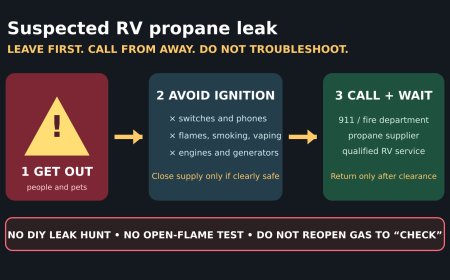
Propane odor, hissing, a visible vapor cloud, or an LP-gas alarm is not a cue to find a spray bottle and start checking fittings. Treat it as an emergency. Get people and pets out, avoid anything that can spark or flame, and call from a safe location away from the RV.
The Propane Education & Research Council (PERC), NFPA, and CPSC all put evacuation and notification ahead of diagnosis.[1][2][3] An RV manual adds model-specific instructions, but it does not turn the occupant into a gas technician. Winnebago's 2026 View manual says not to touch electrical switches, to leave the area, and to have the propane system checked and the leak corrected before reuse.[4]
If there is fire, a visible propane cloud, strong or increasing odor, loud gas release, suspected tank or cylinder damage, or anyone feels unsafe, move farther away and call 911 or the fire department. Do not approach the supply valve.
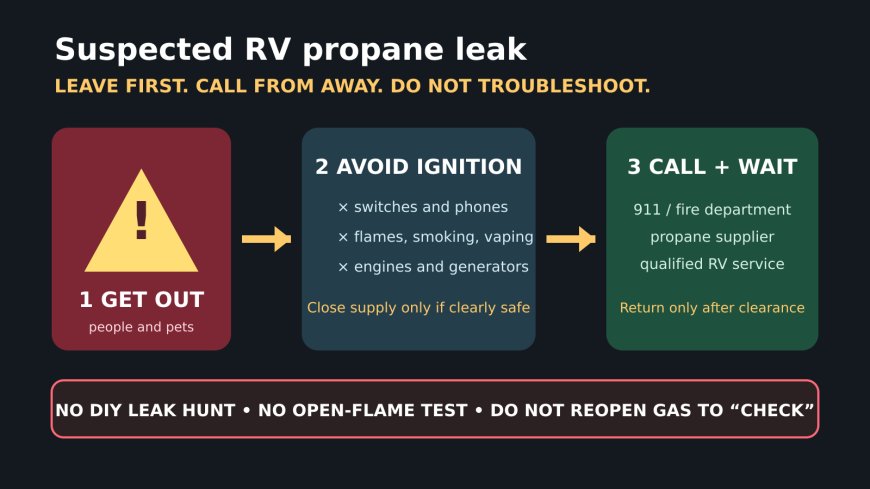
Use this order: leave, call, wait
- Warn others and leave immediately. Move everyone away from the RV and the suspected leak. Do not pause to collect gear.
- Avoid flames and sparks while leaving. Do not smoke or vape. Do not light a burner, match, candle, grill, or campfire. Do not operate lights, fans, appliances, outlets, a generator, a vehicle ignition, phones, or other electrical equipment in the affected area. PERC and NFPA both warn that operating devices can provide an ignition source.[1][2]
- Close the main propane supply only if it is clearly safe. Do this only from an uncontaminated approach, only if you already know the correct valve, and only if there is no fire, vapor cloud, tank/cylinder damage, or suspected leak at the container. Never pass through odor or re-enter the RV to reach a shutoff. PERC's newer safety guide specifically says to turn off tanks unless the leak may be at the tank.[1]
- Call from well away. Contact 911 or the local fire department for an active or uncertain emergency. Also contact the propane supplier and, when directed, the RV manufacturer, dealer, or qualified RV propane service technician. CPSC directs people who smell or hear leaking gas to evacuate before reporting it from outdoors.[3]
- Stay out. Do not return because the odor seems weaker or the alarm stops. Wait until emergency responders, the propane supplier, or a qualified service professional says the area is safe.[1][2]
- Keep the system off. A qualified professional must inspect the system, identify and correct the source, perform the required testing, and authorize return to service before anyone opens the supply or uses propane appliances.[1][2][4]
“Shut it off” is conditional
Many propane instructions say to close the main supply if it is safe to do so. That condition matters more than saving the fuel. A valve outside the RV may still be in a hazardous area. A damaged container, active flame, frost or vapor around a valve, or strong odor at the compartment changes the answer.
Do not move a leaking cylinder, disconnect a regulator, tighten a fitting, pull a fuse, disconnect a battery, unplug shore power, start the engine, or operate a remote electric shutoff while near suspected gas. Any of those actions may require entering the hazard area, disturbing damaged equipment, or creating a spark. Tell responders what you observed and where the containers and shutoffs are located.
If the manual for the exact RV gives a safe remote emergency-shutoff procedure, follow it only when that procedure does not conflict with evacuation or responder instructions. Otherwise, leave the valve to trained responders. There is no prize for being the last person beside the rig.
Ventilation is not a reason to remain inside
Some RV labels instruct occupants to open doors or ventilation openings as part of an odor response.[4] Do not delay evacuation, operate powered vents, or go back inside to ventilate. If a door is already in your path and can be opened without slowing escape or operating electrical equipment, follow the exact manual. Once outside, stay outside.
Propane can collect in low areas, and odor is not a reliable all-clear. NFPA notes that people can lose awareness of an odor after exposure, and PERC warns that airflow, health, sleep, masking odors, or odor loss can make propane harder to detect.[1][2] An alarm deserves the same emergency response even when nobody smells gas. A smell without an alarm also deserves a response.
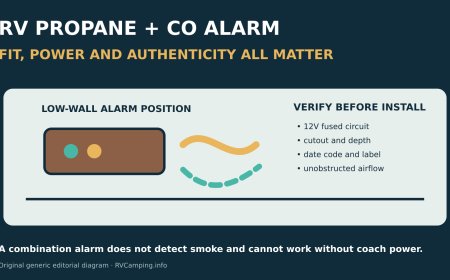
An LP-gas detector and a carbon-monoxide alarm do different jobs. Do not silence, reset, cover, or depower an alarm to see whether it returns while a leak may be present. The alarm's exact manual controls testing and end-of-life maintenance after the area and system are safe.
Do not turn an emergency into a DIY leak test
Bubble solution has a limited, manufacturer-directed role for some routine connection checks performed outdoors under controlled conditions. That is different from investigating suspected gas inside an RV or tracing a live leak through piping, regulators, compartments, or appliances.
Do not use a flame. Do not improvise with a household detergent. Do not pressurize or reopen a shut system to “see if it still leaks.” Winnebago prohibits open-flame testing and warns that some ammonia- or chlorine-containing detergents can damage gas lines.[4] PERC says the entire system must be checked by the propane retailer or a qualified professional before appliances are used again.[1]
“Official guidance” means the instructions for the exact RV, detector, container, regulator, appliance, and approved leak-detection product, plus directions from the propane supplier or authority having jurisdiction. If those documents do not assign a test to the owner, do not invent one.
Give the responder useful facts, not a diagnosis
From the safe location, report:
- campground or street address, site number, and best access route;
- whether there is fire, visible vapor, hissing, damage, or an alarm;
- where and when the odor or alarm was first noticed;
- whether anyone may still be inside or has symptoms or mobility needs;
- tank or cylinder location, if known without approaching;
- whether the supply was closed and by whom;
- recent refill, cylinder exchange, appliance use, service, collision, or road impact.
Do not go back for model numbers. Retrieve manuals, photos, and service records only after responders permit access.
After clearance and repair, obtain a written service record that identifies the fault, tests performed, parts changed, and authorization to return the system to service. Follow the exact appliance relighting procedure or have the technician do it. If the cause remains unknown, the RV is not ready for propane use.
Sources
What's Your Reaction?