


















Andersen Camper Leveler 3604-2 review: quick leveling, small footprint
Andersen's 3604-2 curved levelers speed tandem-axle RV setup, but tire size, axle spacing and campsite surface determine whether they fit.

The Andersen Camper Leveler 3604-2 is a smart buy for towable-RV owners who want finer side-to-side adjustment than stacked blocks provide. The two-pack is best suited to tandem-axle trailers with tires no larger than 32 inches and campsites that need no more than 4 inches of lift. Skip it if your tires exceed that diameter, your axle spacing leaves no safe room for the curved ramps, or you often camp on soft, rutted, or sharp-rock surfaces. The central tradeoff is simple: continuous height adjustment makes setup fast, but the narrow curved leveler needs better ground preparation than a broad stack of blocks.
This is a research-based review. RVCamping.info did not buy, install, or physically test this product.
As an Amazon Associate, RVCamping.info earns from qualifying purchases. If you buy through an Amazon link in this article, we may earn a commission at no additional cost to you.
Check the Andersen Hitches 3604-2 two-pack on Amazon
What the 3604-2 actually is
Andersen's current product page calls each curved ramp-and-chock set SKU 3604. The Amazon listing tied to ASIN B01LYQ1Z8S identifies the bundle as the 3604-2 two-pack, which contains two levelers for the low-side tires of a tandem-axle trailer.[1][3] That distinction matters: a buyer comparing listings may see 3604, 3604-2, or a generic “two-pack” title for essentially the same two-ramp configuration.
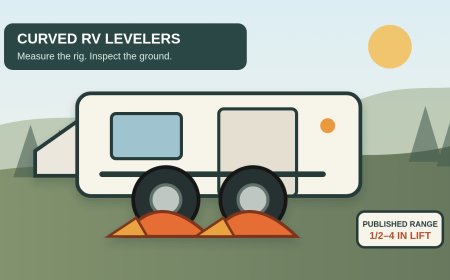
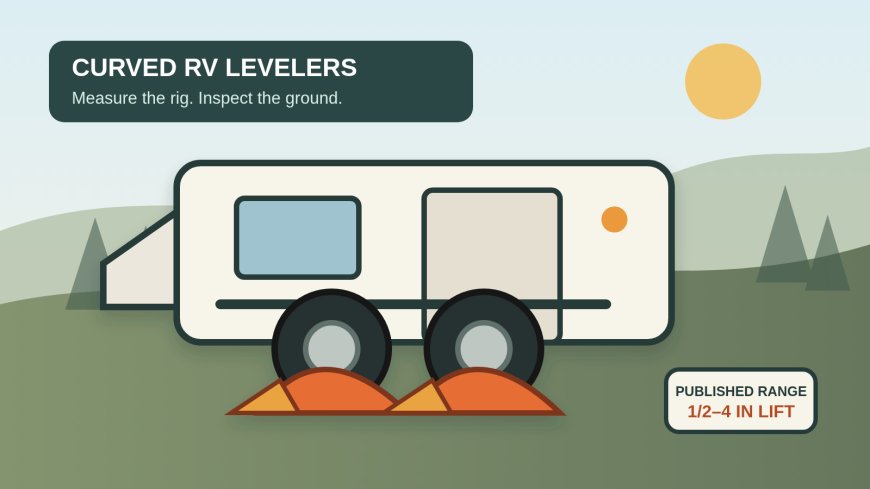
The manufacturer rates the Camper Leveler for RVs and trailers up to 30,000 pounds, tires up to 32 inches in diameter, and lift from 1/2 inch to 4 inches. Each leveler includes a Tuff Chock.[1] Those are product limits, not a promise that the device fits every RV below 30,000 pounds.
| Specification | Verified boundary |
|---|---|
| Reviewed package | Two Camper Levelers and two Tuff Chocks |
| Manufacturer item | 3604 per leveler-and-chock set |
| Amazon listing | 3604-2 two-pack, ASIN B01LYQ1Z8S |
| Lift range | 1/2 to 4 inches |
| Published trailer/RV limit | Up to 30,000 pounds |
| Published tire limit | Up to 32 inches in diameter |
| Leveler width | 6 inches in Andersen's archived fit guidance |
| Best use | Side-to-side leveling of a towable RV on firm, reasonably even ground |
Who should buy it
The two-pack makes the most sense for a tandem-axle travel trailer or fifth wheel without a fully automatic leveling system. Put one leveler under each tire on the low side, move the trailer slowly, and stop when the body is level. A 2023 RV Enthusiast field report describes this as quicker than building and rebuilding a stack of blocks, while still allowing up to 4 inches of lift.[4]
It is also useful for short overnight stops when you want to stay hitched and only need to correct side-to-side lean. You still need room to move the tow vehicle a few feet, a reliable way to read level, and a spotter or a leveling sensor if the driver's view is poor.
Who should skip it
Choose conventional leveling blocks or a broader platform if you regularly park on soft soil, loose gravel with embedded rocks, or deeply rutted sites. Owners in a long-running Grand Design forum discussion reported sinking, slipping, stress cracks, and breakage when rocks created concentrated loads under the plastic. These are owner reports rather than controlled tests, but the pattern is useful enough to change the setup checklist.[5]
The 3604-2 is also a poor match when:
- your tires exceed Andersen's 32-inch diameter limit;
- the space between tandem tires is too short for both levelers, even after checking Andersen's approved trimming diagram;
- you need more than 4 inches of correction;
- your motorhome has dual rear wheels that cannot be supported as the chassis maker requires;
- you cannot move forward or backward without leaving the campsite pad; or
- you want a single product to level, chock against trailer movement, and stabilize the body.
That last point catches new RV owners. Leveling corrects the coach's angle. Wheel chocks help prevent rolling. Stabilizer jacks reduce body movement. One accessory does not automatically perform all three jobs.
The axle-spacing and tire-fit check
Measure before ordering. Check tire diameter, tread width, and the shortest gap between tandem tires on level ground. Andersen's archived help page says the Camper Leveler is 6 inches wide and allows trimming when multi-axle tires are too close, but it directs owners to a specific trimming diagram.[2] Do not improvise a cut from a photo or remove more material than Andersen permits.
The published 32-inch tire limit is a diameter limit. It does not answer every tread-width or dual-wheel question. If the tire overhangs the 6-inch ramp substantially, or your RV manual requires support across the full tread, get written guidance from Andersen and the RV or tire manufacturer before use.
For a tandem axle, plan on one leveler under each low-side tire. A single ramp under one axle changes the load distribution between the two tires and is not the setup sold in the reviewed two-pack.
How to set it up without turning leveling into a recovery job
- Walk the low side and remove sharp stones. Look for depressions that could leave the plastic bridging a hard point. On soft ground, use a broad, load-rated base that stays flat and does not create a slippery interface.[5]
- Confirm that the tow vehicle and trailer can roll slowly in the chosen direction without hitting a pedestal, tree, curb, or neighboring site.
- Position one leveler at each low-side tire, with both thin ends facing the same direction. Center each ramp under the tread as well as the product and tire combination allows.[1]
- Use a spotter when possible. The driver should move at idle speed while the spotter watches both ramps and the level reading. Keep everyone away from the trailer's path and never place hands or feet near a loaded ramp.
- Stop at level or at the 4-inch limit. If the trailer still leans at the product's maximum lift, back down and choose a different site position or leveling method. Do not stack the curved leveler on a makeshift tower.[1]
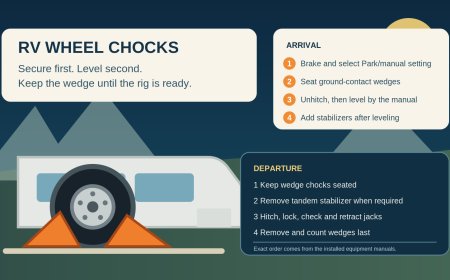
- Insert the included Tuff Chocks. Andersen instructs users to place each chock behind its leveler after the desired height is reached.[1]
- Use the wheel-chocking procedure in the RV owner's manual, including wheels not sitting on the levelers. A long-term owner review used the Andersen ramps alongside separate wheel-chocking and stabilization equipment rather than treating the ramps as an all-in-one system.[6]
- Unhitch and stabilize only after the trailer is secure. Follow the RV maker's order of operations. Stabilizer jacks are not lifting jacks unless the manual explicitly says otherwise.
Before departure, reconnect and prepare the trailer, remove any separate wheel chocks at the correct stage, take pressure off the Tuff Chocks, remove them, then roll slowly down the levelers. Count every ramp and chock before leaving.
Firm pavement versus soft campsites
The curved design works best when its underside has even support and enough grip. On clean pavement or a firm compacted pad, the leveler can roll predictably as the tire climbs. Loose aggregate creates two different problems: the leveler may slide, or one buried stone may carry too much of the load.
Andersen sells a rubber pad for added grip on hard surfaces, which confirms that traction can depend on the surface.[1] Owner reports add a different caution: some users place a broad sacrificial pad or plywood under the leveler to spread load over rocky ground, while others found hard wood could make the ramp slide.[5] There is no universal campsite fix. The base must be flat, strong enough for the actual wheel load, large enough to spread it, and resistant to sliding.
For a long seasonal stay on soil, broad blocks may be the better tool. The Grand Design discussion includes an owner who stopped using the curved levelers for extended stays because the narrow footprint settled over time.[5] In contrast, a separate two-year owner review reported no durability issue and continued to pair the Andersen ramps with dedicated chocking and stabilization equipment.[6] The disagreement is a good reminder that surface preparation and use case matter as much as the product itself.
Does it replace stackable leveling blocks?
Not entirely. The Andersen system is faster when the required lift falls inside its range and the ground is suitable. Stackable blocks are slower, but they can build a broader platform, support jack feet, and adapt to sites where a curved ramp will not fit between tandem tires.
A practical RV kit can include both. Use the curved levelers for routine side-to-side correction on firm sites. Keep a modest set of load-rated blocks for jack support, soft-ground load spreading, or a campsite geometry that rules out the ramps. Do not exceed either product's instructions by combining them into an unapproved stack.
Our verdict
The Andersen 3604-2 earns its storage space for towable owners who value quick, fine adjustment and usually camp on firm pads. Its 1/2-to-4-inch range is more precise than choosing among fixed block heights, and two ramps suit the low side of a tandem axle.[1][4]
The reason to skip it is not complexity. It is footprint. A 6-inch-wide plastic ramp asks the campsite surface to carry a concentrated wheel load without sinking, sliding, or pressing against a hidden rock.[2][5] Measure the rig, inspect the ground, carry real wheel chocks, and keep blocks available for the sites where the Andersen is the wrong tool.
Sources
- Andersen Hitches: Camper Leveler
- Andersen Hitches Help: Camper Leveler Trimming (archived August 19, 2021)
- Amazon listing: Andersen Hitches 3604-2 two-pack, ASIN B01LYQ1Z8S
- RV Enthusiast: On the Level
- My Grand RV owner discussion: Andersen Camper Leveler Review
- PopUpBackpacker: Andersen Camper Levelers, two-year review
What's Your Reaction?