


Shared Bathrooms: the RV-and-Glamping Booking Checklist
Verify the bathroom route from both an RV site and glamping unit, including distance, nighttime lighting, weather exposure, accessibility, shower hours, and hygiene.

Shared bathrooms: the RV-and-glamping booking checklist
By Romana | Category: Glamping
A shared bathhouse can be perfectly workable for an RV-and-glamping group, but "nearby restrooms" is not enough information to book on. The useful answer is a route: how far it is from each accommodation, what the surface and grade are, whether the way is lit, what happens in rain, and whether toilets and showers remain open when someone needs them.
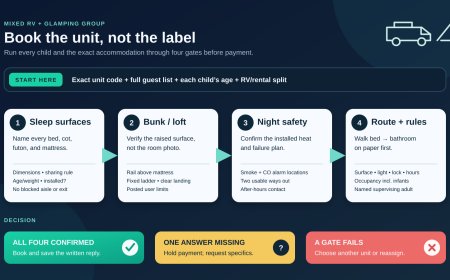
Treat the RV site and glamping unit as separate starting points. Verify each route to the same bathroom building, then check the building's hours and fixtures. A good route from the RV does not rescue a poor route from the yurt at 2 a.m.
The park examples below show why the details matter. They are examples, not endorsements, and their pages were retrieved on September 11, 2026. Confirm current conditions with the operator before paying.
"Nearby" is not a distance
Washington State Parks says the bathrooms and showers for Cape Disappointment's yurts are nearby. The same page says an RV pad with utilities can be added for a fee.[3] That tells a mixed group the two accommodation types can coexist, but it does not answer how many feet separate a selected yurt, selected RV pad, and bathhouse.
California State Parks gives a little more context for the Madrone cabins at Samuel P. Taylor State Park. The cabins have no bathrooms; a separate restroom with coin-operated hot showers is described as a short walk away. Guests are told to pack towels and a flashlight.[4] "Short" may be comfortable before dinner and miserable during a cold, wet nighttime trip.
Do not estimate distance from a stylized campground map. Ask for the route from the exact site and exact unit. Request a measured distance in feet or a normal walking time, and ask whether that measurement follows the permitted pedestrian path. A straight line across an empty-looking patch may cross another campsite, a ditch, stairs, or a road.
Record four distances:
- glamping door to an all-night toilet;
- RV door to that toilet;
- each accommodation to the shower building, if different; and
- parking or drop-off point to the bathroom for anyone who may need a shorter route.
If the operator cannot measure, ask for site numbers on a current map and have staff describe every turn. Keep the answer with both reservation records.
Walk the nighttime route before dark
Arrival is the wrong time to discover that the only path runs behind occupied sites or disappears into gravel. Before anyone unpacks, one person from each accommodation should walk to the toilet, return by the same route, and repeat the walk after dusk.
Look for forks, curbs, steps, roots, potholes, low branches, loose gravel, standing water, vehicle crossings, and places where a mobility device cannot turn or two people cannot pass. Identify landmarks visible at night. A brown restroom sign that blends into trees is not a useful landmark after the lights go out.
Lighting needs two answers. First, ask what the campground provides: path lights, road lighting, an illuminated bathroom entrance, motion sensors, or nothing between buildings. Second, plan personal light. Give every guest a headlamp or flashlight that can be reached from bed, plus spare batteries. A phone light is a backup, not the group's whole plan.
Aim personal lights at the ground and keep them low around neighboring sites. Never mark the route with candles, flame lanterns, trip-height cords, or unapproved lights. Ask whether low-output, temporary markers are permitted; dark-sky parks and campgrounds may restrict exterior lighting. Quiet hours can also make a running RV generator a bad fallback for charging lights. At Mather Campground, the National Park Service posts quiet hours from 10 p.m. to 6 a.m. and limits generators to two daytime windows.[6]
For children, people with low vision, and anyone unsteady when sleepy, agree on a buddy plan. Do not assume the person in the RV will hear a call from the yurt.
Weather changes the route
The booking question is not "Is there a path?" Ask what that path becomes in ordinary bad weather.
- Does compacted soil turn muddy or rut under wheels?
- Does gravel wash onto a slope?
- Do puddles form at the bathroom entrance?
- Are boardwalks, ramps, or steps treated for frost and ice?
- Is the route plowed after snow, and on what schedule?
- Is there overhead cover anywhere along the walk or while waiting?
- Does runoff cross the path?
- Can a vehicle provide an authorized drop-off without blocking the bathhouse or driving through a pedestrian area?
Pack for an outside bathroom trip: a rain shell that is simple to put on, shoes with traction, a dry bag for clothing, and a waterproof pouch for medication or ostomy supplies. Keep wet footwear on a tray inside the rental rather than leaving it outside to fill with rain.
Set a fallback before the forecast turns. That might mean changing to a glamping unit with a private bathroom, selecting a closer unit, or moving the guest who needs the shortest route into the RV if the RV has a suitable toilet. Do not improvise by letting glamping guests use an RV toilet unless the owner agrees and the rig has enough fresh-water and waste capacity for the added use.
Verify an accessible route instead of an accessible label
An "accessible yurt" does not automatically prove that the nighttime route to a shared toilet works for a particular guest. Ask about the unit, route, bathroom entrance, toilet room, shower, and parking as separate pieces.
The U.S. Access Board's guide for federal outdoor developed areas defines an outdoor recreation access route as a continuous, unobstructed pedestrian path connecting accessible spaces and facilities. Its technical guidance calls for a firm, stable surface and a minimum clear width of 36 inches.[1] The guide also says these outdoor provisions are part of the federal Architectural Barriers Act framework; they are not included in the Justice Department's 2010 ADA Standards and do not create the same rule for state, local, or private properties.[1] Use the measurements as useful questions, not as a declaration that every campground must follow that chapter.
Ask the operator to describe the actual route on your dates:
- Is it step-free from the exact glamping unit and RV site to the toilet?
- What are the surface, narrowest width, steepest grade, cross-slope, and longest sloped section?
- Are there thresholds, gates, speed bumps, drainage channels, mats, or lips at transitions?
- Where are passing and resting spaces?
- Does rain, leaf fall, snow, or maintenance equipment change the route?
- Does the bathroom door require a tight turn or heavy pull?
- Which toilet compartment and shower are accessible, and will they be open overnight?
- Is an accessible parking or drop-off space connected to the entrance?
California State Parks identifies one Madrone cabin, Coho Redd, for visitors with disabilities.[4] That is a starting point for a call, not a substitute for asking whether the cabin-to-bathhouse route and bathroom fixtures meet the guest's needs.
Request photos or a short video of the route when dimensions are missing. Ask when they were taken. A dry summer image cannot settle a fall mud question.
Toilets and showers may run on different clocks
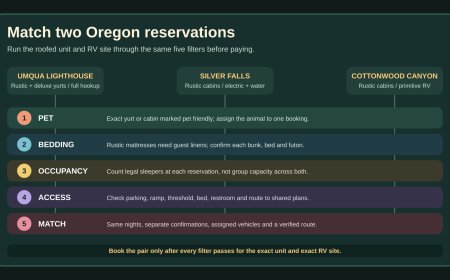
Separate toilet access from shower access. A toilet may stay open all night while showers close, require tokens, or operate in another building. At Oregon's Umpqua Lighthouse State Park, rustic cabin and yurt guests use shared campground facilities, while deluxe yurts have private bathrooms. The park limits its shared showers to registered campers and posts a daily window of 6 in the morning through 11 at night.[2] At East Canyon State Park in Utah, restrooms are described as available year-round, but showers are seasonal in warmer months.[5]
Those examples turn one bathroom question into several:
- Which toilet building is open 24 hours?
- Are any toilets locked during cleaning, winterization, water restrictions, or low occupancy?
- What are shower hours, last-entry time, and seasonal opening dates?
- Are shower and toilet facilities in the same building?
- Are showers free, coin-operated, token-operated, card-operated, or included only for registered guests?
- Where are tokens or change sold, and is that counter open after check-in?
- How many toilets and showers serve the loop? Are individual or family rooms available?
- When are the busiest periods and scheduled cleaning closures?
- Is hot water limited by a timer or tank recovery?
- Who should guests call if the only open toilet is locked or out of service?
Build the group's schedule around posted limits. Shower before the evening rush if a facility closes at 11 p.m. Buy tokens during office hours. Stagger a large group instead of sending everyone during the final half hour. Toilets are different: nobody should be asked to wait for a group schedule, so the all-night route must work independently.
Shared-bathroom hygiene without turning the RV into a washroom
Give each person a bathroom kit that can hang from a hook: towel, shower shoes, soap, toothbrush cover, clean clothing, small flashlight, and a bag for wet items. A hanging kit keeps toiletries off a wet counter and makes it harder to leave medication behind.
Wash hands with soap and water after using the toilet and before handling food. Carry hand sanitizer for moments when a sink is unavailable, but do not use it as an excuse to skip handwashing when soap and water work. Do not wash dishes, clothing, or bodies at drinking-water spigots unless the operator expressly designates the fixture for that use. Mather Campground's bulletin, for example, prohibits bathing, dishes, and laundry at its water spigots and directs campers to manage wastewater through approved facilities.[6]
Keep bathroom gear out of food-preparation space. Store clean towels in the RV or rental, not in a damp bathhouse. Wear shower shoes, avoid placing a toothbrush directly on a counter, and bag wet laundry separately. If soap, toilet paper, or running water is missing, tell the host rather than treating the condition as normal.
A guest with vomiting or diarrhea should not share food preparation duties. Ask the operator for its illness and cleanup procedure, and consider whether that guest can use a separate toilet. The goal is practical containment, not amateur diagnosis.
Send these questions before the cancellation deadline
Use one message so the operator can answer against both bookings:
> We are booking RV site [number/type] and glamping unit [number/type] for [dates]. Please identify the toilet and shower buildings serving each accommodation. For each route, what is the walking distance, surface, lighting, grade, steps or curbs, road crossings, and likely condition in rain or frost? Which toilet is open overnight? What are the shower hours, seasonal dates, payment method, cleaning closures, and guest restrictions? Is there a step-free, firm route to an accessible toilet and shower, and can you provide its narrowest width, steepest section, thresholds, door details, and an accessible drop-off option? Please note any scheduled closure, construction, water restriction, or bathhouse change during our stay.
Save the reply, current campground map, both site listings, and screenshots of facility hours. Reconfirm a few days before arrival because maintenance and weather can change the answer.
The booking works only when every guest can make the bathroom trip from the accommodation where they will actually sleep. Choose by the weakest route, not the best one.
Sources
- Chapter 10: Outdoor Developed Areas — U.S. Access Board
- Umpqua Lighthouse State Park — Oregon State Parks
- Cape Disappointment Yurts — Washington State Parks
- Samuel P. Taylor State Park Camping and Cabins — California State Parks
- East Canyon State Park Yurts — Utah State Parks
- Mather Campground Bulletin — National Park Service
What's Your Reaction?